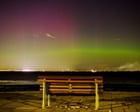
Every time solar activity ticks upward by a fraction of a percent, the British public loses its collective mind. Social media feeds flood with hyper-saturated smartphone captures of magenta skies over housing estates in Kent or industrial parks in Yorkshire. News outlets churn out breathless panic-reporting about geomagnetic storms and coronal mass ejections, as if the apocalypse is arriving via a pink haze over the M25.
People drive for hours in the freezing cold, park illegally on rural verges, point their lenses upward, and stare at a faint smudge of gray light that their camera sensors magically amplify into a glowing neon curtain. They post the photos, collect their dopamine hits, and convince themselves they witnessed a high-latitude polar marvel.
They did not. They witnessed software processing.
The Great Pixels Illusion
Let us start with the core mechanism of the aurora borealis and why the current obsession is built on optical delusion. The phenomenon happens when charged solar particles collide with gases in Earth's upper atmosphere, exciting nitrogen and oxygen molecules to emit photons. At higher latitudes, such as Tromsø or northern Iceland, the particle density and magnetic field geometry allow this reaction to occur with enough raw intensity to saturate human rhodopsin receptors in our rod cells. You see green and purple with your naked eye because the photons are dense enough to trigger biological sight.
Down in Britain, located at mid-latitudes, that density drops off a cliff. When a moderate G3 or G4 geomagnetic storm pushes the auroral oval equatorward, the actual physical light reaching the UK is weak, diffuse, and largely sub-threshold for human night vision.
Enter the modern smartphone. Night mode and long-exposure computational photography do not capture reality; they interpret it. They aggregate light over seconds, boost shadows, shift color channels, and hand you a fantasy.
When you stand in a muddy field in Norfolk staring at a dull, pale-grey streak across the constellations and your phone screen displays a blazing violet masterpiece, you are experiencing a digital hallucination. Yet, the national conversation treats this as a grand national awakening. We have traded actual astronomical observation for algorithmic validation.
The Geography of Disappointment
I have spent years standing in actual sub-zero auroral zones—Abisko, Churchill, Svalbard—watching the sky dance with terrifying speed and structural definition. When a real substorm hits at sixty-degrees north or higher, the sky is alive. It tears, folds, and pulses. It makes you feel small in a way that recalibrates your ego.
Then I watch what happens when a minor Kp-index spike hits southern England. Thousands of people crowd onto coastal cliffs, staring intently at shipping lanes, hoping a passing container ship's crane lights are actually solar flares. The local tourist boards love it. Hotel bookings in coastal towns spike during off-peak autumn weekends because an alert app sent a push notification about a minor coronal hole.
It is a manufactured economic boom built on FOMO. People pay inflated rates for bed-and-breakfast rooms in bleak seaside towns in November just to stand in horizontal rain, squinting at light pollution from an oil refinery, waiting for an algorithm to tell them they are having a magical experience.
The media pushes this cycle because outrage and wonder drive clicks. If an article tells you that tonight's aurora will be a faint, barely perceptible smear visible only through a tripod-mounted DSLR, nobody shares it. If the headline screams that the skies are illuminated and Britain is turning into Lapland, traffic surges. You are being farmed for ad impressions by editors who haven't looked at a night sky without a screen between them and the stars since 2012.
What Real Observation Demands
If you want to experience the night sky, you need to accept some uncomfortable truths about visibility, patience, and scale.
First, stop looking at your phone. If your primary interaction with a natural event is checking the exposure slider on an iPhone 15 Pro, you are not engaging with nature; you are operating a camera.
Second, acknowledge that Britain is fundamentally poorly positioned for consistent auroral displays. The geomagnetic pole does not care about your bank holiday weekend. True mid-latitude events that reach the UK with naked-eye structural clarity happen a handful of times a decade, not every time a minor solar flare burps in our general direction.
Third, light pollution renders ninety percent of these sightings an exercise in urban-glow appreciation. If you can see ASDA from where you are standing, you are not watching the cosmos. You are watching sodium streetlamps scatter off water vapor.
The obsession with capturing the northern lights from British soil has become a symptom of a broader cultural malaise: the desperate need to prove via digital artifact that we were present for something extraordinary, even when the reality was thoroughly mundane.
Put the tripod away. Turn off the geomagnetic alert apps that ruin your sleep cycle every time the sun sneezes. Accept that if you want to see the sky catch fire, you need to buy a thermal suit, book a flight past the Arctic Circle, and stand in the dark without a filter.
Otherwise, you are just taking pictures of streetlights in the fog and calling it space exploration.


