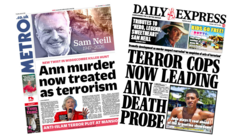
The media script is as predictable as it is exhausting. Whenever a prominent public figure is brutally targeted, a familiar, well-choreographed dance begins. We saw it over the weekend following the horrific death of former MP and Reform UK spokesperson Ann Widdecombe at her home on Dartmoor.
Almost immediately, official press conferences went into overdrive to deliver a singular, comforting sedative to the public: Move along, there is nothing to see here. This is not politically motivated. There is no wider risk to the public.
Then, within forty-eight hours, the narrative fractures. Counter-terrorism police swoop in, take over the investigation, and rearrest the 28-year-old suspect under the Terrorism Act. The "isolated incident" suddenly looks like something far more calculated.
This is not just a failure of early police messaging; it is a systemic pathology in how we talk about violence directed at political figures. We are trapped in a cycle of desperate downplaying, treating targeted acts of extremist violence as mere anomalies or "lone wolf" tragedies until the evidence forces our hands. It is time to dismantle the lazy consensus that we can separate the shocking rise in physical threats to politicians from the toxic, hyper-polarized climate we actively feed every day.
The Myth of the Clean Motive
For years, establishment commentators and authorities have tried to compartmentalize political violence. They want us to believe that unless an attacker carries a signed membership card to an officially designated terror group, their actions exist in a vacuum of "mental health struggles" or random malice.
This is a dangerous delusion.
When a suspect travels nearly 300 miles from Rotherham to a remote bungalow in Devon, armed with a weapon, they are not acting on a random whim. This is premeditated targeting. To suggest in the immediate aftermath of such an event that there is "no political motive" is a insult to common sense. It is an attempt to manage public anxiety at the cost of objective reality.
The hard truth is that modern radicalization does not happen in dark, secret basements anymore. It happens in the open daylight of social media algorithms, political commentary, and dehumanizing rhetoric. By the time an individual decides to drive across the country to commit an act of violence, the distinction between a "lonely, unstable individual" and a "politically motivated actor" has completely dissolved. The instability is the vessel for the political motive.
Why "Don't Speculate" is a Broken Shield
Whenever these tragedies occur, the immediate reflex from police forces and politicians is to issue stern warnings: "Do not speculate on social media." While rushing to judgment without facts is irresponsible, the demand for absolute silence serves a secondary, more insidious purpose. It acts as a shield to prevent the public from asking obvious, uncomfortable questions about public safety and political hostility.
Consider the timeline. On Wednesday morning, Ann Widdecombe was on national television, fiercely defending her political allies and engaging in the sharp, uncompromising debate that defined her decades-long career. By lunchtime, she was dead.
To demand that the public refrain from drawing any connection between her public profile and her violent death is a form of gaslighting. It expects citizens to shut off their critical thinking faculties. When we refuse to point out the obvious link between high-profile political advocacy and the target on a politician's back, we are not protecting the integrity of an investigation. We are simply hiding from the grim reality of our public square.
The Double Standard of Political Empathy
Let’s be honest about the hypocrisy that poisons this conversation. The outpouring of grief and the subsequent political pivot depend entirely on who the victim is and which side of the aisle they represent.
When politicians are attacked, the reaction from opponents is often a performative exercise in saying the right words while subtly maintaining a distance. We saw immediate calls from mainstream politicians warning against "speculation" after certain commentators pointed out the targeted nature of the attack. Why? Because acknowledging the reality of the threat means admitting that the hostility directed at populist or right-wing figures has crossed a terrifying line.
If we only care about the safety of representatives when they align with our preferred worldview, we do not care about democracy at all. We are just using tragedy as tactical leverage.
| Victim Profile | Initial Institutional Reaction | Actual Reality / Outcome |
|---|---|---|
| Out-of-favor or controversial figures | "No immediate sign of political motive; do not speculate." | Investigation transferred to counter-terrorism units once the public narrative is managed. |
| Establishment consensus figures | Immediate national mourning, flags at half-mast, instant declarations of a threat to democracy. | Swift legislative proposals and immediate security overhauls. |
"For people in public life, the world is very much more dangerous than it has ever been."
— Nigel Farage
While many rushed to criticize Farage for pointing this out so quickly, he was entirely correct. The threat landscape has fundamentally shifted. We have reached a point where holding a public office or expressing a strong, controversial opinion requires accepting the very real possibility of physical harm.
Stop Trying to Fix "Tone" (Fix the Security Instead)
The standard prescription after every political tragedy is a wet, useless call for "a kinder, gentler politics." We are told that if we just monitor our language and stop calling our opponents names, the violence will stop.
This is naive nonsense.
You cannot legislate politeness, and you cannot police the internet into a state of harmless harmony. Political debate is, by its very nature, conflict-driven. It is about resources, values, and power. It will always be loud, and it will always be angry.
Instead of chasing the utopian fantasy of a polite public square, we must confront the cold, logistical reality: our public figures are soft targets. We expect people to stand on the front lines of intense, nationally polarizing debates while living in unsecure, easily identifiable rural properties with zero physical protection. We rely on the good manners of a population that has been systematically radicalized by algorithmic rage.
If we want to protect the people who run our country and shape our laws, we need to stop relying on empty platitudes about "one-of-a-kind" figures and start treating their physical security with the seriousness it demands. That means permanent, intelligence-led security details for high-profile figures, robust monitoring of credible threats, and an end to the institutional cowardice that tries to sweep the political nature of these attacks under the rug.
Anything less is just waiting for the next press conference, the next warning against speculation, and the next inevitably broken narrative.