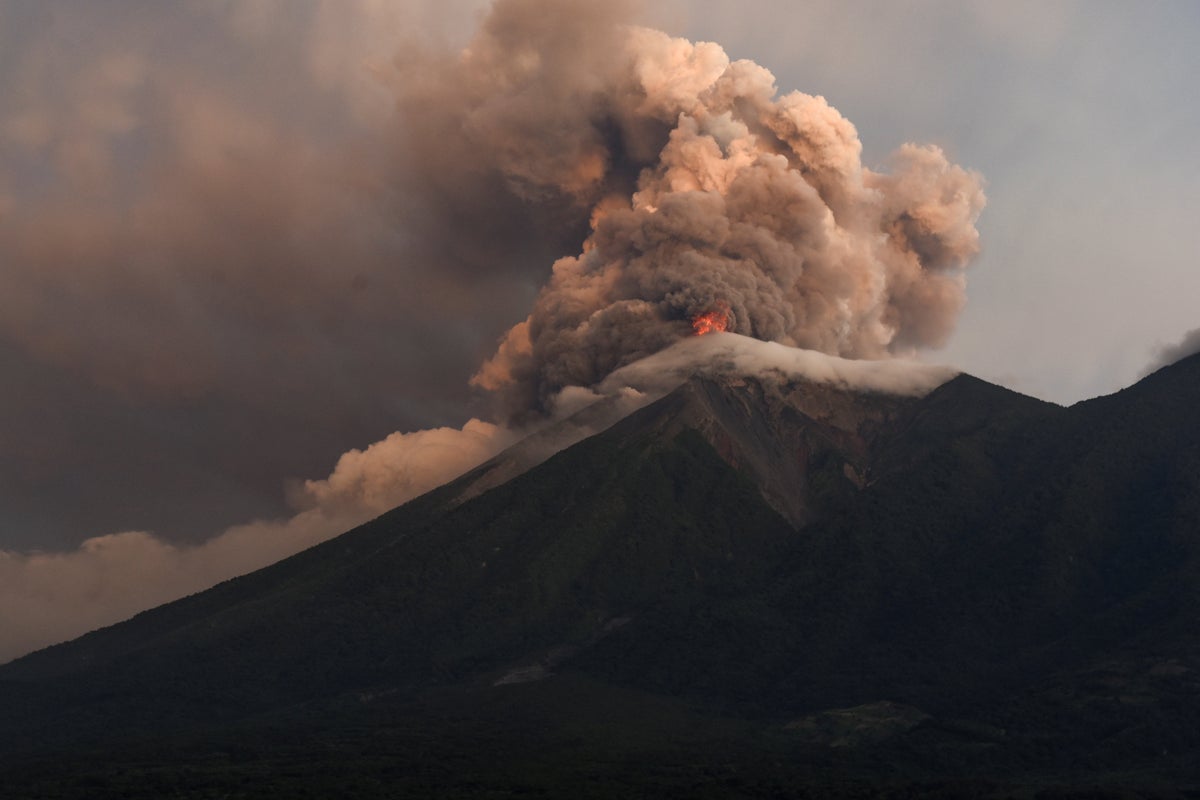
Every time Fuego coughs, the global press runs the exact same stock footage. A gray plume billowing into a cerulean sky. A line of trucks idling on a dirt road. A municipal official in a high-visibility vest pointing urgently toward the horizon while reciting the standard bureaucratic mantra of emergency management: Evacuate, protect, flee.
It is the lazy consensus of disaster reporting. It paints Volcán de Fuego as a malicious intruder that suddenly arrives to disrupt peaceful pastoral life, requiring immediate flight.
The media loves a good panic. It sells ads. But it fundamentally misunderstands how stratovolcanoes actually operate and why human populations refuse to stay away from them.
I have stood in the shadow of active pyroclastic giants across Central America and watched evacuation orders fail for the exact same reason every single time. It is not because the locals are stubborn or ignorant. It is because the standard playbook of total evacuation is an economic and ecological impossibility that ignores how volcanic soil creates civilization in the first place.
If you want to understand why Fuego keeps growing more explosive and why the standard response makes the hazard worse, you have to throw out the disaster tourism handbook and look at the brutal geometry of risk, reward, and volcanic reality.
The Soil Trap Everyone Ignores
Let us clear up the core misconception right out of the gate. Fuego is not getting more aggressive because it hates humanity. It is getting more explosive because basic petrology dictates that ascending basaltic-to-andesitic magma undergoes fractional crystallization.
When emergency planners hyperventilate over every escalation in seismic tremors or ash output, they treat the volcano like a ticking bomb. That is bad geology. Volcanos are dynamic pressure-release valves.
The standard news cycle frames every eruption as an unprecedented catastrophe. But look at the agricultural data. The villages clinging to Fuego's lower flanks—Alotenango, El Rodeo, San Miguel Los Lotes—sit atop some of the most hyper-fertile volcanic andosols on planet Earth. Weathered tephra and ash deliver a cocktail of potassium, phosphorus, and trace minerals that turns ordinary dirt into an agricultural powerhouse capable of multiple harvests a year.
Coffee grown in volcanic soil commands premium global prices. Maize thrives there. Generations of farmers have calculated the risk: deal with periodic pyroclastic surges every few decades, or abandon the land and starve in a concrete housing project three hours away with zero economic mobility.
When officials order a total evacuation, they are telling a farmer to abandon their entire net worth, their livelihood, and their ancestral ecosystem for a tent city. The farmer knows the odds. The state treats every eruption as an existential shock; the farmer treats it as a high-stakes tax on living in paradise.
The Logistics Myth Of Mass Flight
Emergency management agencies love drawing concentric circles on maps. Draw a red zone. Order everyone out. Pat yourself on the back for saving lives.
It is a comforting fantasy. In practice, mass evacuations of volcanic zones in developing nations are logistical disasters that often generate more casualties than they prevent.
I have watched emergency protocols collapse under the weight of their own bureaucracy. When Fuego unleashes a major pyroclastic flow—that horrifying, glowing avalanche of superheated gas, ash, and rock roaring down a ravine at six hundred kilometers an hour—you do not have hours to pack your truck. You have minutes. Sometimes seconds.
If you live in San Miguel Los Lotes, sitting directly in the path of the Las Lajas drainage, a municipal evacuation order issued twenty miles away in Guatemala City is completely useless. By the time the SMS alert pings your phone, the pyroclastic density current has already overridden the topography.
Conversely, issuing sweeping mandatory evacuations for minor ash emissions or strombolian phases destroys trust. Cry wolf three times because a bureaucratic risk-averse playbook demands zero tolerance for uncertainty, and the fourth time—when the mountain actually blows its stack—the locals ignore the sirens and stay behind to protect their livestock.
The state measures success by how many people they herd into temporary shelters. The locals measure success by whether they can return home before looters strip their kitchen wiring.
The Engineering Fallacy Of Defense Works
For decades, civil engineers have tried to outsmart active volcanos with concrete. They build check dams, retention basins, and diversion channels to trap lahars—those terrifying mudflows triggered when heavy rains mix with loose ash on the slopes.
It is a fool's errand.
Imagine a scenario where you try to funnel a million tons of concrete-thick mud traveling at highway speeds through a man-made trench. The energy dynamics are too vast. The channel fills up in ten minutes, overflows its banks, and redirects the destruction onto a village that thought it was safe behind a concrete wall.
Engineering solutions give a false sense of security. They encourage denser settlement in high-risk drainages because people assume the government has "tamed" the mountain.
Nature does not negotiate with civil engineers. Fuego does not care about your concrete retaining wall. When a major eruptive cycle dumps cubic kilometers of loose material onto the upper slopes, every single rainfall event becomes a weapon.
What Actually Works
If we stop treating volcanos like meteorological anomalies and start treating them like tectonic neighbors, the strategy shifts entirely.
First, abandon static evacuation zones in favor of high-precision topography-based warning networks. Pyroclastic flows obey the laws of gravity; they do not care about municipal borders. They follow the barrancas, the deep ravines carved into the flanks of the cone.
Yet, governments continue to build roads and settlements across these natural drainage chutes, then act surprised when the mountain reclaims its plumbing. Real mitigation requires strict zoning laws that ban permanent human habitation inside the primary drainage paths, while allowing resilient agricultural use on the interfluves—the high ground between the ravines.
Second, shift from macro-evacuation to micro-sheltering. If a pyroclastic flow moves too fast for vehicles, road-based evacuations are a death trap. Instead, high-density settlements near hazard zones need engineered, positive-pressure community bunkers built into stable bedrock on high ground outside the ravines. Places where people can run on foot in ninety seconds and survive a two-hour ash storm without suffocating.
Third, stop treating indigenous and rural populations as passive victims waiting for a government rescue. They possess generational hazard awareness that outperforms remote satellite monitoring arrays during the critical opening minutes of an event. Integrate local communication networks directly into real-time seismic sensors instead of routing warnings through a multi-tier bureaucratic chain of command that takes forty minutes to approve a press release.
The Mountain Always Wins
Fuego is a relentless, breathing geological engine. It has been erupting for over five hundred years since the Spanish conquest, and it was doing it long before that.
The desire to sanitize the planet, to make every square inch safe for suburban housing developments and risk-averse bureaucrats, is a modern delusion. Earth is an active, restless planet. Volcanos are the crust's way of recycling itself.
You can panic, you can issue endless evacuation decrees, and you can draft millions of pages of disaster response manuals. Or you can respect the physics of the mountain, stop building in the drainage chutes, build vertical defense where flight is impossible, and accept that living on the edge of creation requires paying the rent when the landlord knocks.
The mountain is not growing more explosive to spite you. It is just doing what it was built to do. Your move is figuring out how to stop standing in its way.


