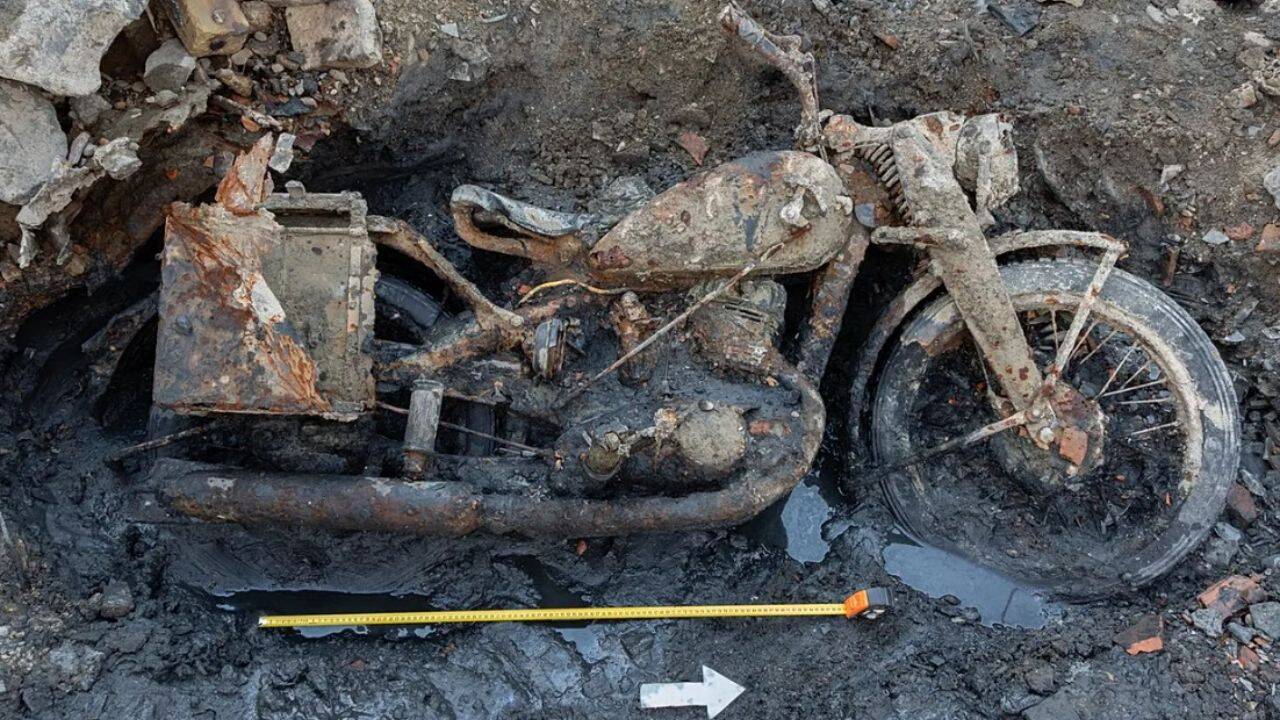
Every time a drought hits Europe, the internet collectively loses its mind over soggy metal. The recent drop in the Danube water level exposed two German soldiers and their trusty DKW motorcycle, prompting a tidal wave of breathless, sentimental journalism. Social media is flooded with armchair historians waxing poetic about lost youth, tragic wartime winters, and the poetry of sunken iron emerging from the mud.
It is romantic, entirely predictable, and completely missing the point.
We love a good sunken relic because it lets us sanitize history into a neat, digestible adventure movie. Two soldiers, one German engineering marvel, frozen in time by a muddy riverbed. But focusing on drowned trinkets is a massive distraction from the brutal, unromantic reality of how historical preservation actually operates. While tourists and bloggers flock to mudbanks to take selfies with corroded motorcycle frames, the actual architectural and documentary heritage of Central Europe is quietly bulldozed, neglected, or monetized into theme-park oblivion.
Let us dismantle the lazy consensus.
The Myth of the Frozen Moment
The core fallacy of the sunken-relic obsession is the belief that finding artifacts in a riverbank gives us an unvarnished portal to the past. It does not. What you are looking at when a DKW RT 125 emerges from the Danube is not a snapshot of heroism or tragedy; it is garbage.
During the frantic retreats of late 1944 and early 1945, retreating armies dumped everything they could not carry. Trucks, motorcycles, weapons, and personal effects were shoved into rivers, buried in bomb craters, or tossed down wells. This was not a dramatic final stand. It was a logistical panic.
I have spent decades examining wartime recovery operations across Eastern Europe, and I have seen municipalities blow entire budgets trying to salvage rusted scrap metal while actual historical archives rot in leaky municipal basements. We treat a mass-produced two-stroke motorcycle like King Tut's tomb simply because it was wet for eighty years.
Consider the engineering reality. A DKW motorcycle from that era was a utilitarian workhorse. Millions were built. They were designed for rapid replacement, not eternal endurance. When water levels drop and expose these machines, preservationists face a nightmare of chemical degradation. Iron oxide does not care about your emotional connection to World War II nostalgia. Once exposed to oxygen after decades of anaerobic silt burial, the corrosion accelerates exponentially.
Yet, local tourism boards treat these drops like divine intervention.
Why We Prefabricate Our Historical Outrage
Why do we obsess over drowned soldiers while ignoring systemic preservation failures? Because physical objects are easy to consume.
A skeleton with a rusted helmet tells a story that requires zero historical literacy. It fits neatly into a two-minute TikTok video or a viral news aggregator. It triggers our primal fascination with mortality without forcing us to confront the uncomfortable geopolitics of the Eastern Front.
When people ask, "What happened to these soldiers?", they are asking the wrong question. The real question is: Why are we treating a routine WWII discard as a miraculous archaeological event while thousands of authentic, documented civilian testimonies and paper archives from the Siege of Budapest sit unindexed, undigitized, and decaying?
The answer is simple. Paper is boring. Rusted German motorcycles are sexy.
Let us look at the numbers. The cost of properly stabilizing, desalinating, and conserving a submerged iron-and-aluminum motorcycle pulled from a river requires tens of thousands of euros. That money comes out of regional cultural funds. That is capital diverted away from cataloging civilian displacement records, protecting crumbling interwar architecture, or funding modern historical research facilities.
We are spending public money to rescue scrap metal because it generates clicks.
The Dangerous Nostalgia Trap
There is a darker undercurrent to this obsession. When we fixate on individual German soldiers washed up in a conquered river, we inadvertently humanize the occupying machinery of a genocidal regime at the expense of local context. Budapest suffered unimaginable horrors during the siege—over thirty-eight thousand civilians died, and the city was systematically flattened.
A pair of unfortunate soldiers sinking into the mud is a footnote in a massive humanitarian catastrophe. Yet, popular media routinely flips the narrative, making the occupiers the tragic protagonists of the riverbed drama.
I have watched local officials trip over themselves to secure funding for military artifact recovery while ignoring Jewish heritage sites and marginalized history hiding right beneath the pavement. It is a prioritization of aesthetic tragedy over factual accountability.
If you want to understand Budapest in 1945, stop staring at the mudbanks of the Danube. Go read the diaries of the nurses who worked in the cellar hospitals under the castle district. Look at the logistics manifests of the food shortages. Listen to the oral histories of families who survived the cellar freezing winters with zero fuel.
Those accounts do not fit on a souvenir postcard. They cannot be hoisted out of the water with a crane for the evening news broadcast.
What We Should Be Doing Instead
If we are serious about respecting history rather than consuming its aesthetic shell, we need a complete operational overhaul of how municipal authorities handle accidental discoveries.
First, stop the circus. When low water exposes wartime debris, it should be logged, secured, and evaluated strictly by professional archivists and military historians—not treated as a tourist attraction for weekend rubberneckers.
Second, redirect private and public funds away from sensationalist artifact recovery and toward digital preservation. The physical objects will eventually turn to dust anyway. The data, the letters, the photographs, and the architectural surveys are what actually survive.
Third, recalibrate our public education around these events. Stop presenting war as an atmospheric backdrop for cool antique finds.
The Danube will continue to rise and fall. More iron will appear. More bones will wash out of the silt. Until we stop treating history as a prop for our afternoon entertainment, we will keep missing the actual story written in the mud.
The motorcycle stays rusted. The real history is already gone.



/getty-brown-bear-56afcf215f9b58b7d01d5195.jpg)