Public health officials love a good press release. An unvaccinated traveler boards a train, rides through six California counties, and suddenly every local news desk hits copy-paste on the exact same panic-inducing headline.
They want you focused on the individual passenger. They want you counting train cars, checking timestamps, and refreshing county health portals in a cold sweat. You might also find this connected article insightful: The Structural Failure of Maternity Screening For Domestic Abuse.
That is a distraction.
Focusing exclusively on the vaccination status of a single commuter misses the massive, systemic vulnerability sitting right in front of us. It is the lazy consensus of modern public health reporting: blame the individual, issue a sweeping regional alert three days too late, and pretend the containment protocol actually works. As discussed in detailed reports by Everyday Health, the results are worth noting.
Having spent years dissecting epidemiological response frameworks and municipal transit sanitation protocols, I can tell you firsthand that press releases do not stop airborne viruses. Ventilation does. Rapid diagnostics do. Honest risk stratification does. Right now, California’s response to transit exposures relies on a 19th-century contact-tracing playbook to fight a 21st-century aerosol threat.
The Anatomy of a Delayed Alert
Let’s look at the mechanics of how these six-county warnings actually happen.
Measles is not spread by a handshake or a shared armrest. It is an obligate airborne pathogen. The Measles morbillivirus suspends itself in microscopic respiratory droplets that hang in stagnant air for up to two hours after an infected person leaves the room—or the train car. With a basic reproduction number ($R_0$) sitting between 12 and 18, it is the most contagious human virus on earth. For comparison, early strains of SARS-CoV-2 hovered around 2.5 to 3.
Now look at the timeline of a standard state health department warning.
- A passenger boards a train while in the prodromal phase—meaning they have a mild cough, a slight fever, and zero rash. They are maximally infectious, and they have no idea they have measles.
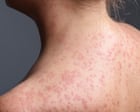
- Four days later, the classic maculopapular rash appears.
- Another two days pass before the patient sees a doctor, gets a swab, and waits for a state lab to confirm the PCR test.
- County health officers finally map the patient's travel history and blast out a warning to six different jurisdictions.
By the time that headline hits your feed, the two-hour window of airborne viral suspension has been closed for nearly a week. The incubation period for anyone infected on that train is already halfway over. You cannot prevent an exposure that happened six days ago with a press release today.
Why Blaming the Passenger Masks Institutional Failure
Every time one of these stories breaks, the comment sections erupt into predictable tribal warfare over vaccine mandates. Meanwhile, transit authorities and state agencies quietly escape scrutiny for running rolling petri dishes.
Here is the uncomfortable truth nobody in Sacramento wants to admit: a properly ventilated train car should not be a super-spreader incubator.
Modern hospital isolation rooms use negative pressure and high-efficiency particulate air (HEPA) filtration cycling 12 or more air changes per hour (ACH) to strip viral aerosols out of the breathing zone. During the height of the pandemic, aviation engineers proved that commercial aircraft cabins—equipped with hospital-grade HEPA filters and vertical airflow—had remarkably low transmission rates compared to ground transit.
Now go step onto a commuter train running between the Bay Area and the Central Valley.
Many regional rail cars still operate on outdated HVAC systems designed to recirculate cabin air to save energy on heating and cooling. Without high-MERV filtration or rapid outside-air exchange, a single cough in Car 3 turns the entire compartment into an aerosol trap.
When officials frame a six-county exposure purely around one passenger's immunization record, they absolve transit agencies of their failure to upgrade basic indoor air quality infrastructure. Even if every passenger on that train were vaccinated, relying solely on herd immunity while neglecting physical engineering controls is bad risk management. Waning immunity, immunocompromised commuters, and infants too young for their first MMR dose are always on public transit. They deserve clean air, not just a retroactive warning label.
Dismantling the Myths Around Transit Exposures
When an alert drops, people immediately flood search engines with the same terrified questions. Most of the mainstream answers are watered-down bureaucratic boilerplate. Let’s strip away the noise and look at the actual virology.
"Am I at risk if I was in a different train car?"
Unless you walked through the infected passenger's car or stood next to them on the boarding platform, your risk is near zero. Train cars are physically separated compartments with independent HVAC zones. The virus does not magically teleport through solid steel bulkheads. Yet county alerts routinely list entire multi-hour train routes without specifying car numbers, seat assignments, or exact platform dwell times—triggering unnecessary panic among thousands of commuters who were never remotely in the breathing zone.
"Does the MMR vaccine actually stop me from catching it on a train?"
Two doses of the Measles, Mumps, and Rubella (MMR) vaccine are roughly 97 percent effective at preventing clinical measles. That is one of the highest efficacy rates of any medical intervention ever created.
However, "97 percent" is not "100 percent." In rare cases, primary vaccine failure (where the immune system never mounted a full response) or secondary vaccine failure (waning antibodies decades later) happens, particularly in high-inoculum environments like a poorly ventilated train car where a person inhales a massive viral load over several hours. If you are vaccinated and develop a fever and conjunctivitis ten days after an exposure, do not dismiss it as a standard summer cold just because you got your shots in 1994.
"What happens if I was exposed and I am not immune?"
If you are unvaccinated, immunocompromised, or pregnant, waiting around to see if you develop a rash is the wrong move. You have two strict biological deadlines:
- The 72-Hour Window: Receiving the MMR vaccine within 72 hours of initial exposure can actually prevent the disease or dramatically reduce its severity, because the vaccine-induced immune response races ahead of the wild virus's slow incubation cycle.
- The 6-Day Window: If you missed the 72-hour mark—or if you cannot take a live-attenuated vaccine due to pregnancy or severe immunosuppression—an infusion of human immunoglobulin (IG) within six days of exposure provides immediate, passive antibodies to blunt the infection.
Notice a glaring problem? If it takes county health officials six days just to investigate the case and publish a press release, both post-exposure prophylaxis windows are already dead by the time the public finds out.
The Unintended Blowback of Blanket Regional Alerts
There is a massive downside to the "warn everyone across six counties" strategy that epidemiologists privately worry about, even if they rarely say it on camera: alarm fatigue and emergency room gridlock.
When you tell millions of residents across Northern and Central California that they might have been exposed to a terrifying, hyper-contagious virus, hundreds of anxious people with standard seasonal allergies, strep throat, or mild rhinovirus immediately storm urgent care clinics and emergency departments.
This creates a catastrophic secondary risk.
If an actually infected patient walks into a packed emergency room waiting area without airborne isolation protocols in place, they will infect every vulnerable person sitting in those plastic chairs. I have seen hospital networks burn through hundreds of thousands of dollars in contact-tracing labor and furloughed staff simply because one febrile patient sat in an unventilated triage lobby for forty minutes before anyone thought to ask about their recent train travel.
Broad, imprecise public alerts do not contain outbreaks. They drive potentially infectious patients straight into the highest-risk congregate settings in the healthcare system.
How to Actually Protect Yourself and Fix the System
If we want to stop playing catch-up every time an infected traveler buys a rail ticket, we need to abandon the theatrical press-release model and implement hard operational fixes.
For Commuters Navigating Active Alerts
- Audit your exact timeline, not the county list. Check your transit app, credit card statements, or location history. If you were not on the specific train line within the exact two-hour window listed by the California Department of Public Health (CDPH), stop worrying.
- Wear a fit-tested N95 on regional rail. Cloth masks and loose surgical masks do nothing against a true airborne aerosol like measles. An N95 or KN95 with a tight facial seal filters out the microscopic droplet nuclei that carry the virus.
- Never walk straight into an ER. If you were genuinely in the exposure window and develop a fever, cough, runny nose, or red, watery eyes, call your healthcare provider or the hospital triage desk from your car. Tell them you have a suspected measles exposure so they can bring you in through a back entrance directly into a negative-pressure isolation room.
For Public Health and Transit Agencies
- Mandate real-time transit manifest integration. Airlines can pinpoint exactly who sat in Row 14 within hours of a confirmed diagnosis because passenger manifests are digitized. Regional rail agencies need anonymized, tap-card-linked alert systems that push targeted SMS notifications to riders who actually scanned onto the affected train car—cutting notification times from six days down to six hours.
- Enforce MERV-13+ and UVGI standards on rail cars. Every state-funded transit vehicle should be retrofitted with high-efficiency filtration and upper-room ultraviolet germicidal irradiation (UVGI), which inactivates airborne viral particles in seconds without requiring massive structural overhauls.
- Deploy rapid point-of-care PCR testing. Waiting 48 to 72 hours for a centralized state reference lab to confirm a measles swab is absurd in 2026. Clinics need decentralized, rapid molecular diagnostics that deliver results in under an hour so post-exposure prophylaxis windows actually remain usable.
The Hard Truth About Herd Immunity
There is an obvious vulnerability in engineering-heavy solutions: you cannot filter the air on every street corner, grocery store, or elementary school classroom. High community vaccination rates remain the foundational firewall against endemic measles. When immunization coverage drops below the 95 percent herd immunity threshold, mathematical certainty takes over, and localized outbreaks become inevitable.
Nobody is arguing that vaccines do not matter. They are the primary reason measles was declared eliminated in the United States in 2000.
The problem is pretending that vaccination is the only lever worth pulling, or that shaming a single passenger in a news headline constitutes a functional public health strategy. Viruses do not read press releases, and they do not care about political talking points. Until transit authorities fix the air inside their trains and health departments fix the six-day lag in their warning systems, we are going to keep reading this exact same headline every few months—and acting surprised every single time.