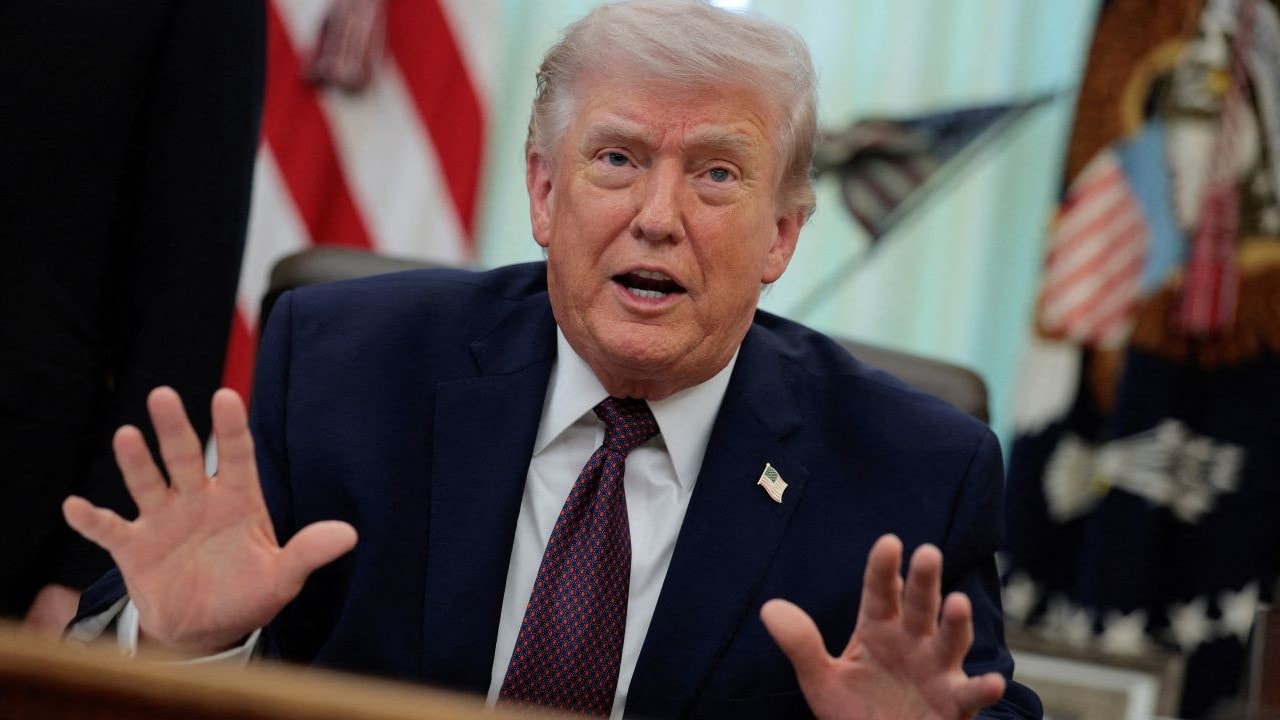
The Strait of Hormuz functions as the carotid artery of the global energy market, a geographic chokepoint where geopolitical posturing translates directly into barrel-price volatility. When United States executive leadership issues threats of kinetic military action—specifically "bombing"—in response to a potential blockade by Iran, the discourse often fluctuates between partisan rhetoric and alarmism. A rigorous analysis requires stripping away the political theater to examine the underlying mechanics of maritime denial, the physics of energy transit, and the structural limitations of military intervention in a narrow waterway.
The Geography of Interdiction
The Strait of Hormuz is approximately 21 miles wide at its narrowest point, with shipping lanes consisting of two-mile-wide channels for inbound and outbound traffic, separated by a two-mile buffer zone. This spatial constraint creates a high-density environment where traditional naval maneuvering is restricted. Iran’s capability to close the strait does not rely on a conventional blue-water navy; rather, it utilizes an asymmetric strategy of "area denial."
The primary mechanisms of interdiction include:
- Naval Mining: The deployment of bottom-moored or rising mines is the most cost-effective method of closure. Modern mines are difficult to detect in the silt-heavy waters of the Gulf and require specialized minesweeping vessels that move at slow speeds, making them vulnerable to shore-based fire.
- Anti-Ship Cruise Missiles (ASCMs): Land-based mobile launchers positioned along the rugged Iranian coastline provide overlapping fields of fire. These systems utilize "shoot-and-scoot" tactics, making them difficult to neutralize through preemptive aerial bombardment.
- Swarm Boat Tactics: The use of fast inshore attack craft (FIAC) armed with rockets or acting as improvised explosive devices (IEDs) can overwhelm the defensive systems of high-value targets like tankers or destroyers.
The Calculus of Kinetic Threats
The U.S. threat to "bomb" Iran to reopen the strait is a statement of intent regarding the use of "Hard Power" to restore "Freedom of Navigation" (FON). However, the military application of force in this context is governed by the laws of diminishing returns. An aerial campaign aimed at reopening the strait would need to achieve three specific operational goals simultaneously to be successful.
First, the suppression of enemy air defenses (SEAD) along the Iranian coast is required to allow sustained operations. Second, the destruction of mobile missile batteries and fast-attack craft bases must occur. Third, a comprehensive mine-clearing operation—which can take weeks or months—must be protected by a continuous air umbrella.
The bottleneck here is time. Global oil markets do not respond to the intent to reopen the strait; they respond to the flow of cargo. A "successful" bombing campaign that neutralizes Iranian assets but leaves the waterway littered with unexploded mines still results in a functional closure. The insurance premiums for commercial tankers would skyrocket to prohibitive levels, effectively halting traffic even if the military declared the lanes "secure."
Economic Feedback Loops and Commodity Fragility
The Strait of Hormuz handles roughly 20% of the world's total petroleum liquids consumption. This is not merely a regional issue; it is a systemic risk to the global supply chain. The logic of a blockade is rooted in "Inelastic Demand." Because most global economies cannot instantly switch energy sources, even a 5% reduction in global supply can lead to a 50% or 100% spike in spot prices.
Specific vulnerabilities include:
- Asian Dependency: Markets in China, India, Japan, and South Korea are the primary recipients of Gulf crude. A disruption forces these nations to compete for Atlantic Basin or West African supplies, driving up prices globally.
- The Spare Capacity Myth: While Saudi Arabia and the UAE possess spare production capacity, much of that capacity is located behind the chokepoint. To bypass the strait, they must rely on pipelines.
- Pipeline Throughput Constraints: The Habshan–Fujairah pipeline (UAE) and the East-West Pipeline (Saudi Arabia) have a combined capacity that accounts for only a fraction of the total volume typically moved through the strait. These terrestrial routes are also fixed infrastructure targets vulnerable to sabotage.
The Signaling Theory of Escalation
Threats of bombing serve as a "Costly Signal" in international relations theory. To be credible, the actor must demonstrate both the capability and the will to incur the costs of the action. For the United States, the costs are not merely the price of munitions, but the potential for a wider regional conflict that could destabilize Iraq, Lebanon, and Yemen.
Iran’s counter-signaling involves "Strategic Ambiguity." By periodically conducting naval exercises or seizing tankers, they remind the world of their "veto power" over the global economy without committing to a full-scale war that would invite their domestic destruction. The threat to "bomb" is an attempt to reset the "Status Quo" by moving the "Overton Window" of acceptable military response.
Logistic and Technical Bottlenecks of Reopening
If a closure occurs, the technical process of reopening the strait involves a sequence of operations that cannot be bypassed through sheer firepower.
- Detection Phase: Side-scan sonar and autonomous underwater vehicles (AUVs) must map the seabed to identify anomalies.
- Identification Phase: Divers or Remotely Operated Vehicles (ROVs) must confirm if an anomaly is a mine, debris, or a natural formation.
- Neutralization Phase: Controlled detonations or mechanical cutting of mine moorings.
The presence of "Smart Mines"—which can be programmed to ignore several ships before detonating on a specific acoustic signature—increases the complexity. A bombing campaign against land targets does nothing to accelerate this underwater timeline. In fact, if the bombing results in sunken Iranian vessels within the shipping lanes, it creates new navigational hazards and sonar shadows that actually delay the reopening.
The Role of Decentralized Energy and Strategic Reserves
The long-term mitigation of the Hormuz threat lies in the diversification of energy transit and the expansion of Strategic Petroleum Reserves (SPR). However, the SPR is a bridge, not a solution. It can stabilize prices for 30 to 90 days, but it cannot replace the 20 million barrels per day that transit the strait indefinitely.
The shift toward liquefied natural gas (LNG) adds another layer of complexity. Qatar is one of the world's largest LNG exporters, and its vessels must also pass through the strait. Unlike crude oil, which can be stored in various ways, a disruption in the "Just-in-Time" delivery of LNG for power plants in Asia and Europe leads to immediate industrial shutdowns.
Structural Realities of Modern Maritime Warfare
The assumption that superior technology (U.S. carriers and stealth aircraft) can easily negate geographic disadvantages is a fallacy. In the narrow confines of the Gulf, a billion-dollar destroyer is at a geographic disadvantage against a $50,000 drone or a $100,000 shore-based missile.
The "Kill Chain" required to stop a blockade is massive. It involves satellites, AWACS (Airborne Warning and Control System), and constant combat air patrols. Maintaining this posture indefinitely creates "Force Fatigue." Conversely, the actor enforcing the blockade only needs to succeed once—by sinking a single large tanker in the channel—to achieve their strategic objective of economic disruption.
Strategic Forecast and the Pivot to Terrestrial Logistics
The persistence of the "Hormuz Dilemma" ensures that global powers will increasingly invest in terrestrial alternatives that bypass maritime chokepoints entirely. This is visible in the development of the "International North-South Transport Corridor" (INSTC) and China's "Belt and Road Initiative" (BRI) pipelines.
For the U.S. executive branch, the threat of bombing is a tool of deterrence designed to prevent the initiation of a blockade. Once a blockade is in place, the utility of kinetic strikes drops sharply while the risk of global economic contagion rises exponentially. The actual strategy for any administration is the maintenance of a "Quiet Deterrence"—a combination of back-channel diplomacy, regional alliances, and a visible but non-combative naval presence.
The move away from maritime dependency is the only permanent solution to the "Hormuz Veto." Until global energy infrastructure is sufficiently decentralized, the world remains hostage to the geography of the Persian Gulf and the volatile rhetoric of those who patrol its shores. Market participants should ignore the headlines of "bombing" and instead monitor the deployment of mine-countermeasure (MCM) assets to the region; when those ships move, the threat is no longer theoretical.