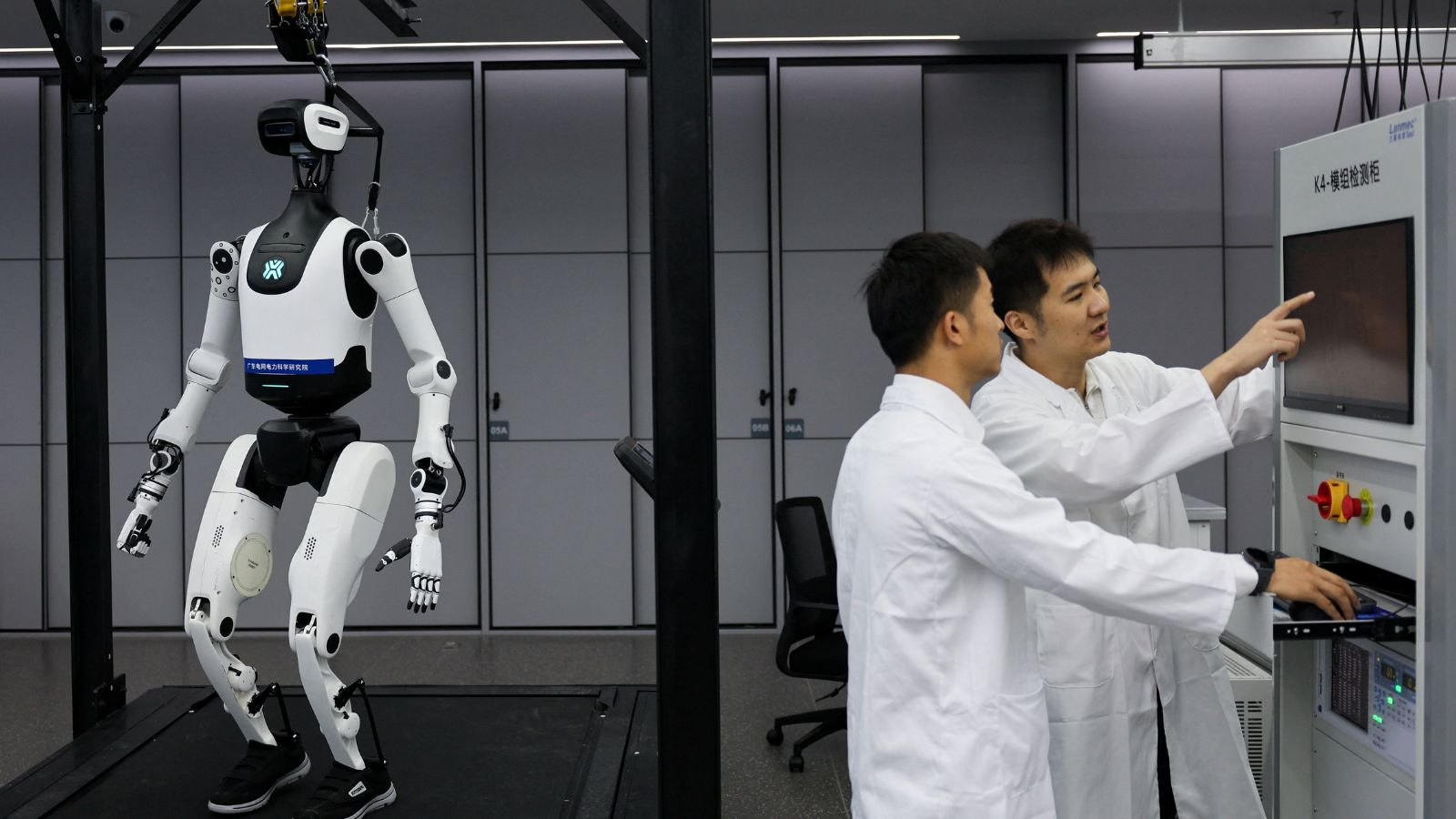
The Federal Communications Commission decree barring foreign-made humanoid robots and advanced quadrupeds establishes a protectionist firewall around the American automation sector, shifting geopolitical competition from software to physical embodiments of artificial intelligence. By utilizing national security rationales to choke off imported hardware, the regulatory apparatus has effectively criminalized the supply chains underpinning roughly 85% of global humanoid manufacturing. Understanding this maneuver requires stripping away diplomatic rhetoric to analyze the underlying mechanics: supply chain concentration, sensor-driven data extraction vulnerabilities, and the economics of domestic reindustrialization.
The Cost Function of Import Dependency
Modern bipedal and quadrupedal systems are fundamentally data-collection nodes wrapped in structural actuators. As these units integrate into industrial floor plates and critical infrastructure, their operational value is derived from dense sensor suites—including LiDAR arrays, high-resolution thermal cameras, and acoustic monitors.
When foreign manufacturers control the hardware pipeline, the cost function shifts from unit price to systemic exposure. The primary vectors of risk identified by regulatory panels center on three distinct variables:
- Exfiltration Surfaces: High-fidelity spatial mapping data gathered during routine material handling can be routed to foreign servers, mapping critical domestic infrastructure with millimeter precision.
- Remote Override Vectors: Continuous internet connectivity required for cloud-assisted autonomy introduces backdoor vulnerabilities, allowing external actors to immobilize fleets or manipulate physical assets.
- Industrial Monopoly Distortion: With Chinese firms like Unitree capturing substantial shares of global deployments through aggressive scaling and cost optimization, domestic startups face an asymmetric pricing pressure that market forces alone cannot clear.
The regulatory intervention acts as an artificial price floor for foreign alternatives, forcing American capital to internalize the cost of building an independent robotics industrial base from the ground up.
The Dual-Use Dilemma and Critical Infrastructure
The convergence of artificial intelligence models and bipedal mobility turns general-purpose automation into a dual-use technology. A machine engineered to stack pallets in a logistics warehouse possesses the spatial awareness and actuation capabilities required for unstructured outdoor environments, security patrols, and contested spaces.
This versatility breaks traditional jurisdictional boundaries between consumer goods and defense hardware. Because the mechanical morphology of a humanoid robot mirrors human operating environments, deployment friction is zero. The machine does not require retrofitted infrastructure; it utilizes existing stairwells, doorways, and control interfaces. Consequently, allowing unvetted foreign hardware into commercial facilities creates an unmonitored physical footprint across logistics hubs, power generation facilities, and manufacturing plants.
The inclusion of connected power inverters alongside bipedal systems in the regulatory ban reinforces this logic. Both device categories share a common architectural vulnerability: remote management interfaces that bridge physical infrastructure with external networks. While power inverters threaten the electrical grid via cyber-physical disruption, humanoid systems threaten industrial integrity via persistent, mobile sensory surveillance.
Supply Chain Decoupling and Reindustrialization Mechanics
Isolating the domestic market from foreign automation creates an immediate supply deficit. American firms cannot currently match the production velocity or bill-of-materials cost structure established by overseas competitors. Closing this gap requires a deliberate sequence of capital allocation and manufacturing scaling.
First, venture capital and defense funding must underwrite component-level manufacturing—specifically high-torque actuators, harmonic drives, and specialized rare-earth permanent magnets. Without domestic foundry and machining capacity for these core subsystems, assembly-only plants remain vulnerable to external supply shocks.
Second, software ecosystems must decouple. If domestic hardware relies on foreign open-source neural network weights or foundational models trained on overseas datasets, the hardware ban remains a surface-level fix. True autonomy security requires concurrent development of domestic imitation learning pipelines and physics simulation engines.
The regulatory enforcement mechanism relies on the FCC Covered List framework, blocking new model authorizations while grandfathering existing deployments already cleared for sale. This creates a temporal buffer, allowing existing research institutions and universities utilizing foreign quadrupeds to exhaust their operational lifecycles while choking off future commercial scaling for targeted brands.
Strategic Deployment of Capital and Compliance
Navigating this regulatory boundary demands a structural pivot for enterprise automation strategies. Organizations can no longer assume frictionless global sourcing for physical artificial intelligence hardware. Compliance mandates a strict audit of operational robotics vendors, mapping firmware update pathways, data storage jurisdictions, and component provenance.
Enterprises seeking to deploy bipedal automation must prioritize domestic vendors or secure conditional exemptions through interagency defense channels where domestic supply is functionally non-existent. Capital expenditure must shift toward domestic original equipment manufacturers capable of weathering compliance scrutiny, even at a temporary premium in unit cost. The competitive advantage will belong to firms that build resilient, sovereign robotics supply chains before enforcement parameters tighten further.