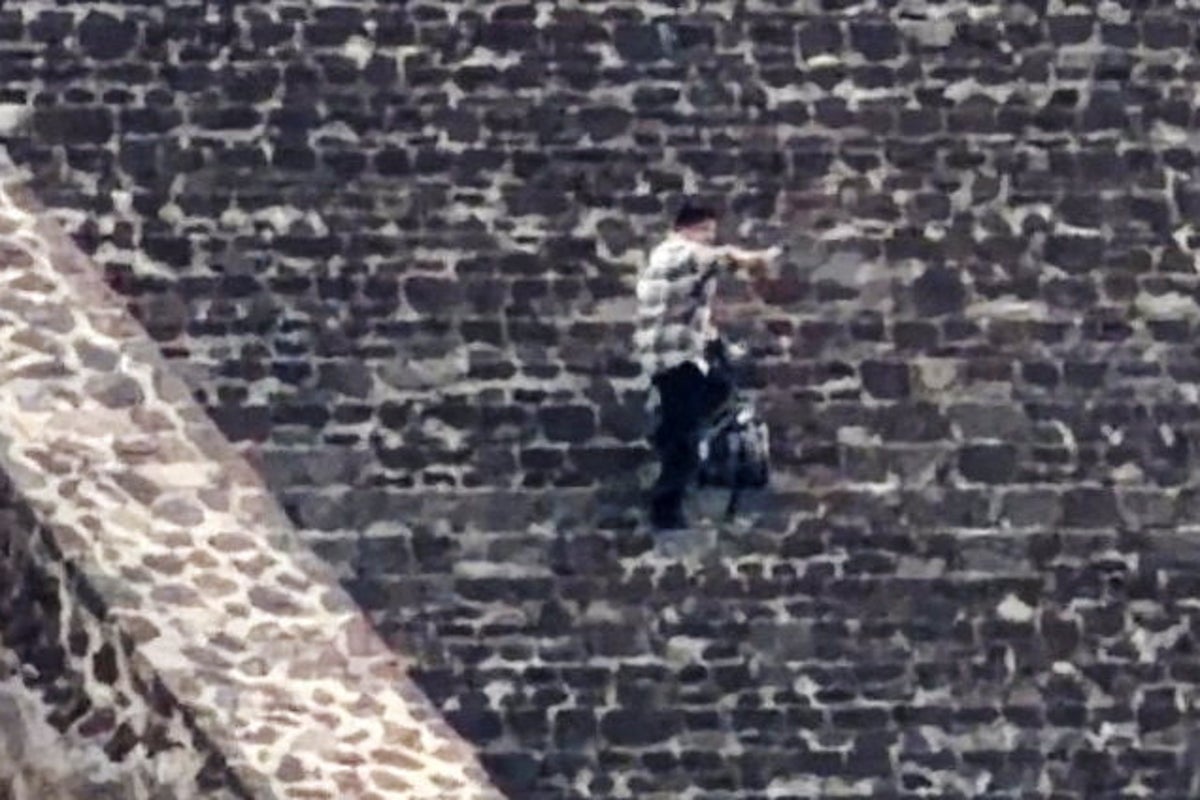
The convergence of high-density tourism and ancient architectural heights creates a specific security vacuum that standard law enforcement protocols fail to address. When a localized conflict or a targeted attack occurs within a site of historical significance—specifically an "ancient pyramid" or similar elevated platform—the traditional security perimeter is inverted. The high ground, historically a defensive asset, transforms into a lethal vantage point for an aggressor, while the "kill zone" encompasses a non-combatant population with limited egress. This incident in Mexico represents a failure of site-specific risk assessment, where the preservation of cultural heritage and the facilitation of mass tourism took precedence over the kinetic realities of modern ballistic threats.
The Geometry of Elevated Lethality
Analyzing an attack from an elevated structure requires a shift from horizontal to vertical ballistic calculus. In a standard street-level shooting, line-of-sight is frequently interrupted by vehicles, street furniture, and pedestrian density. On a pyramid or temple structure, the aggressor gains several mathematical advantages that increase the casualty rate.
1. The Cone of Vulnerability
An attacker firing from a height of 30 to 60 meters creates a three-dimensional cone of fire. This verticality minimizes the effectiveness of standard cover. Traditional barriers (walls, benches, signage) are designed to stop projectiles traveling on a horizontal plane. From an elevated position, the projectile's angle of incidence allows it to bypass these vertical shields, striking targets behind what would otherwise be considered "hard cover."
2. Expanded Field of View and Target Acquisition
Elevation removes the "blind spots" inherent in urban or ground-level environments. The attacker can observe the entire crowd’s movement patterns, identify high-value targets or exit bottlenecks, and adjust fire with minimal physical movement. This creates a psychological "suppression effect," where the crowd’s attempts to flee are visible and predictable, allowing the shooter to lead targets with higher precision.
3. Gravity and Terminal Velocity
While the additional kinetic energy gained from a 60-meter drop is negligible compared to the muzzle velocity of a modern firearm, the downward angle ensures that hits are more likely to strike the head, neck, and upper torso—the "center of mass" from a top-down perspective. This significantly increases the probability of a fatal outcome compared to ground-level limb or lower-torso wounds.
The Fragility of Tourism-Dependent Security Models
The security apparatus at international archaeological sites often operates on a "frictionless" model. The objective is to maximize visitor throughput and aesthetic appeal, which inherently conflicts with rigorous tactical defense. This creates three distinct systemic vulnerabilities.
The Myth of Natural Barriers
Site managers often rely on the remote location or the "sacred" status of a monument as a deterrent. However, these factors act as a magnet for high-impact violence. An attack at a UNESCO World Heritage site guarantees global media saturation, fulfilling the primary objective of many non-state actors or organized criminal elements: the demonstration of state impotence.
Egress Bottlenecks and Crowd Dynamics
Archaeological sites are rarely designed for rapid evacuation. Narrow stone stairways, single-entry tunnels, and controlled checkpoints create "choke points." In the event of a shooting, these bottlenecks become secondary hazards. The "trample risk" often rivals the ballistic risk. When an elevated shooter fires into a crowd, the instinctive reaction is to move away from the sound, yet the restricted terrain forces the crowd into dense clusters, increasing the efficiency of each fired round.
Resource Misallocation
Security at Mexican historical sites is frequently divided between federal police, local municipal forces, and private site security. This fragmentation leads to a "diffusion of responsibility." Federal forces focus on high-level organized crime, while site security focuses on petty theft and vandalism. Neither group is typically trained or equipped for an active shooter scenario involving high-ground suppression.
The Socio-Economic Cost Function of Archaeological Violence
The death of a tourist at a major landmark is not a localized tragedy; it is a systemic economic shock. The "fear tax" applied to the local economy can be quantified through three primary metrics.
- The Immediate Cancellation Surge: Within 72 hours of a high-profile violent event, international booking platforms typically see a 15% to 30% spike in cancellations for the affected region.
- The Insurance Premium Escalation: As risk ratings for a specific destination are downgraded by international monitors, the cost of liability insurance for tour operators and hospitality groups rises, thinning margins in an already competitive industry.
- The Long-Term Brand Degradation: Unlike a random act of street crime, an attack at a national symbol (like a pyramid) attacks the "sovereignty narrative" of the host country. It signals that the state cannot protect its most prized assets.
The Mechanics of Site Hardening Without Desecration
Addressing these risks does not require transforming ancient ruins into bunkers. Instead, it requires the application of "invisible" tactical shifts.
The first requirement is Vantage Point Denial. Any structure that offers a clear line of sight over a high-density area must have restricted access or be monitored by dedicated counter-observer teams. If a pyramid serves as a viewing platform, it must also serve as a security node. This includes the deployment of acoustic gunshot detection systems (AGDS) that can triangulate the source of fire in milliseconds, bypassing the confusion inherent in echoes off stone surfaces.
The second shift involves Dynamic Crowd Management. Utilizing AI-driven cameras to monitor "density heatmaps" allows security to identify and break up bottlenecks before they become lethal traps. If a crowd exceeds a specific density threshold, entry must be paused—not just for comfort, but to maintain a viable "escape lane" for every individual on site.
The third necessity is Tactical Sovereignty. Security forces assigned to these sites must be specialized. Standard patrol officers lack the training to engage a target at an elevation of 50 meters while surrounded by thousands of panicked civilians. Specialized units must be trained in "high-angle engagement" and equipped with optics capable of precision fire at varying inclines.
The Projection for Archaeological Tourism
The incident in Mexico serves as a terminal warning for the global travel industry. The era of "passive security" at historical sites is over. As non-state actors continue to seek high-visibility targets, the perceived safety of "ancient" or "sacred" spaces will continue to erode unless replaced by a proactive, data-driven security architecture.
Site operators must immediately move to conduct Kinetic Vulnerability Audits. This process involves mapping every possible elevated firing position and calculating the resulting cones of fire. Any area of the site that falls within a high-probability "kill zone" without adequate egress or cover must be redesigned or restricted. The failure to treat ancient monuments as tactical terrain is no longer an oversight; it is an act of institutional negligence. The future of archaeological tourism depends on the ability to integrate 21st-century ballistics defense into 1st-century architecture without compromising the integrity of either.
The strategic play is a mandatory shift from "Hospitality-First" to "Security-Integrated Hospitality." Operators who fail to implement vertical-threat protocols will find themselves uninsurable and, eventually, abandoned by the global market. The monument itself remains eternal, but the flow of human capital toward it is entirely dependent on the perception of a managed environment.


