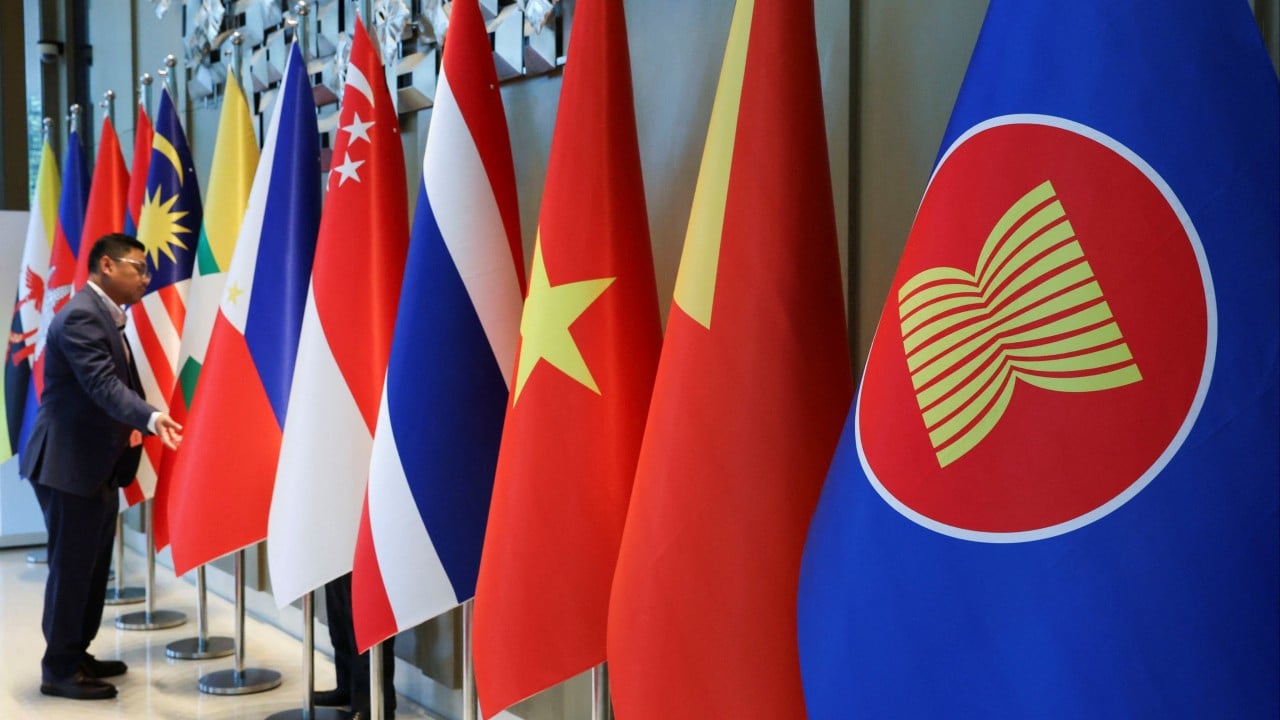
Geopolitical non-alignment in Southeast Asia is frequently mischaracterized by Western policy analysts as passive indecision or diplomatic ambiguity. In practice, the refusal of the Association of Southeast Asian Nations to submit to a binary binary choice between Washington and Beijing represents a rational, risk-weighted optimization strategy. Empirical data from elite regional opinion surveys, such as the ISEAS-Yusof Ishak Institute annual assessment, demonstrate that regional positioning is governed by structural hedging rather than ideological affinity.
To deconstruct this phenomenon, one must evaluate the two primary variables governing regional foreign policy: economic gravity and security dependency. Discover more on a related subject: this related article.
The Economic Vector and the Cost of Decoupling
China's entrenchment as the dominant economic actor across Southeast Asia is maintained by geographic proximity, supply chain integration, and massive capital export through regional infrastructure frameworks. Over fifty-five percent of regional policy leaders identify China as the most influential economic power in the territory. For nations deeply reliant on manufacturing inputs, rare earth processing, and consumer export markets within mainland Asia, any forced economic decoupling from Beijing carries an immediate, quantifiable contraction cost to gross domestic product.
Conversely, the United States commands significant financial and technological leverage, alongside vital capital markets. However, the transactional nature of American trade policy and erratic tariff postures introduce high regulatory volatility. When Washington signals protectionist shifts or utilizes unilateral economic coercion, regional actors register a direct increase in systemic vulnerability. The rational response to this volatility is to diversify exposure: maintaining commercial ties with Beijing while securing technological and security partnerships with Washington, Tokyo, and the European Union. More analysis by The New York Times highlights similar perspectives on this issue.
The Security Dilemma and Maritime Friction
While economic integration pulls Southeast Asia toward its northern neighbor, regional anxiety regarding maritime sovereignty pushes member states to seek external counterweights. Territorial disputes in the South China Sea create a continuous security dilemma. Maritime incursions, overlapping exclusive economic zone claims, and the constant risk of tactical miscalculation by littoral states generate profound operational friction with Beijing's expansive territorial assertions.
This dynamic explains why regional leadership views aggressive maritime posturing as a primary strategic threat. Yet, balancing against China via exclusive alignment with the United States introduces an equally severe risk: entrapment in a superpower conflict. Regional states calculate that hosting permanent American military infrastructure or adopting an overtly containment-oriented posture invites economic retaliation and military escalation within their immediate theater.
The Leadership Deficit and Institutional Agency
Confidence in global leadership is currently experiencing a structural deficit. Perceptions of the United States are heavily influenced by domestic political unpredictability and perceived rollbacks of commitments to multilateral institutions. When executive power in Washington exhibits transactional inconsistency, its reliability as a normative anchor for the rules-based international order degrades.
At the same time, China's growing political-strategic footprint does not automatically translate into deep normative trust. While Beijing's economic relevance is uncontested, regional capitals remain hyper-aware of asymmetric power dynamics. Consequently, forced-choice metrics—where regional elites are polled on whether they would align with Beijing or Washington—oscillate on razor-thin margins, reflecting a continuous state of equilibrium management rather than a permanent directional shift.
Strategic Adaptation and Operational Forecasts
The operational reality for Southeast Asian foreign ministries is the management of dual-dependency constraints. Institutional mechanisms like the ASEAN Outlook on the Indo-Pacific are designed explicitly to preserve convening power and prevent external major powers from dictating regional security architecture.
For multinational corporations, foreign investors, and state planners, operating within this theater requires abandoning expectations of unaligned stability or definitive ideological capture. Strategy must account for a permanent operational environment defined by functional compartmentalization: trade conducted primarily through Asian mega-supply chains, capital managed via global Western financial networks, and security maintained through distributed multi-partner balancing. The continuation of this multi-directional hedging remains the baseline optimal strategy for navigating great power competition without bearing the catastrophic costs of systemic rupture.