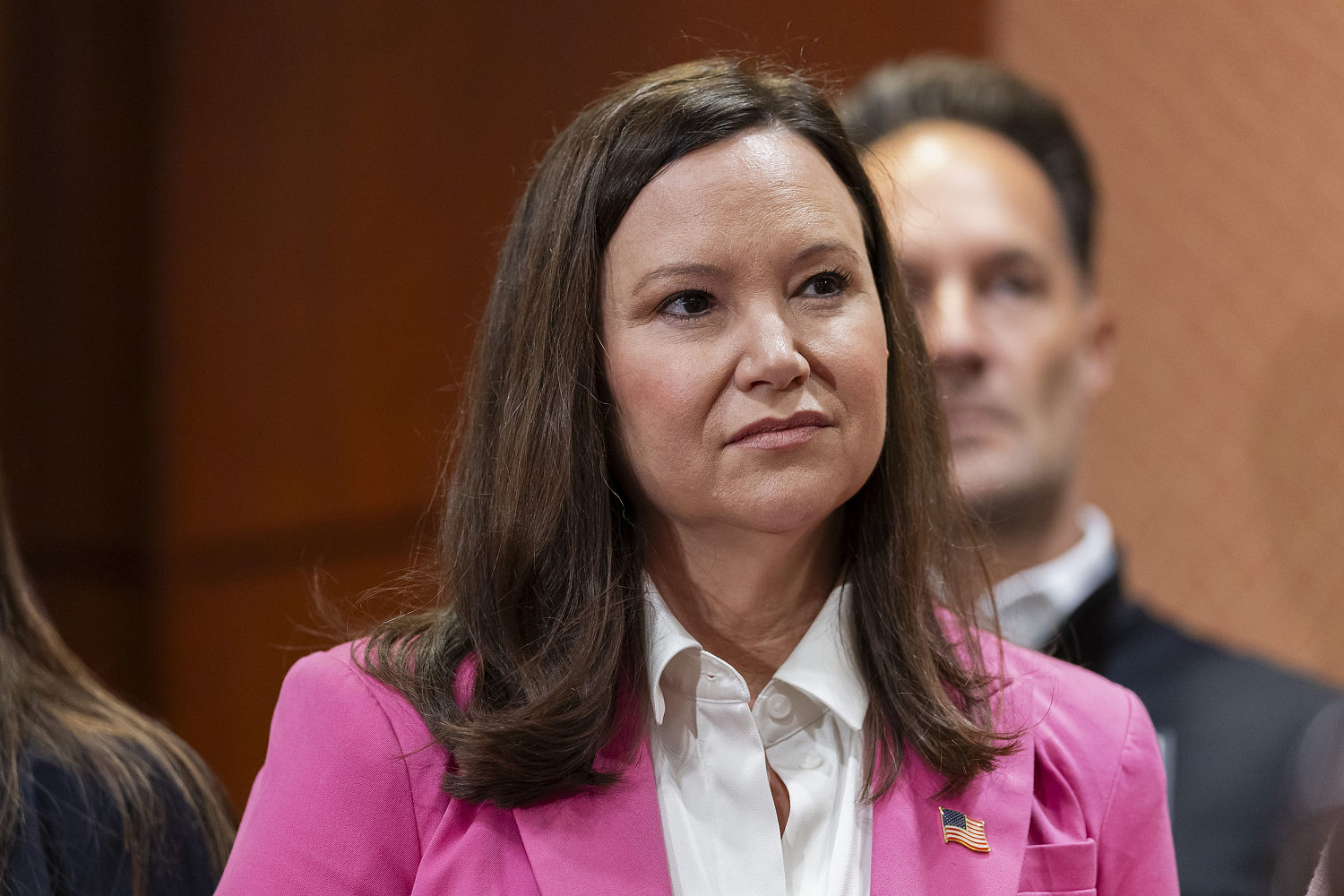
Republican Senator Ashley Moody’s victory in the Florida special Senate election to fill Marco Rubio’s vacated seat demonstrates how structural incumbency, statewide executive brand equity, and demographic realignment neutralize traditional midterm headwinds. Rather than representing a localized electoral anomaly, the outcome validates a repeatable campaign model built on pre-existing statewide name recognition, asymmetric voter registration advantages, and disciplined ideological consolidation.
The Structural Architecture of the Vacancy
When Marco Rubio exited the United States Senate to assume the role of Secretary of State, the resulting vacancy triggered a compressed electoral cycle governed by Florida statutory timelines. Under Florida law, the governor holds unilateral authority to appoint a temporary successor until the next general election cycle resolves the remainder of the unexpired term. Governor Ron DeSantis’s selection of then-Attorney General Ashley Moody immediately altered the competitive equilibrium of the race before a single general election ballot was cast.
This appointment functioned as an institutional force multiplier. Unlike an open-seat primary where multiple ambitious state-level actors deplete capital and fracture donor networks, the executive appointment bypassed intra-party attrition. Moody entered the special election phase with the full apparatus of Senate incumbency—franking privileges, committee assignments, and earned media saturation—layered atop six years of statewide visibility as Florida’s chief legal officer.
In electoral economics, the cost of acquiring name recognition in a media-expensive state like Florida—which encompasses ten distinct media markets ranging from Pensacola to Miami—represents the primary barrier to entry for any challenger. Moody’s prior two statewide campaigns in 2018 and 2022 had already amortized this customer acquisition cost. By the time the special election cycle commenced, her baseline unfavorable ratings were statistically insulated by years of law-and-order messaging, consumer protection enforcement, and high-profile litigation against federal administrative agencies.
The Three Pillars of Moody’s Electoral Advantage
Standard political commentary often attributes statewide victories to charismatic appeal or isolated news cycles. A rigorous deconstruction of the Florida special election reveals three structural mechanisms that dictated the mathematical ceiling for any Democratic opponent.
1. The Voter Registration Asymmetry
Electoral outcomes in modern polarized environments are heavily constrained by baseline partisan registration. Over the six-year period preceding the special election, the Florida Republican Party executed a systematic voter registration reversal, transforming a historic Democratic registration advantage of several hundred thousand voters into a Republican surplus exceeding one million active registrants.
This registration gap alters campaign resource allocation through the following causal chain:
- Reduced Persuasion Spend: With a built-in structural surplus, the Republican campaign required fewer marginal independent voters to achieve a 50-percent-plus-one threshold.
- Turnout Efficiency: Campaign capital shifted away from expensive persuasion media toward low-cost, high-yield base mobilization.
- Opposition Burn Rate: The Democratic challenger faced an immediate structural deficit, forcing early expenditure on voter registration and persuasion just to reach parity before addressing base turnout.
2. Executive-to-Legislative Brand Transfer
Transitioning from Attorney General to United States Senator is one of the highest-probability career paths in American politics, governed by the mechanics of issue ownership. As Attorney General, Moody maintained continuous ownership of high-salience issues: border security litigation, opioid settlement distribution, and anti-fraud initiatives targeting Florida’s senior demographic.
Voters evaluate legislative candidates using cognitive shortcuts based on prior executive performance. Because Moody’s tenure as Attorney General involved frequent appearances alongside county sheriffs and local law enforcement associations, she neutralized Democratic attempts to frame her as a partisan Washington insider. Her brand remained anchored in state-level executive enforcement, allowing her to campaign as a protector of Florida’s fiscal and legal autonomy rather than a defender of congressional gridlock.
3. Coalition Consolidation Across Geographic Tiers
Florida’s electoral map functions as an aggregation of distinct regional economies rather than a monolithic electorate. Winning statewide requires optimizing vote share across four primary geographic tiers:
- The Panhandle and North Florida: High-turnout conservative strongholds where the primary objective is maximizing margin rather than winning vote share.
- The I-4 Corridor (Tampa to Orlando): Historically the decisive swing region, where suburban demographic shifts and population inflows from the Midwest and Northeast have steadily tilted the electorate rightward.
- Southwest Florida: Rapidly growing coastal counties characterized by high concentrations of retirees and small-business owners sensitive to tax and regulatory policy.
- Southeast Florida (Miami-Dade, Broward, Palm Beach): The traditional Democratic firewall, where shifting Hispanic voting patterns—particularly among Cuban, Venezuelan, and Colombian diasporas—eroded the margin offsets Democrats historically relied upon to counteract North Florida deficits.
Moody’s campaign maintained strict discipline across these tiers, preventing margin erosion in Miami-Dade while maximizing raw vote volume in the suburban counties surrounding Tampa—her native political base—and Southwest Florida.
The Cost Function of the Opposition’s Strategic Deficit
To understand why the special election never materialized into a competitive toss-up, analysts must examine the structural cost function facing the Democratic opposition. In political strategy, a challenger overcoming a baseline partisan deficit must execute three sequential phases without error: candidate recruitment, capital accumulation, and narrative disruption.
First, candidate recruitment in a compressed special election cycle suffers from adverse selection. High-tier officeholders—such as incumbent members of Congress or major city mayors—face steep opportunity costs when abandoning safe seats for a low-probability statewide bid. Without a top-tier recruit possessing pre-existing statewide donor lists, the opposition struggled to match the fundraising velocity of an incumbent Senator backed by the National Republican Senatorial Committee.
Second, national Democratic donors operate on strict return-on-investment models. With limited capital distributed across contested Senate battlegrounds nationwide, institutional funders triage states based on polling elasticity. Because Florida’s baseline partisan lean required an extraordinary investment per marginal vote gained, national outside spending groups allocated their marginal dollars to lower-cost states in the Rust Belt and Sun Belt, starving the Florida opposition of air-war parity during the critical final sixty days.
Third, narrative disruption requires a salient wedge issue capable of fracturing the incumbent’s coalition. While Democrats attempted to nationalize the race around reproductive rights, healthcare access, and federal legislative controversies, Moody’s campaign localized the framing around inflation, property insurance stability, and immigration enforcement. In an environment where voters prioritized household balance sheets over abstract ideological debates, the challenger’s messaging failed to detach suburban independents from the Republican column.
Operational Mechanics of the Special Election Cycle
Special elections differ fundamentally from standard presidential or midterm cycles in their turnout elasticity and media dynamics. Because the race shared the ballot with broader cycle dynamics while operating under distinct term-length rules—determining who would serve the remainder of Rubio’s term before the seat faces a full six-year cycle—voter education became an operational priority.
Moody’s field operation relied on three tactical executions:
- Early Vote Banking: Florida’s vote-by-mail and early in-person voting windows allow campaigns to track daily ballot returns at the precinct level. The Republican apparatus aggressively banked low-propensity conservative voters early, removing them from the persuasion universe and allowing field staff to reallocate door-knocking capacity to sporadic voters in the final week.
- Law Enforcement Endorsement Stacking: Rather than releasing endorsements in a single press event, the campaign dripped endorsements from individual county sheriffs across regional media markets, generating localized earned media coverage in rural and suburban newspapers that national outlets routinely ignore.
- Hispanic Media Micro-Targeting: Instead of treating Spanish-language media as a single demographic block, the campaign segmented messaging across South Florida radio and digital channels, tailoring economic and foreign policy arguments specifically to diaspora communities sensitive to Latin American political instability.
Limitations and Vulnerability Vectors
While Moody’s victory confirms the durability of Florida’s Republican realignment, treating this outcome as permanent invulnerability ignores underlying structural vulnerabilities that will govern future electoral cycles.
First, down-ballot roll-off remains a persistent risk in non-presidential cycles. When the top of the ticket lacks a polarizing presidential figure, low-propensity populist voters who turn out exclusively for national figureheads often abstain. Moody’s margin benefited from institutional Republican infrastructure, but maintaining that turnout ceiling in future cycles requires continuous grassroots engagement independent of national party leadership.
Second, statewide economic friction points pose direct attribution risks to an incumbent party that holds total control over state government. Rising property insurance premiums, escalating housing costs in South and Central Florida, and infrastructure strain from rapid population growth create localized voter frustration. As Republicans hold the governorship, both legislative chambers, and both Senate seats, voters experiencing acute cost-of-living pressures have no local Democratic executive to blame. If macroeconomic conditions deteriorate, single-party dominance shifts from an operational asset to an accountability liability.
Third, the compressed term structure means Moody faces immediate re-election pressures on a shortened runway compared to a standard six-year Senate term. Continuous campaigning constrains legislative bandwidth and exposes the incumbent to primary challenges from the ideological flank if she compromises on federal spending or regulatory packages in Washington.
Strategic Imperatives for Future Senate Campaigns
The blueprint established by Ashley Moody’s special election victory dictates the operational standard for statewide campaigns in high-growth, media-fragmented states. Political strategists operating in similar environments must execute three concrete adjustments to replicate or counter this model:
- Front-Load Brand Equity Through Executive Offices: Parties seeking to build a durable Senate bench must prioritize down-ballot executive offices—specifically Attorney General, Chief Financial Officer, and Agriculture Commissioner. These roles provide continuous, taxpayer-funded earned media platforms and issue ownership that legislative seats cannot match.
- Treat Voter Registration as a Permanent Capital Expense: Campaigns cannot outspend a million-voter registration deficit in the final ninety days of an election. Party committees must treat year-round voter registration as fixed infrastructure rather than a seasonal campaign activity, anchoring field budgets around net registration gains in high-growth suburban counties.
- Localize National Issues Through Economic Proxies: Statewide candidates must abandon abstract national talking points in favor of localized economic proxies. Translating federal regulatory, energy, and immigration policies into direct impacts on state insurance markets, local tax burdens, and municipal infrastructure neutralizes opposition framing and locks in pragmatic suburban voters.



