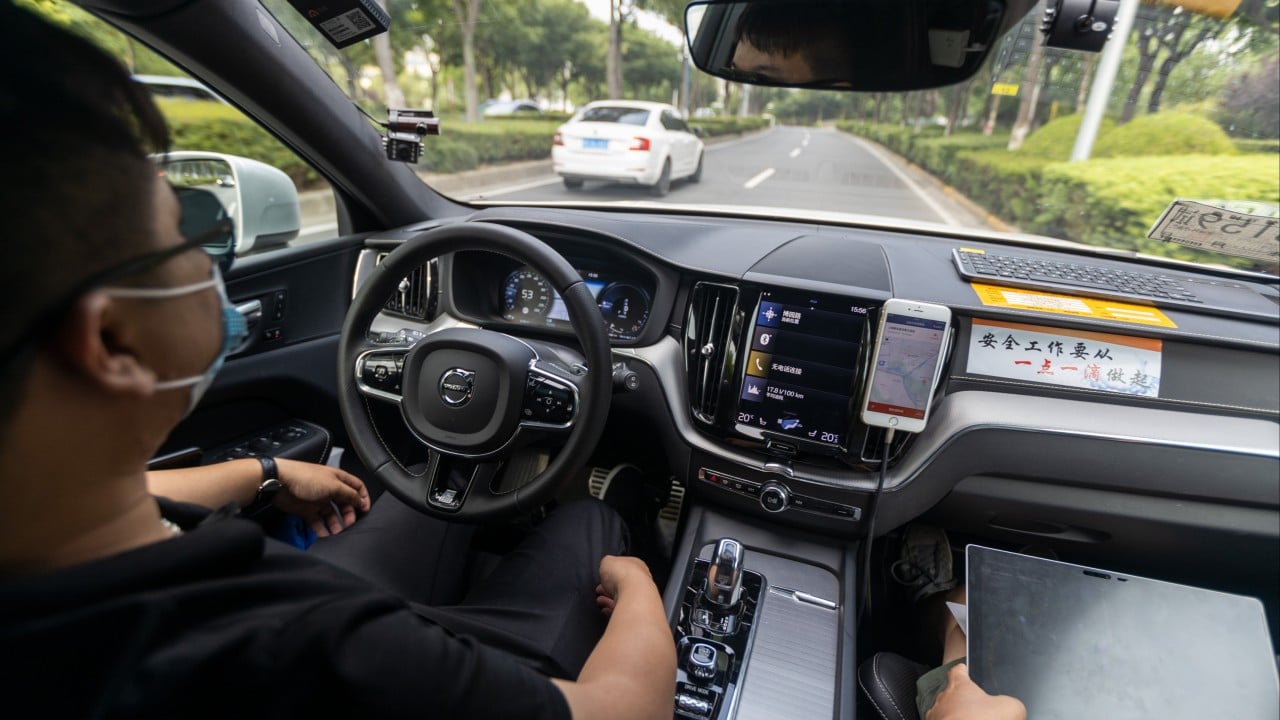
Autonomous vehicle deployment in high-density urban corridors is governed by a strict regulatory and topological cost function. When DiDi Chuxing initiates testing protocols for driverless fleets within Hong Kong—specifically targeting dense mixed-traffic zones like Tseung Kwan O—the initiative exposes the friction points between mainland Chinese software stacks and unique municipal street architectures. This movement is not merely a geographic expansion; it is an operational stress test designed to validate localized sensor fusion, right-hand-drive navigation logic, and regulatory compliance under adversarial conditions.
The Topological Constraints of Urban Testing
Hong Kong presents a distinct operational environment that differentiates it from Tier-1 mainland Chinese testing zones such as Beijing's Yizhuang Economic and Technological Development Area. The municipality operates on a right-hand-drive, left-hand-traffic layout combined with high vertical density, narrow lane configurations, aggressive pedestrian behaviors, and dense multi-level transport networks.
For an autonomous driving stack, this environment alters the sensory input variables:
- Spatial Redundancy: Narrow corridors restrict the lateral margin of error, demanding higher spatial accuracy from LiDAR and camera sensor suites.
- Occlusion Frequency: High pedestrian footfall and dense commercial architecture create persistent blind spots, requiring predictive modeling rather than mere reactive braking.
- Infrastructure Integration: Integration with high-speed arterial links, subterranean interchanges, and mass transit nodes creates complex multi-layered routing challenges.
The Transport Department of Hong Kong regulates these tests via a phased licensing framework. Entrants must progress from supervised on-board operator models to remote teleoperation setups before achieving unassisted commercial trials. DiDi’s entry into districts like Tseung Kwan O represents the middle tier of this progression, where the primary objective shifts from basic obstacle avoidance to managing edge cases in high-density traffic.
The Economics of Fleet Scaling
Deploying autonomous fleets in dense municipal territories requires optimizing unit economics across three primary vectors: hardware depreciation, safety driver overhead, and teleoperation ratios.
[Operational Cost Structure]
  ├── Sunk Capital (Sensors, Compute Units, Vehicle Chasses)
  ├── Variable Labor (Safety Operators vs. Remote Teleoperation Supervisors)
  └── Regulatory Compliance (Licensing Fees, Continuous Safety Audits)
In the initial testing phase, the cost function is dominated by safety operator salaries and redundant hardware configurations. To transition toward profitability, operators must achieve a high vehicle-to-operator ratio via remote monitoring centers. DiDi’s strategy relies on shifting human oversight from the cabin to centralized control facilities. However, the density of Hong Kong's urban fabric elevates the frequency of intervention requests, limiting the speed at which this ratio can scale.
Software Localization and Sensor Fusion Mechanics
Standardized autonomy algorithms trained on mainland traffic patterns experience performance degradation when introduced to Hong Kong’s traffic ecology. Mainland environments typically feature wider lanes, standardized grid systems, and predictable lane-discipline enforcement via extensive digital surveillance. Hong Kong introduces micro-behaviors unique to its public transport ecosystem, including sudden deceleration by public light buses, complex pedestrian jaywalking patterns, and abrupt merging maneuvers by professional drivers.
To resolve these variables, autonomous fleets must adjust their perception-action loops:
- Perception Layer: Raw point clouds from LiDAR must be fused with high-definition optical streams to track fast-moving, erratic objects in confined spaces.
- Prediction Layer: Behavioral models must assign probabilistic weightings to aggressive local driving habits, distinguishing between a vehicle yielding and one executing an assertive lane change.
- Execution Layer: Motion planning algorithms must balance passenger comfort against aggressive defensive driving constraints to prevent traffic disruption without sacrificing safety.
Competitive Positioning and Market Dynamics
The entrance of major mobility conglomerates into Hong Kong's testing ecosystem—exemplified by Baidu's Apollo Go securing early fully driverless permits on Airport Island alongside DiDi's targeted route expansions—establishes a competitive benchmark. Hong Kong functions as an international validation crucible. Success within this jurisdiction provides empirical proof of software adaptability, serving as a functional standard for expansion into other complex international markets operating under left-hand traffic laws, such as Singapore or London.
The strategic deployment of capital into these regional trials is not aimed at immediate commercial revenue generation. Instead, it serves to accumulate the high-entropy driving data required to satisfy municipal safety audits. Autonomous mobility providers must systematically isolate failure modes in low-speed, high-complexity corridors before petitioning for city-wide commercial operating licenses.
Deploy engineering resources to establish a dedicated telemetry uplink between local test vehicles and regional cloud infrastructure, minimizing latency for remote fallback systems while maximizing edge-case data harvesting speed.