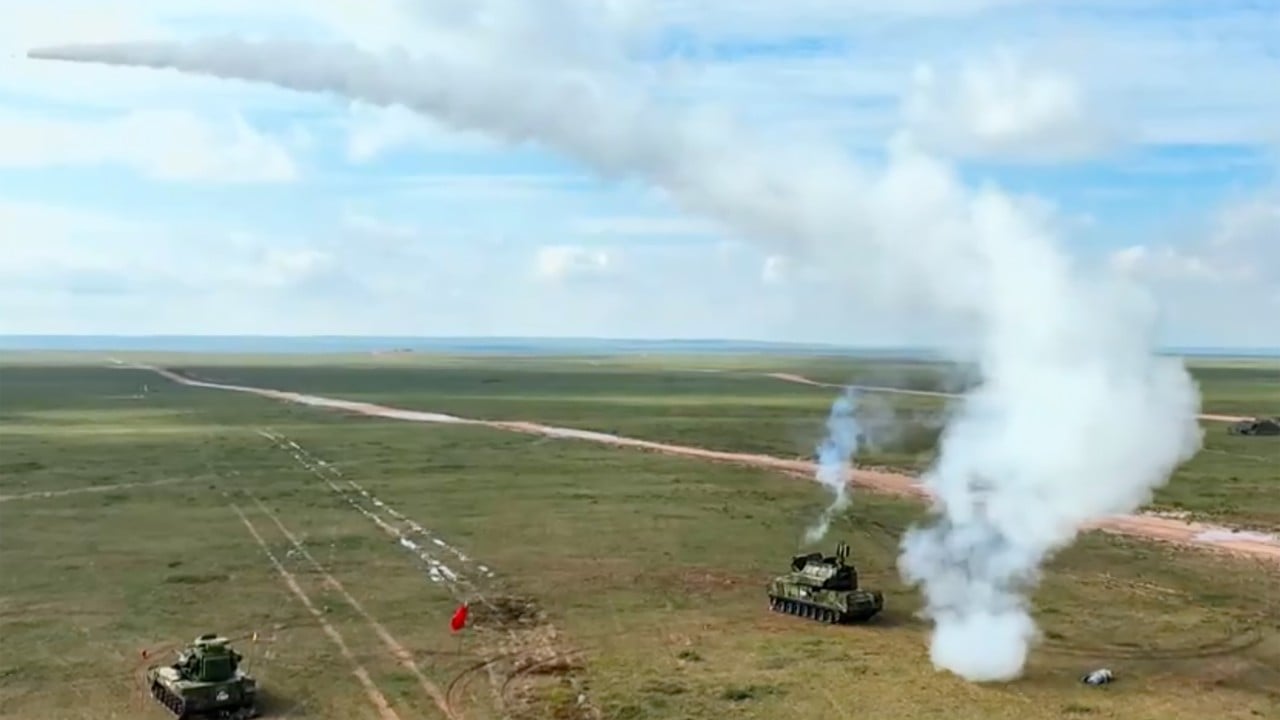
Modern military procurement strategies in South Asia have shifted from aggregate platform accumulation to the optimization of compressed, multi-layered point-defense envelopes. The public appearance of the Chinese-manufactured HQ-17AE mobile short-range surface-to-air missile system by the Pakistan Air Force illustrates a fundamental shift toward resolving low-altitude vulnerabilities. Rather than evaluating this acquisition through traditional geopolitical generalizations, analyzing the technical parameters, sensor-to-shooter bandwidth, and economic trade-offs reveals the precise structural mechanics governing contemporary short-range air defense (SHORAD).
The Architecture of Compressed Air Defense Layers
Defense networks operating against modern cruise missiles, loitering munitions, and low-flying combat aircraft require dense, overlapping engagement zones. The integration of the HQ-17AE—alongside Turkish point-defense assets such as the Korkut 35 mm and Sahin 40 mm gun systems—establishes a multi-tier engagement hierarchy within the final fifteen kilometers of airspace.
The operational mechanics of this multi-layered umbrella rely on distinct functional zones:
- The Outer Missile Tier: Managed by systems like the HQ-17AE, covering ranges from 1.5 kilometers out to 15 kilometers against non-stealth aircraft, and compressed bounds against stealth platforms and incoming missiles.
- The Inner Ballistic/Kinetic Tier: Managed by rapid-fire automated gun systems operating below 4 kilometers, designed to shred micro-munitions where missile engagement is economically or mechanically unviable.
- The Sensor Fusion Layer: Phased-array search radars operating alongside engagement radar modules to reduce latency between initial target acquisition and fire control allocation.
This layered structure solves the historical deficiency of single-tier defenses, which often saturated their tracking channels when confronted with mixed-package attacks involving both high-value cruise missiles and low-cost uncrewed aerial vehicles.
The Sensor-to-Shooter Bandwidth Constraint
A common analytical error in assessing mobile air defense systems is assuming that raw target detection equals engagement capability. The HQ-17AE possesses a PESA (Passive Electronically Scanned Array) search radar with a detection range reported near 45 kilometers, capable of tracking up to 24 targets simultaneously. However, the system's electronic scanning engagement radar supports only four simultaneous engagement channels per combat vehicle.
This creates a structural bottleneck:
- The detection-to-boundary window leaves approximately 30 kilometers of transit space for a non-stealth aircraft between initial radar detection at 45 kilometers and the outer 15-kilometer missile launch threshold.
- Within that transit window, data must be processed, threat priorities must be ranked algorithmically, and commands must be distributed across the four available engagement channels.
- Because each combat vehicle carries eight ready-to-fire vertical cold-launch interceptors distributed in two four-round packs, a single vehicle can execute two complete multi-target salvos before requiring mechanical reloading or battery replenishment.
This mathematics proves that tracking capacity outstrips firing capacity by a factor of six (24 tracked targets versus 4 engagement channels). Consequently, the operational limitation of the system is not finding the target; it is the allocation efficiency of the limited missile inventory against saturated swarm vectors.
The Mobility and Economic Cost Function
The tactical value of the HQ-17AE variant stems from its wheeled Dongfeng 6x6 chassis, which trades the high cross-country soil-bearing pressure of tracked Tor-derived predecessors for extended operational road mobility. Reaching transit speeds up to 90 kilometers per hour, the platform can maintain pace with mechanized ground formations or rapidly redeploy between dispersed air bases. Crucially, the system retains the capacity to search, track, and guide missiles while moving at speeds up to 25 kilometers per hour on flat roads, decoupling air defense nodes from static defensive earthworks.
The underlying economics of this deployment address the asymmetric cost-exchange ratio that plagues modern missile defense. Firing a premium precision-guided surface-to-air missile costing hundreds of thousands of dollars against an inexpensive loitering munition degrades long-term military sustainability. By integrating the HQ-17AE with cannon-based anti-aircraft systems, military planners force a resource allocation split: high-value supersonic cruise missiles and tactical aircraft are funneled into the missile tier, while low-cost asymmetric drone threats are suppressed by cheaper programmable airburst ammunition at close range.
Deploying mixed-origin military architectures—combining Chinese command-and-control frameworks, Russian-derived missile designs, and Turkish gun assets—introduces significant software and logistical friction. Interoperability protocols across disparate data links require continuous bridging to prevent latency spikes during high-tempo engagements.
To maximize the survivability of mechanized corridors against saturated air attacks, force commanders must mandate decentralized tactical execution protocols, ensuring individual battery commanders retain autonomous firing authority when electronic jamming isolates them from central command nodes.
Pakistan unveils Chinese HQ 17AE system to enhance low altitude air defense capabilities
This video provides visual confirmation of the mobile launcher architecture and integration dynamics discussed in the tactical analysis above.
http://googleusercontent.com/youtube_content/1