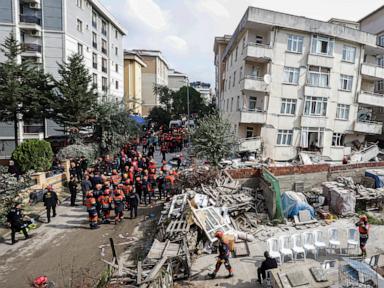
Urban structural failures follow predictable thermodynamic and mechanical pathways. When a building collapses—such as the partial structural failure in Istanbul that trapped civilians, including a child—public discourse typically defaults to immediate emotional responses and superficial descriptions of the aftermath. Analysts, structural engineers, and emergency logistics experts view the same event through a different lens: a failure cascade characterized by material fatigue, gravity-load redistribution, and immediate tactical friction in search and rescue operations. Understanding this phenomenon requires deconstructing the incident into three core vectors: pre-failure structural vulnerability, the kinematics of the collapse sequence, and the operational constraints governing emergency extraction.
The Structural Anatomy of Partial Collapses
A partial collapse is rarely an isolated anomaly; it is the endpoint of a cumulative stress threshold breach. Urban residential and commercial structures, particularly in historical or densely developed metropolitan environments like Istanbul, frequently endure multi-decade loading cycles. These cycles include fluctuating thermal stresses, material degradation from atmospheric moisture, and unpermitted structural modifications executed by occupants over time.
Material Fatigue and Load Path Failure
Load-bearing systems rely on continuous downward transmission of dead loads (the permanent weight of the structure) and live loads (occupants, furniture, temporary dynamic forces) into the foundation. When a primary support element—such as a reinforced concrete column or a load-bearing masonry wall—yields, the structure initiates a load redistribution phase.
[Primary Element Failure]
       │
       ▼
[Dynamic Load Redistribution] ──> [Surrounding Members Overstressed]
       │
       ▼
[Progressive Shear or Compression Failure] ──> [Partial Floor Plate Collapse]
If the adjacent structural members possess sufficient reserve capacity, the building stabilizes in a damaged state. If those members are already operating near their ultimate yield strength, the sudden transfer of dynamic load triggers progressive shear or compression failure. This explains why partial collapses frequently drag down adjacent floor slabs vertically while leaving outer perimeter walls standing, creating a dense web of interlocking debris known as "pancaked" slabs.
The Mechanics of Confinement
In a pancaked partial collapse, concrete floors drop sequentially onto one another, sealing off the spaces between them. The survival of trapped individuals depends entirely on void space creation—pockets formed by overturned furniture, reinforced partition walls, or triangular geometries generated when a floor plate anchors to an exterior wall while dropping in the center. The volume of these voids dictates the survival window, governed strictly by ambient temperature, crush injuries, and available breathable oxygen.
Operational Friction in Emergency Extraction
First responders facing a partial structural collapse operate under severe time constraints known in rescue management as the golden period. The probability of survival decreases non-linearly after the initial seventy-two hours, dropping precipitously within the first twelve hours if crush syndrome or asphyxiation risks are high.
Information Asymmetry and Site Triage
The primary bottleneck in the initial phase of any collapse response is information asymmetry. Incident commanders rarely possess accurate blueprints, real-time occupancy counts, or exact coordinates of the trapped victims. Initial operations rely on acoustic sensors, thermal imaging, and canine units, each carrying distinct operational limitations:
- Acoustic sensors are easily disabled by ambient urban noise, heavy machinery vibration, and structural settling sounds.
- Thermal imaging requires line-of-sight or minimal thermal insulation between the victim and the surface, rendering it ineffective beneath feet of dense masonry and concrete dust.
- Canine units provide high reliability under optimal atmospheric conditions, but wind patterns, heavy fuel odors, and psychological stress can degrade scent tracking.
Logistical and Shoring Constraints
Once potential voids are located, rescue teams cannot simply excavate. Moving debris arbitrarily risks shifting the remaining unstable superstructure, causing secondary collapses that endanger both victims and rescue personnel.
Phase 1: Stabilization (Shoring unstable walls, preventing secondary drops)
Phase 2: Void Access (Micro-drilling, fiber-optic scoping, controlled tunneling)
Phase 3: Extraction & Triage (Stabilizing crush injuries, controlled extrication)
Engineers must deploy hydraulic shoring systems, timber cribbing, and pneumatic struts to lock hanging floors and fractured lintels into place before manual or mechanical removal of rubble can begin. This sequential dependency creates a strict operational ceiling on extraction speed. Every cubic meter of material cleared must be evaluated for its structural stabilizing role.
The Regulatory and Mitigation Paradigm
Preventing urban structural failures requires shifting from reactive emergency management to predictive structural monitoring. Cities characterized by aging building stocks face systemic risks that cannot be resolved solely through better fire and rescue deployment.
The economic cost of structural neglect is calculated through a simple risk function: the probability of material degradation multiplied by the density of urban occupancy. In high-density districts, the absence of mandatory structural audits every decade ensures that latent defects remain hidden until a catastrophic threshold is breached.
Municipal authorities must implement standardized non-destructive testing protocols—such as ultrasonic pulse velocity testing, rebound hammer tests, and reinforcement corrosion mapping—to identify degraded load paths before they transition from elastic deformation to sudden brittle failure. Without continuous structural auditing, emergency response agencies will remain trapped in a permanent cycle of high-risk rescue operations, reacting to mechanical inevitabilities rather than mitigating them at the source.