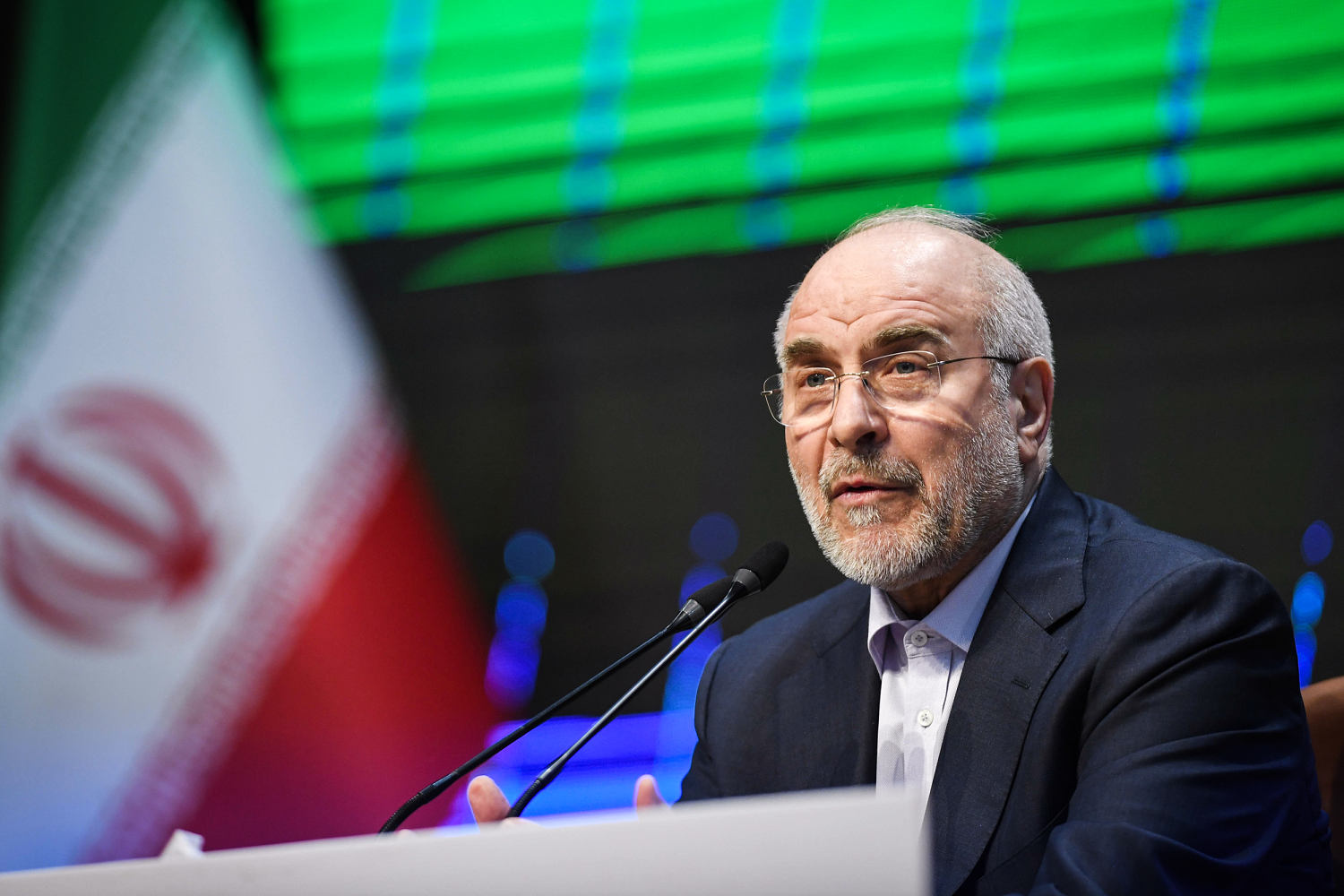
The current shift in the Iranian political apparatus is not a mere change in personnel but a fundamental restructuring of the state’s executive and ideological architecture. While international observers often focus on the rhetoric of individual "hard-liners," the more significant transformation lies in the institutional convergence between the Islamic Revolutionary Guard Corps (IRGC), the Office of the Supreme Leader, and a new generation of technocratic ultraconservatives. This alignment reduces the traditional friction between the "elected" and "unelected" branches of the Iranian government, creating a more streamlined, albeit more rigid, decision-making engine.
The Mechanics of Power Consolidation
The rise of hard-line figures must be viewed through the lens of a "Managed Transition." For decades, the Iranian political system operated on a pendulum of factionalism, swinging between reformists/pragmatists and conservatives. That pendulum has been structurally halted. The disqualification of moderate candidates by the Guardian Council and the strategic elevation of figures like Mohammad Bagher Ghalibaf or the late Ebrahim Raisi’s protégés represent a deliberate narrowing of the political spectrum. Recently making headlines in this space: The Kinetic Deficit Dynamics of Pakistan Afghanistan Cross Border Conflict.
This narrowing serves three primary strategic functions:
- Succession Insurance: The most critical variable in Iranian politics is the eventual succession of the Supreme Leader. By filling the parliament (Majles) and the judiciary with ideological purists, the deep state ensures that the Assembly of Experts—the body responsible for choosing the next leader—operates within a controlled environment.
- Economic Autarky: Hard-liners advocate for the "Resistance Economy," a framework designed to insulate the Iranian domestic market from Western sanctions. This involves strengthening internal supply chains and pivoting trade toward the BRICS+ bloc and the Shanghai Cooperation Organization (SCO).
- Command and Control Efficiency: Friction between the presidency and the IRGC has historically slowed Iranian foreign policy execution. A unified hard-line front eliminates this "veto player" problem, allowing for more rapid deployment of regional strategies.
The Cost Function of Ideological Purity
The shift toward an uncompromising executive branch carries a quantifiable set of risks that the Iranian leadership appears willing to absorb in exchange for internal stability. Additional information into this topic are covered by NBC News.
The Participation Deficit
Lower voter turnout is a direct byproduct of the narrowing political field. In a system that derives its legitimacy from a blend of divine mandate and popular participation, a sustained drop in turnout creates a "legitimacy tax." This manifests as increased domestic unrest and the necessity for higher expenditures on internal security apparatuses. When the state loses its ability to co-opt the middle class through reformist representation, it must rely more heavily on the Basij and other paramilitary forces to maintain order.
Technical Brain Drain
The preference for ideological alignment over technical merit (the "Commitment vs. Expertise" trade-off) creates a bottleneck in the management of complex systems. Iran faces acute challenges in water management, grid stability, and hydrocarbon extraction efficiency. Hard-line administrations tend to prioritize loyalty in ministerial appointments, which often results in the mismanagement of these critical infrastructure sectors. The cost of this inefficiency is not just economic; it is a catalyst for localized protests.
Regional Kinetic Strategy and the "Trump Variable"
The prospect of a return to a "Maximum Pressure" style of U.S. diplomacy does not appear to be deterring the hard-line ascent; rather, it is accelerating it. The hard-line logic dictates that pre-emptive escalation is the only effective deterrent against a transactional or aggressive U.S. administration.
This strategy operates on two levels:
- The Nuclear Threshold: Hard-liners have moved the discourse from "civilian nuclear energy" to "strategic deterrence." By reducing the breakout time and limiting IAEA oversight, the regime creates a "fait accompli" that forces any U.S. administration to choose between total war or acceptance of a threshold state.
- The Forward Defense Doctrine: The IRGC-Quds Force utilizes a network of non-state actors (The Axis of Resistance) to export the kinetic cost of conflict away from Iranian soil. A hard-line government provides the diplomatic cover and logistical funding required to sustain these proxies, viewing them as essential buffers against Israeli or American intervention.
The New Technocratic Ultraconservatives
A common analytical error is to view the rising hard-liners as purely ideological zealots. A distinct subset of this movement is composed of "Technocratic Ultraconservatives"—individuals who are Western-educated or highly sophisticated in their understanding of global markets, yet remain fundamentally committed to the survival of the Velayat-e Faqih system.
They do not seek to integrate with the West; they seek to outmaneuver it. This group focuses on:
- Digital Sovereignty: Developing the National Information Network (NIN) to decouple the Iranian internet from the global web, allowing for social control while maintaining digital banking and governance.
- Sanctions Circumvention Infrastructure: Building complex financial "switchboards" involving front companies in the UAE, Turkey, and Southeast Asia to facilitate the sale of sanctioned crude.
- Defense Innovation: Prioritizing low-cost, high-impact technologies such as the Shahed-series loitering munitions. These systems demonstrate a high "cost-to-kill" ratio, forcing adversaries to expend expensive interceptor missiles (e.g., Patriot or IRIS-T) against cheap, mass-produced drones.
Structural Bottlenecks in the Hard-Line Vision
Despite the consolidation of power, three structural bottlenecks threaten the long-term viability of the hard-line strategy.
First, the Fiscal Constraint. The Resistance Economy can prevent total collapse, but it cannot generate the 6-8% GDP growth required to absorb the millions of young Iranians entering the labor market. Without significant foreign direct investment (FDI), which remains blocked by the FATF (Financial Action Task Force) blacklist and sanctions, the economy will remain in a state of stagflation.
Second, the Succession Friction. While the field is narrowed, the hard-line camp is not a monolith. Rivalries between the IRGC's economic wing and the traditional clerical establishment are significant. The transition period after the current Supreme Leader will be the ultimate stress test for this unified front.
Third, the Social-Cultural Divergence. There is a widening delta between the values of the urban Gen Z population and the aging revolutionary elite. The "Woman, Life, Freedom" movement was a symptom of this gap. Hard-line policies on social restrictions (e.g., the Hijab and Chastity Bill) act as friction points that ignite broader grievances regarding economic mismanagement and corruption.
The Strategic Forecast
The Iranian state has calculated that the risk of internal collapse due to reformist "opening" is greater than the risk of stagnation under hard-line "closure." We should expect a continued purge of pragmatist elements from the bureaucracy and an even tighter integration of the IRGC into the civilian economy.
On the international stage, Iran will likely leverage its "threshold nuclear status" as a primary bargaining chip, not for a comprehensive "Grand Bargain," but for a series of tactical de-escalations that allow for localized sanctions relief. The objective is "Stability through Strength" rather than "Stability through Integration."
Strategic actors must prepare for an Iran that is more predictable in its hostility but more resilient to traditional diplomatic pressure. The era of the "moderate interlocutor" in Tehran is functionally over. Future engagements will be purely transactional, conducted with a leadership that views compromise as a sign of systemic weakness rather than a tool of statecraft.
The move toward an authoritarian, IRGC-aligned executive is the final stage in the institutionalization of the revolution. It is a pivot toward a permanent wartime footing, designed to outlast the political cycles of its Western adversaries. Success or failure will depend on whether the regime can develop its "Technocratic Ultraconservatism" fast enough to offset the mounting pressures of an alienated populace and a stagnant economy.
Monitor the specific appointments within the Supreme National Security Council and the management of the Setad (the Execution of Imam Khomeini's Order) for indicators of which hard-line sub-faction is gaining the upper hand in the lead-up to the inevitable leadership transition. These appointments will dictate whether Iran pursues a path of North Korean-style isolation or a Chinese-style model of authoritarian capitalism.