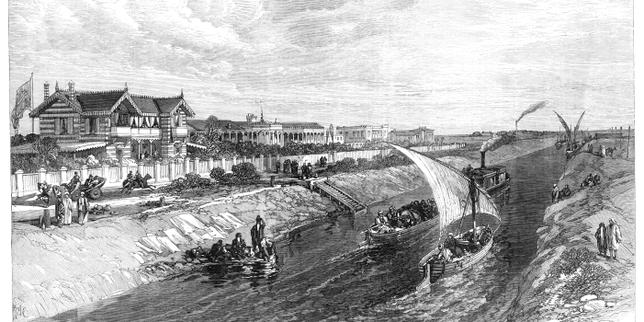
History books love a neat narrative. They tell you Ferdinand de Lesseps was a visionary diplomat who united oceans against the odds, carving the Suez Canal out of the desert through sheer force of French willpower and engineering brilliance. It is a comforting story. It is also complete garbage.
Strip away the romantic nationalist fluff, and you find a financial catastrophe, a monument to human rights abuses, and a geopolitical trap that France built entirely for itself before handing the keys to London on a silver platter. The standard telling frames the canal's early decades as a heroic French triumph overshadowed by British greed. That gets the reality backward. The French did not build an asset; they engineered a bankruptcy, sacrificed tens of thousands of Egyptian laborers on the altar of vanity, and left a debt bomb that forced a helpless nation into decades of foreign occupation.
If you want to understand why global supply chains remain fragile today, stop looking at modern logistics software. Look back at the mid-nineteenth century, when the ultimate infrastructure play was financed by raw coercion and marketed as international philanthropy.
The Myth Of The French Masterstroke
The lazy consensus among historians is that the Universal Company of the Maritime Canal of Suez was a triumph of private enterprise over British skepticism. Lord Palmerston opposed it, the narrative goes, because British sea power preferred the overland route, and narrow-minded fogies tried to stop a genius.
This is historical malpractice. Palmerston was not blind to progress; he understood basic math. The project made zero economic sense on conventional terms. It was heavily subsidized through forced labor—the corvée—and extracted from an already bankrupt Egyptian treasury via extortionate loans arranged by greedy Parisian bankers. De Lesseps was not an innovative engineer; he was a master marketer with deep connections to Napoleon III, treating a sovereign nation’s economy as his personal venture capital fund.
When you force peasants to dig sand with bare hands and teaspoons while withholding fresh water in the Sinai heat, you are not innovating. You are running a lethal labor camp under the banner of maritime unity. The human toll is rarely tallied in corporate histories, but an estimated twenty thousand Egyptian laborers died during the excavation phase. Calling this a French triumph ignores the blood ledger entirely.
The Bankruptcy Machine Disguised As Engineering
Let us look at the actual economics of the early operational phase. For decades, the canal operated as a cash sink before it became a cash cow. The initial capital subscriptions were drained by staggering cost overruns, administrative bloat in Paris, and the catastrophic collapse of the forced labor supply once international pressure forced a reluctant end to the corvée in 1864.
Egypt was forced to buy back shares it never wanted, take on ruinous European debt to compensate the canal company for lost labor rights, and ultimately surrender its financial sovereignty to Anglo-French debt controllers.
Imagine a scenario where a modern startup founder convinces a local government to build a highway, drains the municipal budget, kills a fraction of the local workforce, forces the city to borrow money at predatory rates to keep the lights on, and then sells out to a foreign competitor when the bills come due. We would call that a corporate crime syndicate. Yet in history curricula, it gets a plaque and a portrait.
The French did not master the desert. They mortgaged Egypt's future to line the pockets of Parisian bondholders, only to watch Benjamin Disraeli swoop in and buy the Khedive's shares in 1875 for Britain, securing imperial control of the shortcut to India. De Lesseps walked away with a fortune in prestige, while Egypt got seventy years of direct occupation. A brilliant strategy, if your goal is leaving a smoking ruin for someone else to police.
The Geopolitical Trap That Never Closed
The standard framing suggests Britain simply stole the prize through ruthless financial maneuvering. That ignores how easily the trap was sprung. France built a choke point and assumed control would naturally follow cultural prestige. They forgot a fundamental rule of infrastructure: whoever controls the financing controls the utility.
By treating the canal as a political project rather than a commercial enterprise governed by sound risk management, the French enterprise invited foreign intervention. The moment Said Pasha and his successor Ismail Pasha ran out of cash, the project became a hostage to European creditors. The Dual Control established by Britain and France in the 1870s was the direct consequence of financial recklessness.
When Egyptian nationalists under Ahmed Arabi tried to reclaim their country from foreign debt collectors in 1882, the British fleet bombarded Alexandria and occupied the country. The canal was the catalyst. It turned Egypt from an autonomous Ottoman province into a British protectorate.
We see this exact pattern repeat today in modern mega-infrastructure initiatives across developing economies. Mega-projects backed by foreign capital often serve as Trojan horses for long-term geopolitical leverage. The vocabulary changes from canal shares to debt-trap diplomacy, but the mechanics remain identical.
The Real Lesson Of Suez
The first age of the Suez Canal teaches us a brutal truth about large-scale engineering. If a project requires systemic human exploitation, predatory financing, and structural insolvency to get off the ground, it is not an achievement. It is a liability.
The French did not conquer the desert. They outsourced the suffering, inflated the balance sheet, and handed the keys to their greatest rival.
Stop romanticizing the pioneers of nineteenth-century engineering. They were financial arsonists playing with human lives, and the global economy has been paying the insurance deductible ever since.