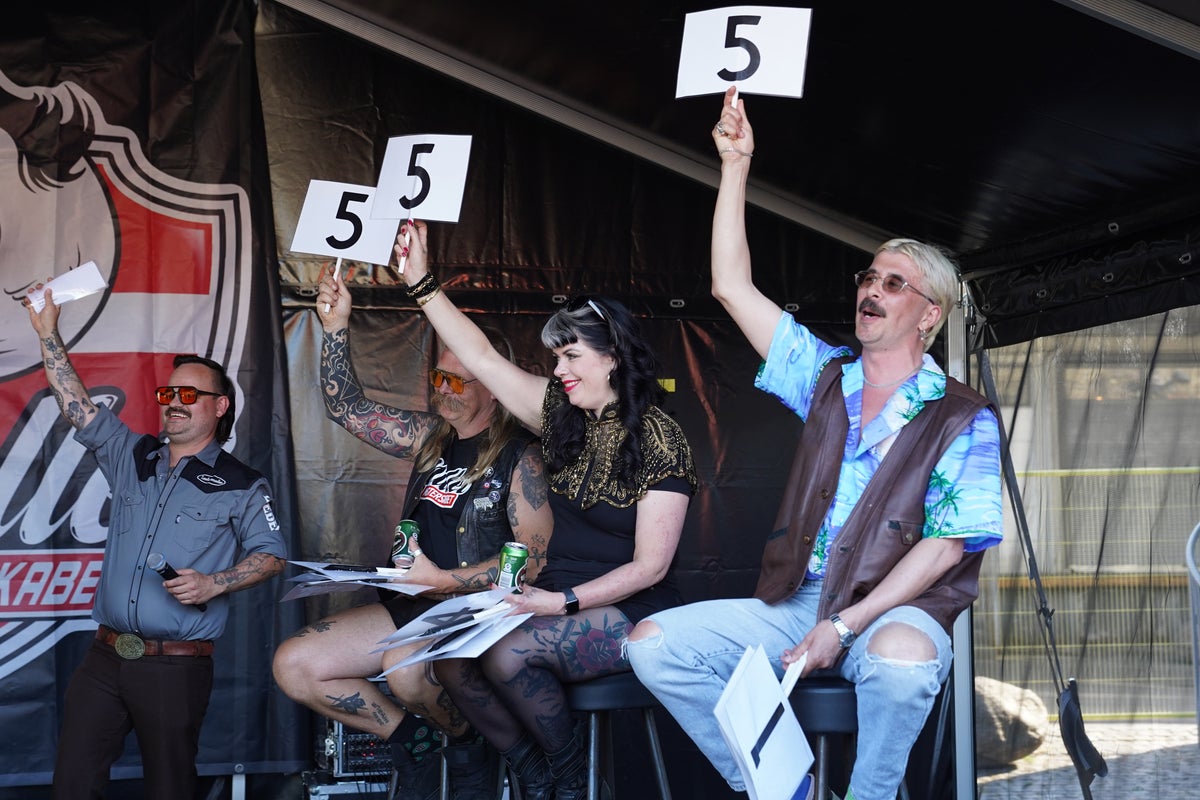
The crowds packed into the venue for Denmark’s 2026 Mullet Championship were not just cheering for bad hair. They were celebrating a calculated rebellion against Scandinavian minimalism. While casual observers view the resurgence of the business-in-the-front, party-in-the-back hairstyle as a ironic joke, the reality cuts much deeper. The mullet has transitioned from a punchline into a symbol of working-class defiance against the pristine, hyper-curated aesthetic that has dominated Nordic culture for over two decades.
To understand why hundreds of spectators gathered to crown the best locks in Denmark, you have to look past the superficial shock value. This is a deliberate rejection of "Hygge" capitalism. For years, the global perception of Danish lifestyle has been filtered through a lens of clean lines, muted pastel tones, and effortless sophistication. The mullet throws a wrench into that machinery. It is loud, asymmetrical, and intentionally disruptive.
The Economics of Aesthetic Rebellion
Hair is political, but more importantly, it is economic. The sudden explosion of competitive haircutting events across Europe signals a shift in how the public processes economic anxiety and class identity.
In Denmark, a nation praised for its high standard of living and social equality, an undercurrent of frustration has been brewing among the traditional working class. The gentrification of urban spaces in Copenhagen and Aarhus has brought with it an unspoken pressure to conform to a specific bourgeois standard. The minimalist look requires money. It demands expensive, sustainable fabrics and high-end salon visits that cost thousands of kroner.
The mullet, by contrast, is democratic. It can be cultivated in a local barbershop or chopped together in a friend's kitchen with a pair of household scissors.
By elevating this specific haircut to a championship level, participants are carving out a space where the rules of polite society do not apply. The judges at these events do not look for perfection. They look for audacity. The criteria focus on density, contrast, and the sheer confidence required to walk down a street with a mane that looks like a relic of 1982.
Demolishing the Hygge Myth
The mainstream media loves to frame these championships as lighthearted, quirky human-interest stories. They use words like "ugly-beautiful" to describe the aesthetic, treating the contestants like exhibits in a museum of the bizarre. This condescending framing misses the entire point of the movement.
The Rejection of Corporate Neatness
Corporate culture across the Nordic region has long enforced a dress code of invisible conformity. You are expected to fit in, to look neat, and to avoid drawing too much attention to your individual eccentricities.
The contestants at the 2026 championship represent the exact opposite of that philosophy. Many of them work in trades—construction, logistics, manufacturing—where the corporate gaze cannot easily reach them. For these individuals, the hairstyle acts as a badge of honor. It says that they are not beholden to the expectations of a white-collar office environment.
The Paradox of Irony
There is a fine line between genuine subcultural expression and corporate co-optation. Right now, the mullet occupies a strange middle ground.
- The Authentic Track: Working-class youth who adopt the style as a continuation of punk and rock traditions.
- The Hipster Track: Urban elites who wear the haircut ironically, discarding it the moment the trend loses its counter-cultural edge.
The Danish championship serves as a battleground between these two factions. The purest forms of the haircut always win, usually sported by individuals who have worn the style long before it became a trending topic on social media platforms. The judges can spot an ironic mullet from a mile away. It lacks the necessary grit.
How the Trend Spreads Across Borders
Denmark is not an isolated case. The phenomenon has been building momentum across Europe, with national championships popping up in France, Belgium, and Australia.
Each region infuses the event with its own local grievances. In Australia, the mullet is tied to the "bogan" identity, a term once used as a classist slur that has since been reclaimed by the public. In France, the championship serves as a middle finger to Parisian high fashion. The Danish iteration is unique because it directly challenges the concept of Janteloven—the cultural rule dictating that individual citizens should not think they are better or more special than the rest of society.
The mullet violates Janteloven fundamentally. You cannot wear this haircut and remain anonymous. You are forcing every passerby to make a conscious judgment about your character, your taste, and your background.
The Future of Subcultural Commodification
What happens when the mainstream fully absorbs the rebellion? We are already seeing signs of the fashion industry attempting to sanitized the mullet. High-end designers are featuring modified versions of the cut on runways, calling it the "wolf cut" or the "shag" to strip it of its working-class connotations.
This sanitization is the ultimate threat to the movement. Once a subculture becomes palatable to the masses, it loses its power to disrupt. The organizing committees behind these championships face a difficult choice. They can either lean into the commercial sponsorship deals currently being waved in front of them, or they can keep the events underground, gritty, and fiercely independent.
If the 2026 Danish championship proved anything, it is that the desire for raw, unpolished self-expression is stronger than ever. The roaring crowd in Denmark wasn't just cheering for hair; they were cheering for the right to be unappealing to the corporate eye. The moment these events start looking like polished marketing campaigns is the moment the true mullet dies. The preservation of its ugliness is its only salvation.