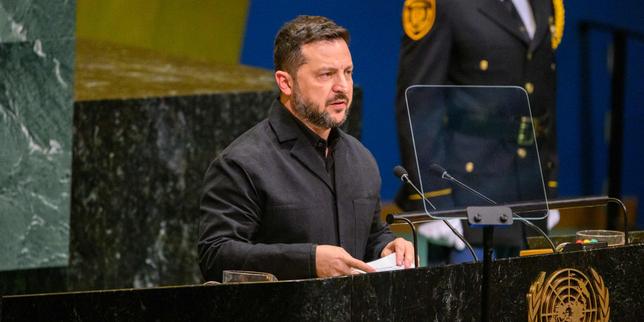
The marble floors of the United Nations General Assembly hall in New York have a very specific acoustic signature. When a diplomat walks across them in polished leather shoes, the sound is crisp, measured, and polite. It is the sound of paperwork, of carefully drafted resolutions, of men and women in tailored suits debating the fine print of international norms while drinking lukewarm coffee from paper cups.
Six thousand miles away, in a basement in Kharkiv, the sound is entirely different.
Let us imagine a woman named Olena. She is a hypothetical composite of thousands of real Ukrainians living through the fourth year of a grinding war of attrition, though the dust in her hair and the tremor in her hands are entirely real. For Olena, the acoustics of survival are defined by a low, guttural hum that vibrates in her molars before her ears even register it—the sound of a Shahed drone descending through the dark, or the hypersonic scream of a ballistic missile launched from an airfield across the Russian border, less than forty miles away.
Between the launch button in Belgorod and the shattering of Olena’s kitchen window, there are roughly forty-five seconds.
Forty-five seconds is not enough time to put on boots. It is barely enough time to grab a sleeping child from a crib and reach the interior hallway, the space between two load-bearing walls that Ukrainians have come to worship like a secular altar.
This is the invisible chasm that separated the man standing at the green marble podium in Manhattan from half the diplomats sitting in the plush blue seats before him. When Volodymyr Zelensky stepped up to the microphone at the United Nations to defend Ukraine’s cross-border strikes into Russian territory, he did not speak the sanitized dialect of international diplomacy. He did not talk about tactical degradation, logistical bottlenecks, or strategic deterrence.
He stripped the argument down to three words in French translation that echoed across the global press like a gunshot in a library.
Ne pas mourir.
Not to die.
The Architecture of an Unfair Fight
To understand why those three words caused such a tremor in the diplomatic corridors of New York, Paris, and Washington, you have to understand the terrifying geometry of modern warfare—and the strange, suffocating rules imposed upon the victim.
Imagine, for a moment, that you are locked in a small room with a man twice your size who is holding a heavy iron pipe. Every few minutes, he swings the pipe at your head. You have a shield, though it is battered and cracking at the edges. Outside the room, standing behind a thick glass window, are your neighbors. They want to help you. They pass you a short wooden stick through a slot in the door, along with a list of strict instructions.
You may use this stick to block his blows, the neighbors tell you. You may even strike his hands when he reaches inside your personal space. However, you must never, under any circumstances, reach past the threshold of his side of the room to knock the pipe out of his grip. That would be an escalation. That might make him angry.
For nearly three years, that hypothetical scenario was the literal operational reality of the Ukrainian Armed Forces.
While Russian bombers took off unmolested from airfields deep inside Russian territory—places like Engels, Morozovsk, and Kursk—and Russian artillery batteries parked comfortably just miles behind the border to flatten Ukrainian towns, Kyiv was bound by an invisible leash. Western allies, terrified that a strike inside Russia using donated weapons might trigger a wider, potentially nuclear confrontation, insisted that Ukraine fight with one hand tied behind its back.
The math of this arrangement was brutal and entirely one-sided. Russia possessed sanctuary. Ukraine possessed only targets.
When I first stood near the northern border of Ukraine during the winter blackouts, the absurdity of that sanctuary felt like a physical weight in the chest. You could stand in the freezing dark of a Ukrainian village where the electrical substation had been reduced to twisted, blackened copper by missiles fired from across the horizon, and you could literally see the warm, unbroken glow of streetlights on the Russian side of the line. Their trains ran on schedule. Their oil refineries hummed through the night, pumping the fuel that powered the tanks rolling toward Donbas. Their airbases operated like commercial airports, loading glide bombs onto Sukhoi jets with the leisurely efficiency of a logistics hub.
Meanwhile, Ukraine’s air defenses—miraculous as they were—were dying a death by a thousand cuts.
The Illusion of the Shield
There is a persistent, dangerous myth among people who watch wars from the safety of peaceful capitals. It is the belief that defense alone can save you.
In theory, an air defense system like the American Patriot or the European SAMP/T is a marvel of human engineering. It calculates trajectories at speeds that defy human comprehension, launching an interceptor missile to collide with an incoming warhead miles above the earth. Watching a successful interception at night looks like a sudden, silent star blooming in the black sky, followed seconds later by a thunderclap that rattles every windowpane for ten miles.
People see those bright flashes on their phone screens and feel reassured. The shield is working.
But shields break.
Think of air defense like trying to catch arrows shot at you from a forest. Even if you are the fastest archer-catcher in the world, eventually your hands will bleed, your arms will tire, and the man in the forest has an endless supply of wood. You cannot win a battle by catching arrows forever. The only way to survive is to walk into the forest and burn the workshop where the arrows are being made.
By the time Zelensky stood before the United Nations, the statistics of that arrow-catching contest had become unsustainable. Russia was launching thousands of drones and hundreds of cruise and ballistic missiles every single month. Each interceptor missile costs millions of dollars and takes months to manufacture in factories in Arkansas or Bavaria. A Shahed drone, assembled from commercial electronics and fiberglass in a converted factory in Tatarstan, costs roughly the price of a mid-sized sedan.
Worse still was the arrival of the glide bomb—massive, Soviet-era dumb bombs weighing up to three metric tons, fitted with cheap pop-out wings and a rudimentary satellite guidance kit. Released by Russian jets flying forty miles behind the front line, these monsters cannot be intercepted by traditional air defenses. They fall from the sky like meteors, capable of turning a nine-story apartment building into a crater of pulverized concrete in a fraction of a second.
When Zelensky looked out at the rows of diplomats at the UN, he was looking at people who were still debating the etiquette of how Ukraine was allowed to defend itself while Russian glide bombs were erasing entire cities like Vovchansk and Toretsk from the map.
"We want to survive," he told them, his voice raspy from exhaustion, stripped of the theatrical cadence he once used as an actor. "We want to live. And when we strike back at the bases from which death is launched at our children, we are told not to escalate. What could be a greater escalation than the destruction of our nation?"
The Shift in the Dark
So Ukraine stopped asking for permission to build its own arrows.
What happened next is one of the most extraordinary transformations in modern military history, born entirely out of desperation. Denied the long-range Western missiles needed to reach Russian airfields and oil infrastructure, Ukrainian engineers, software developers, and garage tinkerers went underground.
In abandoned Soviet factories, behind blackout curtains in Kyiv, and inside nondescript workshops in Lviv, a new kind of warfare was quietly assembled. They took light sport aircraft and gutted the cockpits, replacing the pilot with a flight computer and a belly full of high explosives. They designed sleek, delta-winged drones with names like Lyutyi—meaning "Fierce"—and Beaver, built from carbon fiber and powered by modified commercial engines.
And then, they sent them east.
The first times the explosions echoed across the Russian interior—at an oil depot in Belgorod, an airfield in Pskov, a refinery in Ryazan—the reaction in the West was a mixture of shock and nervous hand-wringing. Critics whispered that Kyiv was being reckless. They warned that striking inside Russia would harden Russian public opinion, unite the population behind Vladimir Putin, and provoke an unthinkable retaliation.
Listen closely to that argument, because it reveals a profound psychological blind spot.
It assumes that the aggressor is a delicate creature whose rage must be carefully managed, while the victim is an infinitely elastic sponge capable of absorbing endless trauma without breaking. It treats Russian aggression like a force of nature—a hurricane or an earthquake—that cannot be reasoned with, only appeased, while treating Ukrainian self-defense as a provocative political choice.
Zelensky’s speech at the UN was a direct demolition of that double standard.
When Ukrainian drones began striking Russian oil refineries hundreds of miles from the border, something remarkable happened. The war, which the Kremlin had carefully packaged for its domestic audience as a distant, heroic "special military operation" happening somewhere else, suddenly smelled like burning petroleum in the morning air of Russian cities.
Gasoline prices spiked. Air defenses had to be pulled away from the front lines in Ukraine to protect palaces, refineries, and airbases deep inside Russia. Russian bombers were forced to relocate hundreds of miles further east, reducing the number of sorties they could fly each day and giving Ukrainian soldiers on the ground precious hours of breathing room.
It was not revenge. It was physics. Every Russian air defense battery moved to protect a refinery in Samara was one less battery shooting at Ukrainian pilots over Zaporizhzhia. Every thousand tons of aviation fuel burned in a depot fire in Rostov was hundreds of glide bombs that would never fall on a hospital in Kharkiv.
The Moral Fog of Self-Defense
I will be honest with you: sitting in the quiet comfort of a study, thousands of miles away from the hum of drones, it is easy to feel uneasy about the expansion of any war. The fear of escalation is not irrational. Russia possesses the largest nuclear arsenal on earth, led by a man who has staked his entire political existence—and perhaps his life—on subjugating his neighbor. When Western leaders hesitate, when they agonize over every red line, they are carrying the terrifying weight of trying to prevent a global catastrophe.
We should not pretend those fears are imaginary. History is littered with conflicts that spiraled out of control because leaders miscalculated the pride and desperation of their adversaries. Look at July 1914, when a cascade of mobilization orders and rigid alliances dragged an entire continent into a meat grinder that nobody truly wanted.
Yet history also teaches a darker, colder lesson about what happens when the world demands restraint from the weak in order to pacify the strong.
In 1938, the leaders of Britain and France stood in Munich and convinced themselves that by forcing Czechoslovakia to surrender its border fortifications—its literal ability to defend itself—they had purchased "peace for our time." They believed they were managing escalation. In reality, they were simply dismantling the shield of a democratic nation so the aggressor could swallow it whole a few months later without breaking a sweat.
The diplomats at the United Nations know this history. The portraits of the founders who built that institution out of the ashes of World War II hang in the very hallways they walk through every day. The entire premise of the UN Charter—specifically Article 51—is the inherent, sacred right of individual or collective self-defense if an armed attack occurs against a member state.
Notice that Article 51 does not include a footnote saying, Self-defense is valid only up to the internationally recognized border of the aggressor, after which you must politely stop and allow them to reload.
When Zelensky stood before the assembly and defended Ukraine’s strikes inside Russia, he was holding up a mirror to the institution’s own founding document. He was asking a simple, devastating question: If a nation does not have the right to destroy the weapons aimed at its own heart before they are fired, then what does the right to self-defense actually mean?
What Remains When the Speeches End
There is a strange loneliness to being a wartime leader on a global stage. You become a walking reminder of things comfortable people would rather forget.
In the first year of the invasion, Zelensky was treated like a rock star in Western capitals—a Churchill in an olive-drab sweatshirt, an effortless symbol of courage that made everyone who applauded him feel noble by association. By the fourth year, the applause had grown shorter, more polite, tinged with the subtle fatigue that always sets in when a crisis refuses to resolve itself neatly.
War is messy. It does not stay inside clean moral boxes. When a country fights for its survival, its actions become harder, sharper, less palatable to those who prefer their heroes to remain purely passive victims.
A passive victim is easy to love. A passive victim weeps in the rubble, accepts blankets and humanitarian aid, and never forces you to confront your own fear of the bully.
A fighting survivor is much more complicated. A fighting survivor builds long-range drones in basements, crosses borders into Kursk, blows up ammunition depots in the middle of the Russian night, and looks you dead in the eye at the United Nations to tell you that he will do whatever it takes not to bury another generation of his people.
Think back to Olena in that basement in Kharkiv, counting the seconds in the dark, listening to the concrete ceiling groan above her head.
She does not care about diplomatic communiqués. She does not care about the subtle distinctions between tactical escalation and strategic ambiguity. She knows only one truth, a truth that is older than treaties, older than borders, older than the glass tower on the East River.
If the man holding the iron pipe never feels the sting of the stick, he will never stop swinging.
Eventually, the speeches at the United Nations ended. The translators took off their headsets. The delegates gathered their leather briefcases, stepped out onto First Avenue into the crisp autumn air of Manhattan, and hailed yellow cabs to take them to dinner.
Thousands of miles away, night fell over eastern Europe. Somewhere in the dark, an engine coughed to life on a hidden airstrip, a small carbon-fiber silhouette lifted off into the freezing wind, and the long, desperate math of staying alive began all over again.



