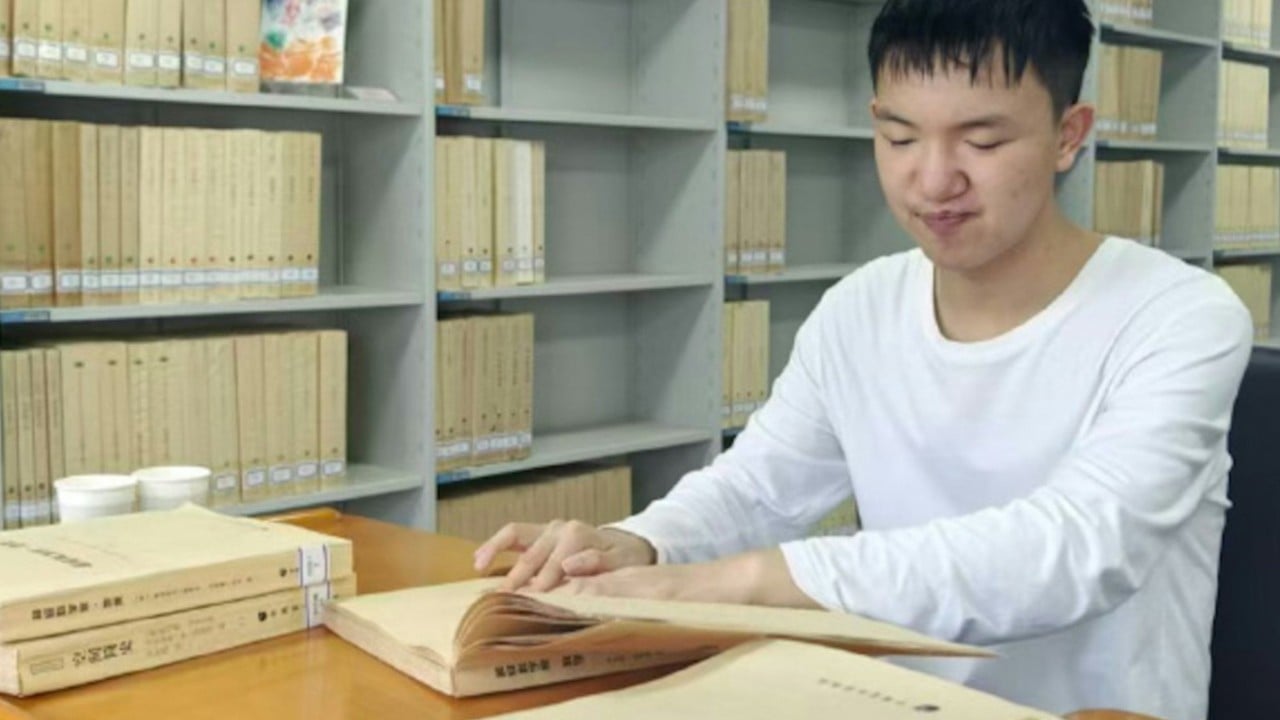
The feel-good media engine loves a triumph-over-adversity narrative. You have likely seen the headlines celebrating the blind Chinese teenager who aced the grueling gaokao college entrance exam and immediately announced plans to study medicine. The internet wept tears of pure joy. Social media commentators praised the pure altruism of "passing on the warmth."
It is a beautiful story. It is also an incredibly naive way to look at the brutal reality of medical training and healthcare infrastructure.
When we treat the deeply flawed, highly exclusionary system of medical education as a stage for heartwarming human-interest stories, we fail both the students and the patients. We substitute systematic critique with cheap sentimentality. The lazy consensus insists that pure willpower and a noble heart are enough to conquer any structural barrier. They are not. If we truly care about accessibility and healthcare outcomes, we need to stop applauding the miracle and start questioning the machinery.
The Gaokao Illusion and the Reality of Medical Training
The gaokao is a monument to standardized testing. It measures a specific kind of academic endurance, memory retrieval, and high-pressure performance. Scoring exceptionally well while navigating a system designed almost entirely for sighted individuals is an undeniable feat of individual brilliance. But crushing a written exam is not the finish line; it is merely the gate.
Medical school is not a reading seminar. It is a grueling, tactile, visual, and spatial crucible.
Consider the fundamental mechanics of medical training. Anatomy labs require the precise identification of microscopic structures, nerve pathways, and tissue variations. Diagnostic imaging—interpreting X-rays, CT scans, and MRIs—is inherently visual. Surgical rotations demand split-second physical interventions based on visual cues.
To pretend that a high test score automatically translates into a viable path through a traditional medical curriculum is a disservice to the student. When institutions rush to accept a student for the positive public relations buzz without fundamentally overhauling their pedagogical tools, they set that student up for an uphill battle against an unyielding curriculum.
The Danger of the "Altruism Trap"
The competitor narrative leans heavily on the idea that this student is choosing medicine solely to "pay it forward" and help others. This is the Altruism Trap, and it is rampant across the healthcare industry.
We systematically socialise young people to believe that medicine is a calling that requires total self-abnegation. We expect doctors to be saints. When we tie a student's worth to their desire to suffer for the greater good, we mask the systemic flaws of the profession:
- Extreme burnout rates that begin as early as the second year of medical school.
- A culture of toxic perfectionism that penalises vulnerability or mental health struggles.
- An administrative burden that forces modern physicians to spend more time looking at electronic health record software than looking at patients.
Choosing a career in medicine based on a romanticised notion of giving back is dangerous. Intentions do not read charts at 3:00 AM after a 28-hour shift. Competence, systemic support, and institutional resources do. By focusing entirely on the emotional narrative of the "noble choice," the mainstream media ignores the structural grind that chews up well-meaning students and spits out cynical, exhausted graduates.
Accommodations are Not a Favor
When universities admit students with severe visual impairments into highly demanding STEM fields, the public reaction usually centers on how "generous" or "progressive" the school is. This mindset is entirely backwards.
True accessibility is not an act of charity. It is a rigorous, expensive, and legally mandated engineering problem.
If a medical school accepts a blind student, they cannot simply hand over a braille textbook and call it a day. They must fundamentally redesign how clinical medicine is taught.
Imagine a scenario where a medical school invests millions in tactile anatomical models, advanced audio-descriptive diagnostic software, and dedicated clinical assistants who serve as the student's eyes during rounds. This is what real inclusion looks like. It is concrete, costly, and difficult.
Yet, most universities under-resource these departments. They rely on the sheer grit of the disabled student to bridge the gap, effectively forcing them to work twice as hard as their peers just to achieve parity. When the student succeeds, the university takes the credit for being "inclusive," despite having done the bare minimum.
Dismantling the Premium on Purely Visual Medicine
Here is the counter-intuitive truth that the mainstream media completely missed: the medical establishment is stubbornly, unnecessarily obsessed with sight.
We live in an era of rapidly accelerating technological integration. AI-driven diagnostic tools can translate visual data into auditory or text-based reports with staggering speed. Digital stethoscopes can convert heart murmurs into visual waveforms or amplified, filtered audio tracks. Telemedicine and automated triaging are shifting the locus of care.
The problem isn't that a blind student cannot practice medicine. The problem is that the medical system refuses to evolve past the 20th-century archetype of the physician who relies solely on their own eyes and a physical chart.
A visually impaired medical student forces us to ask a much better question: Why are we still training doctors as if technology does not exist?
If we restructured medical education to emphasize cognitive synthesis, communicative empathy, and data interpretation over raw visual inspection, we wouldn't just accommodate disabled students—we would build better doctors across the board. We would create a system where a physician's value is derived from their analytical mind, not just their sensory organs.
The Brutal Truth About Patient Outcomes
Let us address the question that everyone thinks but nobody wants to say out loud: Would you want a blind doctor treating you in an emergency?
The instinctual, gut-reaction for many is a quiet, uncomfortable "no." And under the current, broken system of medical training, that fear is logical. If a doctor is thrown into a chaotic ER designed exclusively for sighted people, without the necessary technological infrastructure, patient safety is compromised.
But that is a failure of design, not a failure of the individual.
A visually impaired physician can be an extraordinary asset in specialities like psychiatry, neurology, internal medicine, or rehabilitative care, where diagnostic reasoning, deep listening, and systemic analysis are paramount. By forcing every single medical student through the exact same rigid, generalist pipeline—regardless of their specific physical abilities or career goals—we lock out brilliant minds who could revolutionize specific subfields of healthcare.
The mainstream media wants you to feel warm and fuzzy about a blind teenager beating the odds. You shouldn't. You should feel angry that the odds are stacked so absurdly high in the first place, and that our medical institutions are so painfully slow to adapt to the realities of the modern world. Stop cheering for individual miracles and start demanding systemic evolution.
:max_bytes(150000):strip_icc()/parts-of-a-swamp-cooler-2718628-a477e6f0787b4f8bb62ddf2def31d495.png)