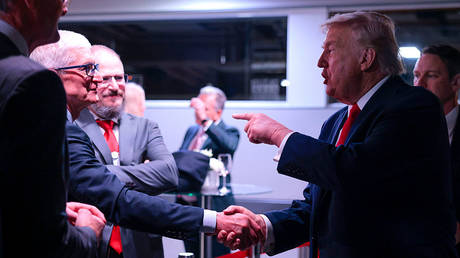
The relationship between Donald Trump and Tim Cook represents a definitive case study in asymmetric negotiation and the strategic management of regulatory risk. While media narratives often focus on the performative aspects of their interactions—specifically the "Tim Apple" naming incident—these surface-level events mask a sophisticated operational strategy. This strategy centers on the preservation of a global supply chain during a period of intense protectionist volatility. To analyze this dynamic, one must look past the anecdotes to the underlying economic incentives and the specific levers of influence Cook utilized to secure exemptions from the Section 301 tariffs.
The Strategic Architecture of Corporate Immunity
The success of Apple’s lobbying efforts during the Trump administration was not a byproduct of personal affinity, but rather a masterclass in regulatory arbitrage. Cook recognized that the administration’s primary metric of success was domestic job creation and the optics of "America First" manufacturing. By aligning Apple’s corporate objectives with these political KPIs, Cook shifted the conversation from trade deficits to national competitiveness.
The Access-Compliance Feedback Loop
Cook’s method for maintaining access to the Executive Branch relied on three distinct operational pillars:
- Direct Channel Calibration: Unlike other Big Tech CEOs who relied on legal teams or lobbyists, Cook engaged directly. This eliminated the signal-to-noise ratio inherent in traditional government relations. By appearing in person at the White House or the Mac Pro assembly plant in Austin, Cook provided the administration with the high-visibility "wins" they required.
- Narrative Mirroring: Cook adopted the administration’s vernacular regarding manufacturing, even when the underlying data suggested that Apple’s primary value add remained in design and software—high-margin sectors that do not require physical assembly lines in the U.S.
- Optic-Heavy Investments: The $350 billion contribution to the U.S. economy announced by Apple in 2018 served as a pre-emptive strike against regulatory scrutiny. While much of this figure comprised existing spending and tax payments on repatriated cash, the headline served its purpose as a political shield.
The Economics of the "Tim Apple" Naming Convention
The "Tim Apple" incident is frequently cited as a gaffe, yet its utility in the context of brand positioning within a populist framework is undervalued. For a President who views entities through the lens of their primary stakeholder, the conflation of the CEO with the corporation is a logical endpoint.
From a behavioral economics perspective, the acceptance of this moniker by Cook was a low-cost, high-reward concession. In a negotiation, conceding on matters of ego or nomenclature while holding firm on substantive policy—such as the exclusion of the iPhone from the 15% tariff list—is an optimal outcome. The cost of a social media meme is negligible; the cost of a 15% price hike on a flagship hardware product is catastrophic for volume and market share.
Quantifying the Tariff Exemption Framework
The primary threat to Apple’s bottom line was the imposition of tariffs on Chinese-made electronics. To mitigate this, Apple utilized a specific logical framework to argue for exclusions. This framework bypassed emotional appeals and focused on the Competitive Parity Principle.
Apple argued that imposing tariffs on their products would effectively penalize a domestic champion while subsidizing foreign competitors like Samsung, which has significant manufacturing operations in South Korea and Vietnam. This created a logical trap for an administration focused on "winning" against foreign entities. If the policy intended to hurt China actually benefited a South Korean conglomerate at the expense of an American icon, the policy was failing its stated goal.
The Cost-Benefit Calculus of Austin, Texas
The 2019 tour of the Mac Pro assembly plant in Texas was the physical manifestation of this strategy. The Mac Pro is a low-volume, high-margin product. Assembling it in the U.S. is a viable operational choice because the labor cost as a percentage of the total MSRP is minimal compared to the iPhone.
- iPhone Assembly: High volume, tight margins, massive labor requirement.
- Mac Pro Assembly: Low volume, high margins, automated/niche labor requirement.
By showcasing the Mac Pro plant, Cook provided the visual proof of "American manufacturing" without disrupting the high-efficiency, China-centric supply chain required for the iPhone. This is the Tokenism of Production—using a specific, visible subset of operations to protect the broader, more vulnerable whole.
The Fragility of Personalist Diplomacy
The limitation of the Cook-Trump model is its reliance on the individual rather than the institution. This creates a single point of failure in corporate strategy. When diplomatic relations are tied to the specific rapport between a CEO and a Head of State, the corporation becomes vulnerable to political turnover.
The transition to the Biden administration required a complete pivot in Apple’s lobbying language, moving from "manufacturing and trade" to "climate change and privacy." This shift demonstrates that the "Tim Apple" era was not a permanent change in Apple’s DNA, but a tactical mask worn to navigate a specific regulatory environment.
The Mechanism of Selective Memory in Political Rhetoric
Recent recollections of these interactions by Donald Trump serve a specific political purpose: reinforcing the narrative of the "Dealmaker." By describing the deference of a high-profile CEO, the political actor validates their own status as the ultimate arbiter of corporate success.
For the analyst, the truth of whether Cook "kissed ass" is irrelevant. What matters is the utility of the perception. If the President believes he has won a social or psychological victory, he is more likely to grant the policy concessions the corporation seeks. This is the "Ego-for-Equity" trade. Cook traded social capital and personal branding for billions of dollars in avoided tariff costs.
Strategic recommendation for Global Hardware Entities
In an era of rising nationalism and fragmented global trade, the "Apple Model" of executive diplomacy remains the gold standard for risk mitigation.
- Isolate the Principal: The CEO must be the primary point of contact for volatile leaders to ensure clear communication and to offer the leader the prestige of "peer-to-peer" negotiation.
- Map Political KPIs to Corporate Needs: Identify the specific metrics the administration uses to define success (e.g., job numbers, trade balance) and frame corporate requests as the primary way to achieve those metrics.
- Concede on Optics, Hold on Fundamentals: Accept labels, participate in staged events, and allow the political actor to claim "victory" in exchange for substantive regulatory relief or tax advantages.
- Maintain Operational Flexibility: Use low-volume product lines as "sacrificial lambs" for domestic manufacturing to protect the high-volume, offshore supply chains.
The objective is never to "win" a public debate or maintain a specific image among the intelligentsia. The objective is to ensure that the $2 trillion market cap remains unencumbered by the whims of protectionist policy. Cook’s performance was not a lapse in dignity; it was a clinical execution of corporate survival.