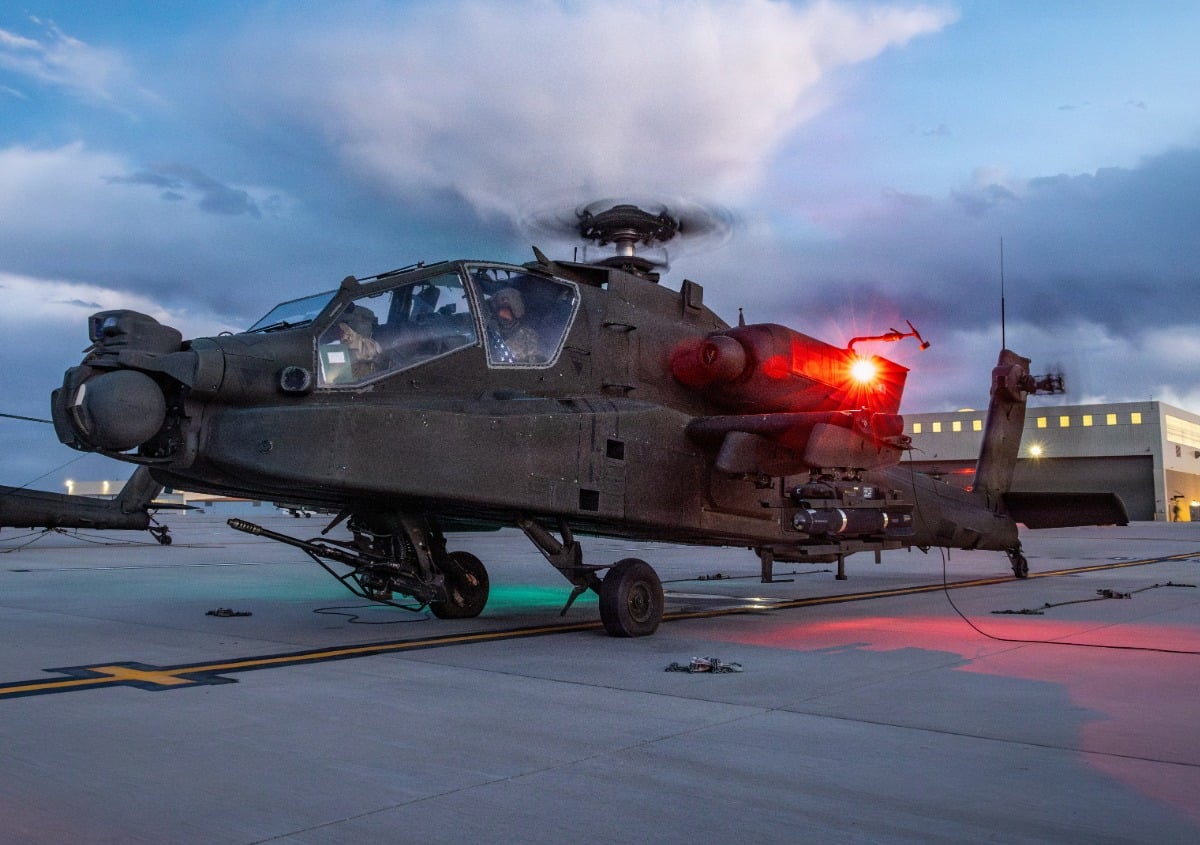
Lockheed Martin has finalized a $502 million contract to sustain and modernize the foundational sensor suites of the U.S. Army AH-64 Apache attack helicopter fleet. This massive capital allocation targets the Modernized Target Acquisition Designation Sight and Pilot Night Vision Sensor system, colloquially known to military pilots as the eyes of the Apache. Without these advanced optical and infrared components, the world's most formidable attack helicopter is rendered entirely ineffective in dark or obscured environments. The newly secured funding guarantees that over a thousand global airframes remain operationally viable amid shifting global threat environments.
Yet, this massive transaction exposes a deeper reality within modern defense procurement. Winning a high-profile hardware bid is merely the point of entry for defense primes. The true financial engine lies in long-term sustainment contracts.
The Hidden Economics of Military Sensor Dominance
Modern combat aviation dictates that structural durability matters little if an aircraft cannot see through smoke, dust, and complete darkness. The system in question, the M-TADS/PNVS, integrates forward-looking infrared sensors, day television cameras, and laser rangefinders. These elements slave directly to the pilot’s helmet tracking system, projecting thermal and optical imagery directly onto a monocle over the crew member's eye.
The primary driver behind this $502 million deal is not the production of brand-new sensors, but rather the defense infrastructure known as Performance Based Logistics. Under traditional defense contracts, the military pays for individual parts and repairs as they break. Performance Based Logistics upends this convention by forcing defense contractors to meet specific system readiness metrics instead.
If an Apache unit anywhere in the world cannot fly because a sensor module fails, the financial penalty falls squarely on the contractor. Consequently, Lockheed Martin utilizes this half-billion-dollar injection to maintain a worldwide supply chain of line-replaceable modules. This structure relies on rapid-turnaround depot maintenance rather than overhauling entire units in the field.
Financially, this shifts the dynamic of defense manufacturing. The original production run of a military sensor package generates a predictable, one-time spike in revenue. The decades-long tail of keeping those components functioning generates a reliable, multi-billion-dollar recurring cash stream.
Technical Vulnerabilities of High Altitude Night Vision
Maintaining operational readiness for electro-optical pods involves a constant battle against physical degradation. The turret assembly sits on the nose of the helicopter, completely exposed to extreme vibrations, atmospheric moisture, and abrasive desert sands.
The Problem of Environmental Abrasion
When an Apache flies at low altitudes in arid environments, the rotor wash kicks up thousands of micro-particles. These particles strike the sapphire window lenses of the forward-looking infrared system at hundreds of miles per hour. Over time, this creates micro-abrasions that scatter light waves and degrade image resolution.
To combat this, a significant portion of this contract focuses on the deployment of upgraded turret designs. The newest hardware iterations incorporate more durable stabilization motors and advanced optical coatings designed to withstand structural stress.
Resolving the Digital Video Bottleneck
Older versions of the Apache targeting sight relied on legacy analog video routing. Analog signals are notoriously susceptible to electromagnetic interference from the helicopter's own radios and weapon systems. This frequently caused image jitter or static at critical moments during a targeting sequence.
The current modernization standard replaces these aging pathways with fiber-optic digital architecture. By switching to high-definition digital streams, pilots can identify vehicle models and personnel identifiers at twice the distance of legacy systems. This increased standoff capability keeps the helicopter outside the effective range of shoulder-fired anti-aircraft missiles.
Global Supply Chains and the Foreign Military Sales Pipeline
The $502 million contract does not exist within an American vacuum. The Pentagon frequently aggregates domestic support requirements with Foreign Military Sales allocations to lower the unit cost for all participating nations.
+--------------------------+----------------------------------+
| Recipient Nation         | System Integration Target        |
+--------------------------+----------------------------------+
| United States Army       | Fleet-wide M-TADS/PNVS Support   |
| Poland                   | Gen 4 Architecture Baseline      |
| Egypt                    | Remanufactured E-Model Upgrades  |
+--------------------------+----------------------------------+
As European and Middle Eastern nations aggressively update their rotary fleets, they must adhere to the same technical baselines established by the U.S. Army. Poland's recent acquisition of the AH-64E Apache, for example, directly ties into this sensor ecosystem. By expanding the global user base, the industrial base achieves economies of scale that protect domestic supply chains from component obsolescence.
A major challenge for defense logistics teams is finding replacements for microchips that commercial manufacturers stopped making ten years ago. The massive scale of this sustainment fund gives the primary contractor the capital required to purchase lifetime bulk buys of sensitive semiconductor components, preventing parts shortages from grounding active line units.
The Operational Reality of Modernized Day Sensors
The integration of the Modernized Day Sensor Assembly directly alters how ground operations unfold. Early iterations of the Apache relied on direct-view optics, requiring the co-pilot gunner to peer through an optical relay tube like a submarine periscope.
"The removal of physical optical tubes in favor of pure electronic multi-purpose displays changed combat coordination fundamentally."
Modern electronic systems display color imagery alongside near-infrared streams. This allows crews to spot laser pointer markers from ground troops instantly, removing the communication delays that historically plagued close air support missions.
However, this reliance on software-driven target tracking introduces a heavy burden on software maintenance. A substantial portion of every modern defense dollar funds continuous code updates, patch deployments, and cybersecurity hardening against potential electronic warfare threats.
The half-billion-dollar contract proves that in modern warfare, software and optical maintenance are just as critical as ammunition production. The military cannot fight if it cannot see.