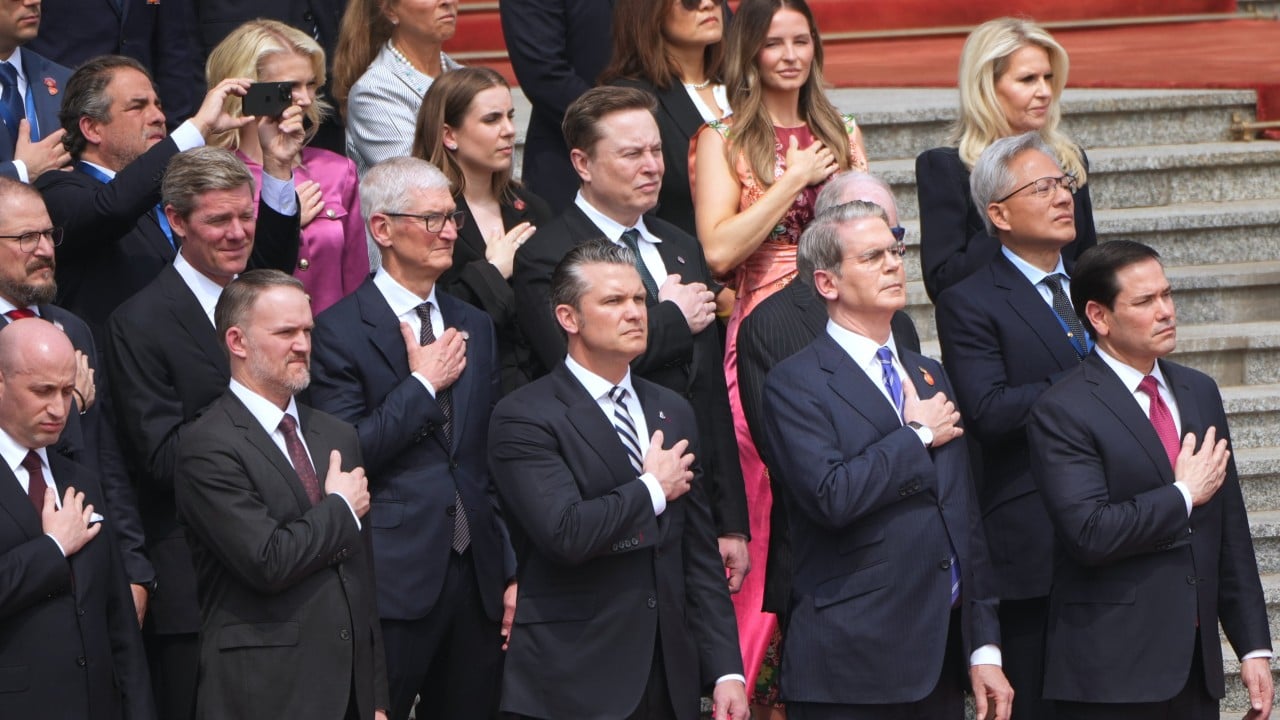
You don't fly the masters of the tech universe across the Pacific just for a photo op. When Donald Trump touched down in Beijing for his high-stakes summit with Chinese President Xi Jinping, he didn't just bring diplomats. He packed Air Force One with a corporate entourage worth nearly a trillion dollars, featuring Tesla's Elon Musk, Apple's Tim Cook, and Nvidia's Jensen Huang.
The immediate headlines focused on the classic Art of the Deal theatre. Trump quickly announced that China verbally committed to buying 200 Boeing jets and ramping up soybean purchases. But look past the standard political victories. The real story here isn't agricultural exports or commercial aircraft. It's about drawing the new battle lines for global technology dominance, specifically artificial intelligence and semiconductor manufacturing.
Trump brought America's tech elite to Beijing because the economic cold war has shifted from steel tariffs to computing power. The White House wanted to use these CEOs as leverage, while the executives desperately needed to protect their single biggest manufacturing hub and consumer market. It is a dangerous balancing act.
The Trillion Dollar Leverage Play
For years, Washington and Beijing have exchanged heavy blows over trade. The administration previously squeezed China with massive tariffs, hitting up to 125% on certain imports. Yet, despite the aggressive rhetoric, American tech giants remain completely dependent on Chinese supply chains and consumers.
Bringing figures like Cook, Musk, and Huang directly into a bilateral government meeting wasn't a standard diplomatic itinerary choice. Trump explicitly noted that he dragged these executives into his scheduled talks with Xi because he wanted to show the Chinese government exactly what American innovation looks like, and what China risks losing if relations completely fracture.
The administration wants to force China to open its markets to American corporations on friendlier terms. By putting Apple, Nvidia, and Qualcomm in the room, Trump dangled the ultimate carrot. He basically told Xi that American tech giants are ready to do business, but only if Beijing plays by Washington's rules on intellectual property and market access.
What the CEOs Are Actually Buying
The executives didn't hop on a 14-hour flight just to support the administration's trade agenda. They have their own fires to put out. Each tech leader in that room represents a company facing an existential crisis regarding its relationship with China.
Take Jensen Huang. Nvidia is the undisputed king of artificial intelligence hardware. Yet, federal export controls have severely crippled its ability to sell high-end chips like the H200 to Chinese firms. Huang's presence in Beijing, seated at a state dinner alongside Chinese tech executives like Xiaomi's Lei Jun and ByteDance's Liang Rubo, underscores a desperate corporate mission. Nvidia needs Washington to loosen the leash on commercial tech sales so it doesn't lose billions in potential revenue from Chinese tech giants building their own AI frameworks.
Then there's Tim Cook. Apple relies heavily on Lens Technology, a massive Chinese manufacturing firm chaired by Zhou Qunfei. Interestingly, Zhou was seated directly between Cook and Elon Musk at the state banquet. That seating arrangement tells you everything you need to know. Cook needs to keep Chinese factories humming to ensure iPhone production remains stable, even as Apple attempts to diversify into India and Vietnam.
Musk occupies an even more complicated position. He serves as an informal adviser to Trump while simultaneously running Tesla, which relies on its Shanghai Gigafactory for a massive chunk of its global vehicle production. Musk is attempting to act as a geopolitical bridge, trying to keep the peace so Tesla can survive the intensifying global electric vehicle war.
The AI Guardrail Smoke Screen
During his return flight on Air Force One, Trump told reporters that the two nations discussed creating shared rules for artificial intelligence. He mentioned establishing standard guardrails to keep the tech safe.
Don't buy the altruistic talk about AI safety. This isn't about protecting humanity from rogue algorithms. It's about establishing a regulatory framework that determines who gets to sell AI technology to whom. As billionaire investor Dan O'Leary pointed out during the summit, the nation that commands the best AI will inevitably command the best medicine, the best education, and the most advanced military defense.
The discussion of guardrails is a calculated chess move. If the US and China can agree on basic regulatory boundaries, it creates a predictable legal environment. This allows companies like Nvidia, Qualcomm, and Micron to resume shipping specific tiers of commercial silicon to Chinese buyers without fearing a sudden, total export ban from Washington.
Moving Past the Verbal Deals
We've seen this movie before. During Trump's 2017 state visit to China, Beijing promised a massive $84 billion investment in West Virginia shale gas that ultimately failed to materialize. Verbal commitments at a state banquet are cheap; binding contracts are expensive.
If you're tracking the true impact of this Beijing summit, stop watching the political speeches and start monitoring these specific metrics over the next few months:
- Export Control Revisions: Watch for the Department of Commerce to issue specific license exceptions for commercial-grade AI chips. If Nvidia suddenly gets the green light to sell altered versions of its hardware to Chinese tech firms, the Beijing trip was a massive success for Silicon Valley.
- Supply Chain Retaliation: Keep an eye on China's ministry of commerce regarding rare earth minerals like neodymium and indium. If Beijing eases its strict export restrictions on these critical elements, it means Trump's corporate entourage successfully de-escalated the electronics supply bottleneck.
- Corporate Investment Inflows: Track whether financial giants like BlackRock and Citigroup, whose CEOs also attended the trip, secure broader regulatory approval to operate inside China's domestic wealth management sectors.
The Beijing summit proved that you cannot separate modern American geopolitics from Silicon Valley corporate interests. Trump didn't bring tech leaders to China out of a sudden love for Big Tech; he brought them because they are the most potent weapons in America's economic arsenal.


