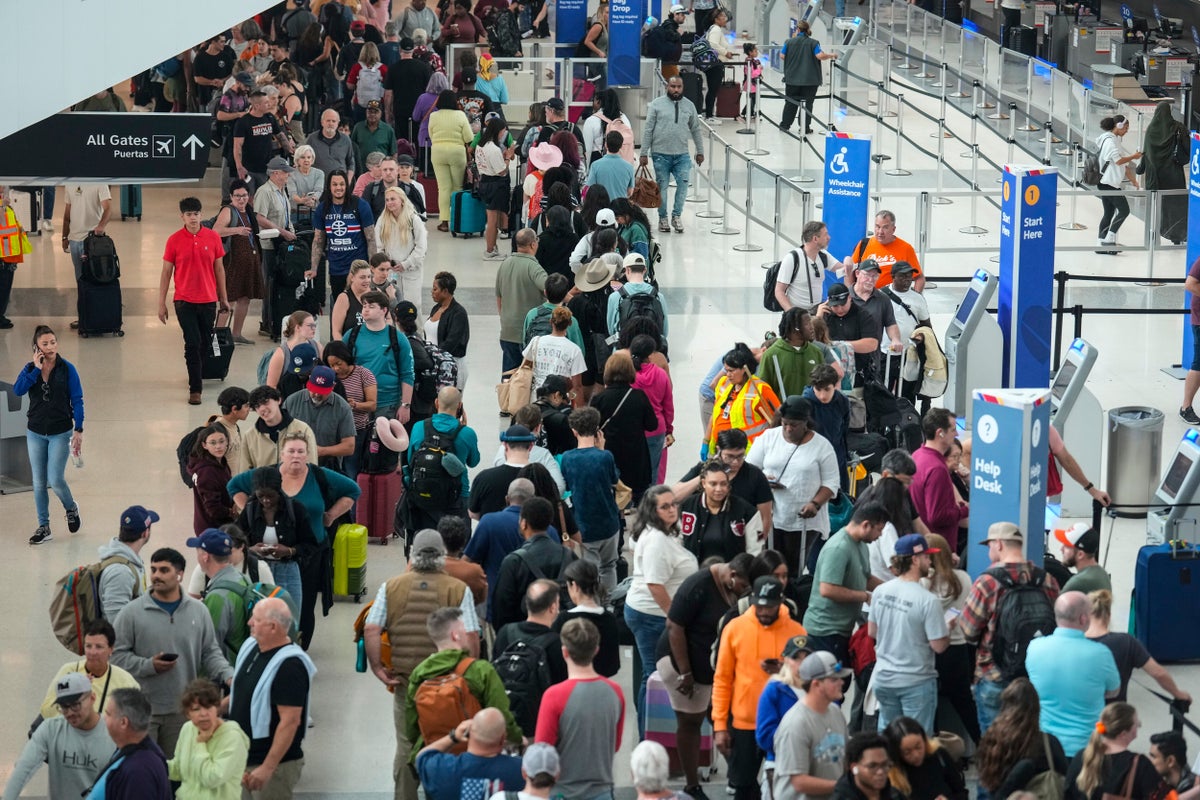
The recent departure of 300 Transportation Security Administration (TSA) officers is not a localized HR friction point; it is a systemic failure in the aviation throughput model. When airline CEOs sound an alarm, they are reacting to a degradation in the "effective capacity" of the national airspace system. In high-volume logistics, the total capacity of a network is governed by its narrowest constraint. For the modern traveler, that constraint is no longer the availability of aircraft or the speed of the jet engine, but the processing rate of the security checkpoint.
The Mathematics of the Security Bottleneck
To understand why the loss of 300 officers triggers an industry-wide crisis, one must quantify the relationship between staffing levels and passenger flow. Security screening operates as a stochastic queuing system. The arrival of passengers is non-linear—peaking in early morning and late afternoon "banks"—while the service rate (the speed at which TSA officers can process individuals) is largely fixed by technology and regulatory protocol.
A 1% reduction in front-line staff does not lead to a linear 1% increase in wait times. Because queuing systems follow the principles of Kingman’s formula, as the system utilization approaches 100%, wait times increase exponentially. When a checkpoint loses the staff required to operate even one additional lane during a peak period, the "back-pressure" builds into the terminal, causing missed connections, delayed departures, and a cascading failure of the airline’s daily schedule.
Three Pillars of the TSA Workforce Crisis
The current instability rests on three structural pillars that make the TSA uniquely vulnerable to labor shocks compared to the broader private sector.
1. The High-Friction Onboarding Cycle
Unlike a retail environment where a new hire can be functional within days, a TSA officer must undergo rigorous federal background checks, medical evaluations, and standardized training at the Federal Law Enforcement Training Center (FLETC). This creates a "lag-to-lead" time of several months. When 300 officers quit, the system cannot "hire its way out" of the deficit for two full fiscal quarters. The result is a persistent gap where demand for travel outstrips the government's ability to certify the labor required to facilitate it.
2. The Asymmetry of Stress and Compensation
TSA officers operate in a high-stakes environment where the cost of a "False Negative" (failing to detect a threat) is catastrophic, while the "False Positive" (additional screening) creates consumer hostility. This cognitive load is rarely balanced by the GS-level pay scales, which often lag behind private-sector logistics roles at companies like Amazon or FedEx. When the labor market tightens, the opportunity cost of staying at the TSA becomes too high for the average officer, leading to the "alarm" sounded by CEOs who recognize that their multibillion-dollar fleets are being grounded by $20-an-hour labor shortages.
3. The Lack of Surge Capacity
Private corporations maintain "slack" in their systems or use price signals (surge pricing) to manage demand. The TSA has no such mechanism. It is a rigid, centralized service. When 300 officers leave, there is no "reserve" force to deploy. This lack of elasticity means that the only way to manage the shortage is to reduce the quality of the service—either through longer lines or by diverting resources from smaller regional airports to major hubs, which creates a secondary crisis in rural connectivity.
The Cost Function of Security Delays
Airlines do not care about long lines merely because they are inconvenient for passengers. They care because of the "Downstream Economic Ripple."
- Fuel Burn and Gate Management: If a flight is held for 15 minutes to accommodate 20 passengers stuck in security, the airline loses its "slot" at the destination airport. This results in "ground delay programs" that cost thousands of dollars per minute in wasted fuel and crew timing-out.
- The Re-accommodation Tax: When a passenger misses a flight due to security delays, the airline is often forced to re-book them. This displaces "revenue-generating" seats on the next flight, effectively costing the airline the full price of a ticket plus the logistical overhead of handling the stranded traveler.
- Brand Erosion and Direct Demand Reduction: If the "perceived cost" of travel (time plus stress) exceeds the "utility" of the trip, discretionary travelers opt for video conferencing or driving. This shrinks the total addressable market for the aviation industry.
Technological Displacement vs. Human Necessity
There is a common misconception that automation can solve the staffing crisis. While Computed Tomography (CT) scanners and biometrics improve the "service rate" per officer, they do not eliminate the need for a human presence. Current FAA and DHS regulations require a specific ratio of officers to active lanes for bag searches, pat-downs, and document verification.
Technological implementation actually increases the "technical debt" of the TSA in the short term. New machines require new training protocols, which further pulls veteran officers away from the front lines to serve as instructors. Consequently, the "tech-fix" often exacerbates a labor shortage before it relieves it.
Structural Vulnerabilities in the Hub-and-Spoke Model
The impact of these 300 resignations is felt disproportionately at "Mega-Hubs" like Hartsfield-Jackson (ATL) or O'Hare (ORD). Because these airports serve as the nervous system for national transit, a labor-induced bottleneck at one hub causes "at-gate" delays that ripple to airports 3,000 miles away.
The "Spillover Effect" occurs when an aircraft scheduled for four flights in a day gets delayed by a TSA shortage on its first leg. By the fourth leg, that 20-minute morning delay has often compounded into a two-hour evening delay or a cancellation. The CEOs are not sounding the alarm on a 300-person resignation; they are sounding the alarm on the loss of thousands of scheduled block hours across their entire network.
Limitations of Current Industry Responses
The airline industry’s primary lever—lobbying for increased federal funding—is a slow-acting remedy. Even if Congress authorized an immediate pay raise or a hiring surge today, the "onboarding friction" mentioned earlier ensures that the upcoming peak travel seasons remain at risk.
Some carriers have attempted to mitigate this by integrating "Private Screening" programs (like CLEAR) or pushing more passengers into TSA PreCheck. While this segments the population and speeds up the "trusted traveler" flow, it does nothing to address the core labor deficit. In fact, if the ratio of PreCheck passengers to standard passengers becomes too skewed, the PreCheck lanes themselves become the new bottleneck, neutralizing the incentive for the program.
Strategic Imperatives for the Aviation Ecosystem
The current crisis dictates a shift from "Reactive Management" to "Predictive Infrastructure Planning."
The first priority must be the decoupling of TSA funding from the standard federal budget cycle to allow for "Market-Competitive Compensation." If the TSA cannot adjust wages in real-time to match local labor market conditions (e.g., paying more in high-cost-of-living cities like San Francisco than in smaller markets), the attrition will continue.
Second, the industry must push for "Modular Security Architectures." This involves moving the security perimeter away from the physical bottleneck of the airport "chokepoint." Off-site baggage screening and remote document verification could theoretically reduce the headcount required at the physical gate, but this requires a massive shift in DHS policy and a new framework for "Chain of Custody" security.
The immediate operational play for airlines is a radical transparency in "Real-Time Throughput Data." Currently, airlines and the TSA operate on fragmented data sets. Integrating airline "load factors" (how many people are actually on the way to the airport) with TSA "manpower logs" would allow for more precise gate-side decisions. If the data shows a 45-minute security lag, the airline can proactively delay the "boarding call" to keep the terminal from overcrowding, thereby maintaining a semblance of order in a fractured system.
The 300 resignations serve as a "stress test" that the current system is failing. The solution is not more ribbons and signs; it is a fundamental re-engineering of the labor-value proposition and the physical flow of the secure traveler.