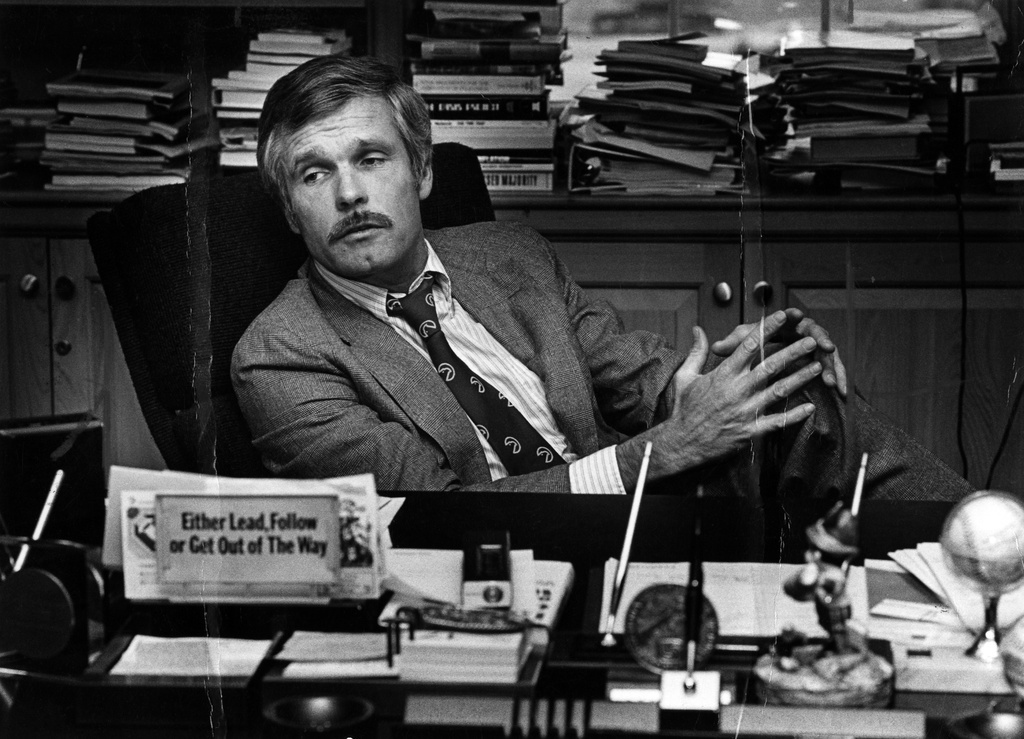
The death of Ted Turner at 87 marks the final closure of the 20th-century vertical integration model in broadcast media. While mainstream obituaries focus on his persona—the "Mouth of the South"—a structural analysis reveals that Turner’s success was not a product of charisma, but of early-stage identification of satellite distribution arbitrage and the aggressive exploitation of undervalued IP. Turner transformed a failing billboard business into a global media hegemony by systematically dismantling the scarcity model held by the "Big Three" networks (ABC, CBS, and NBC).
The Geometry of Information Flow
Before Turner, television operated on a scarcity-based linear model. Content was gated by high entry costs into local markets and limited by the physical constraints of terrestrial broadcasting. Turner broke this via the "Superstation" framework. By uplinked his independent Atlanta station (WTCG, later WTBS) to the RCA Satcom 1 satellite in 1976, he decoupled content from geography.
This created a specific economic advantage: The Marginal Cost Displacement.
While traditional networks spent millions to maintain local affiliate relationships and physical towers, Turner’s distribution cost per additional household dropped toward zero once the satellite infrastructure was in place. He transitioned from a local competitor to a national aggregator without the overhead of a traditional network. This set the stage for the launch of CNN in 1980, an enterprise that the industry initially labeled "Chicken Noodle Network" due to its lean operational budget.
CNN and the 24-Hour Utility Function
The launch of CNN changed the news from a scheduled commodity into a continuous utility. To understand the impact, one must analyze the Information Velocity Shift. In a three-network system, news was a finite product delivered in 30-minute blocks. Turner recognized that the demand for information is not periodic but constant.
CNN’s structural logic rested on three operational pillars:
- Global Aggregation: By establishing bureaus worldwide, CNN became the first network to prioritize the "infrastructure of presence" over the "infrastructure of production."
- The Live-Event Premium: Turner understood that "Live" is the only content that resists time-decay. By broadcasting the Gulf War in real-time, CNN proved that the value of information is inversely proportional to its latency.
- Cross-Subsidization: Turner used the profits from his entertainment assets (TBS and later TNT) to fund the high-risk, high-cost newsgathering operations of CNN until it reached critical mass and advertiser buy-in.
Systematic Vertical Integration: The MGM Acquisition
Turner’s 1986 acquisition of the MGM film library for $1.5 billion—a move widely criticized by analysts at the time as over-leveraged—was a masterstroke in Asset Life-Cycle Management. He realized that the value of "evergreen" content (classic films) was being under-monetized in a world of expanding cable channels.
He didn't buy a film studio; he bought a proprietary data set of cultural IP. By owning the library, he eliminated the licensing fees for his own networks (TNT, TBS, and eventually TCM). This created a self-sustaining loop:
- Acquire library at a fixed cost.
- Distribute across owned channels to capture 100% of the ad revenue.
- Use the cash flow to service the debt and acquire more IP (Hanna-Barbera, etc.).
This strategy was the precursor to the modern streaming wars. Disney+, Netflix, and Max are all iterations of the Turner MGM acquisition logic: control the library to control the margin.
The Goodwill Deficit: The AOL-Time Warner Error
The 2000 merger between AOL and Time Warner represents the catastrophic failure of the "Synergy Hypothesis." Turner, as the largest individual shareholder, saw his net worth plummet from $10 billion to roughly $2 billion in the aftermath.
The failure was rooted in a fundamental misreading of Technological Convergence. The leadership believed that "content is king" and "distribution is queen," and that merging the two would create an impenetrable moat. They failed to account for:
- Platform Neutrality: The internet did not want to be a walled garden.
- Culture Friction: The aggressive, fast-paced culture of a tech firm (AOL) was incompatible with the slow, legacy-driven culture of a media conglomerate (Time Warner).
- The Debt-to-Equity Trap: The inflated valuation of AOL during the dot-com bubble meant that when the bubble burst, the entire combined entity was crushed under the weight of its own paper value.
Turner was eventually marginalized within the company he helped build. This serves as a cautionary case study in "Founder Dilution"—the point at which a visionary’s stake becomes small enough that their strategic intuition is overruled by institutional risk-aversion.
Environmental Philanthropy as a Hedge
Turner’s later years were defined by his "Global Security Architecture" approach to philanthropy. His $1 billion pledge to the United Nations in 1997 was not merely an act of charity but a strategic attempt to stabilize the international systems that allowed his global media empire to function.
He applied the same data-driven rigor to his land holdings. As one of the largest private landowners in the United States, Turner transitioned from media mogul to Biological Asset Manager. He focused on the restoration of the American Bison, treating the species as a biological product that required a specialized supply chain to return to market viability (Ted’s Montana Grill).
The Strategic Legacy: A Finite Play in an Infinite Game
Ted Turner’s career demonstrates that disruption is rarely about better technology; it is about better Distribution Logic. He did not invent the news; he invented a more efficient way to move it. He did not invent movies; he invented a more efficient way to own and air them.
The current media environment is currently grappling with the second-order effects of Turner’s innovations. The unbundling of cable is the direct consequence of the satellite model reaching its logical conclusion. As viewers shift from aggregators (TBS/CNN) to direct-to-consumer platforms, the "Turner Model" of cross-subsidization is collapsing.
Modern media executives must now solve for the "fragmentation of attention," a problem Turner never had to face because, in his era, he was the one creating the fragments. To survive the post-Turner era, firms must shift from Linear Aggregation (collecting many things for one audience) to Niche Dominance (collecting specific things for a high-value audience).
The terminal phase of Turner’s life marks the end of the "Billionaire Media Generalist." The future belongs to the specialists who can navigate the high-velocity, low-margin environment of the algorithmic web—an environment that Turner’s CNN inadvertently helped build by training the world to expect information at the speed of the satellite uplink.
Investors and strategists should look at the current divestiture of legacy assets (Paramount, Warner Bros. Discovery) as the "Correction of 1986." The libraries are being re-priced for an era where the distribution pipe is no longer a monopoly. The final strategic play for any media entity now is to move away from "Broadcasting" (Turner's word) and toward "Targeted Utility." If the content does not serve a specific, non-fungible function for the user, it is merely noise in a system that Turner made too loud to ignore.