Silence.
That is what waiting for a reply from the edge of the solar system actually feels like when you are sitting in a windowless room in Pasadena, California, watching a green line crawl across a black monitor.
Most people think space exploration looks like a cinema screen—all roaring thrusters, flashing red alerts, and heroic shouts over a headset. It doesn't. In the quiet hum of NASA’s Deep Space Network control rooms, exploration looks like an engineer nursing a lukewarm mug of coffee at three in the morning, staring at a clock that refuses to hurry. It is a game of patience played against the absolute speed limit of the universe.
And right now, that speed limit is about to draw a historic, invisible line in the dark.
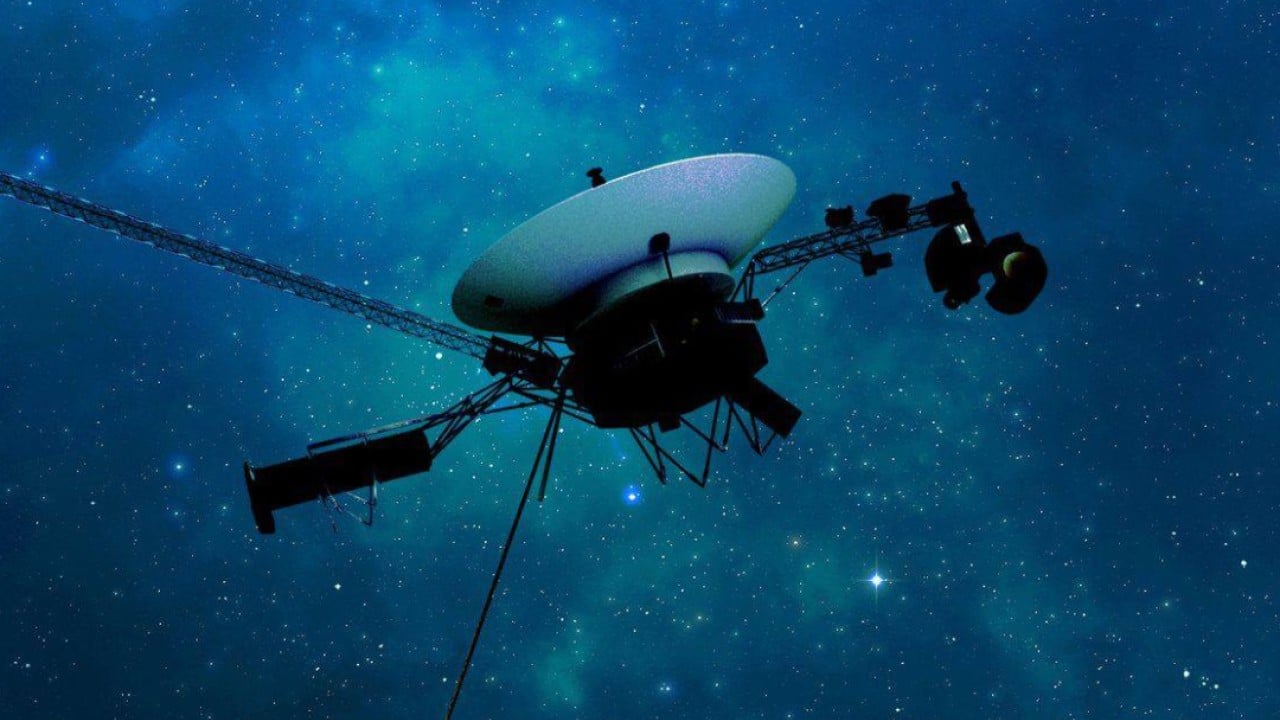
In November 2026, NASA’s Voyager 1 spacecraft will reach a distance of one full light-day from Earth. Roughly 16.1 billion miles—or 25.9 billion kilometers—away from the pale blue dot that built it, this 1970s relic will cross a threshold no human-made object has ever touched. At that distance, a radio signal traveling at the speed of light—186,282 miles per second—takes twenty-four full hours just to reach the spacecraft. Getting an answer back takes another twenty-four.
Forty-eight hours for a single "hello" and "I’m still here."
To understand why this milestone matters, you have to stop looking at the numbers on a spreadsheet and start feeling the sheer, terrifying weight of that gap.
The Architecture of a Long-Distance Relationship
Consider a hypothetical scenario to grasp what a light-day really means. Picture a flight controller named Elena sitting at her console at the Jet Propulsion Laboratory. Outside her building, the San Gabriel Mountains are bathed in the amber glow of a Tuesday afternoon. Elena types a command—a string of binary code meant to tell Voyager 1 to adjust its orientation by a fraction of a degree so its antenna stays locked onto Earth. She hits execute.
The signal leaves a massive, 70-meter parabolic dish in Goldstone, California, punching through Earth’s atmosphere at the speed of light.
By the time Elena drives home on the 210 freeway, eats dinner with her family, and goes to sleep, that signal has already blown past the orbit of Mars, cleared the asteroid belt, and screamed past the icy rings of Saturn. When she wakes up the next morning and brushes her teeth, the radio wave is plunging deep into interstellar space, flying through the heliopause—the boundary where the sun’s hot solar wind finally gives up against the cold pressure of the wider galaxy.
It is not until Wednesday afternoon, a full twenty-four hours after she pressed the button, that Voyager 1 actually receives her instruction.
And if something goes wrong? If a cosmic ray flips a single bit of memory in the spacecraft's ancient computer, or a thruster clogs with propellant residue? Elena won't know until Thursday afternoon. Two full days of blindness. By the time the telemetry arrives back on Earth, whatever happened out there in the dark is already ancient history.
This is not remote control. It is sending messages in a bottle across an ocean that takes two days to cross, hoping the ship hasn't sunk before the glass washes ashore.
Built by Ghosts, Flown by Their Grandchildren
There is an uncanny emotional gravity to Voyager 1 that separates it from modern marvels like the James Webb Space Telescope or the Perseverance rover. When Voyager launched on September 5, 1977, Jimmy Carter was in the White House. Star Wars had just hit theaters that summer. Personal computers were hobbyist kits soldered together in garages.
The engineers who designed Voyager 1 did not use computer-aided design software. They used slide rules, drafting tables, and pencils. They built a machine with roughly 69.63 kilobytes of memory—less digital storage than a single low-resolution smartphone photo today. To put that in perspective, the key fob in your pocket right now likely has more raw computing power than the spacecraft currently navigating the space between the stars.
Yet, that primitive hardware is still running.
The original architects of the mission—the men and women who stayed up all night debating radiation shielding and gold-plated copper records—are mostly retired now, or gone. The people keeping Voyager 1 alive today are often engineers in their twenties and thirties who weren't even born when the probe flew past Jupiter in 1979.
When a crisis hits—and they hit with terrifying regularity now—these young engineers have to become digital archaeologists. They dig through boxes of yellowing paper schematics, faded microfilm, and decades-old binders written in assembly languages that nobody teaches in universities anymore.
We saw this play out in dramatic fashion between late 2023 and mid-2024. Voyager 1 suddenly stopped sending readable science and engineering data back to Earth. Instead of clean telemetry, the Deep Space Network received a repeating, nonsensical pattern of ones and zeros. For months, the spacecraft was effectively speaking gibberish.
Think about the vulnerability of that moment. You have a priceless, irreplaceable machine 15 billion miles away, powered by a decaying chunk of plutonium-238 that loses about four watts of electrical power every year. You cannot send a mechanic. You cannot reboot it with a paperclip. And every single diagnostic test you run takes nearly two days just to confirm whether your guess was right or wrong.
The team eventually traced the glitch to a single corrupted chip inside the flight data subsystem—a piece of hardware that had simply worn out after nearly five decades in the deep freeze of space. Because they couldn't fix the broken silicon, they had to rewrite the software to work around it, slicing the code into pieces and stashing it in different corners of the spacecraft's tiny memory bank where space still remained. When the first coherent signal finally trickled back onto the screens in April 2024, grown engineers wept at their desks.
They had performed brain surgery in the dark, across a chasm of billions of miles, using an instruction manual written before they were born.
What Does Space Actually Feel Like Out There?
When people hear that Voyager 1 is in "interstellar space," they often picture an empty, pitch-black void. A place where nothing happens.
That assumption gets the reality completely backward.
The space between the stars is not empty; it is an invisible, turbulent sea of plasma, magnetic fields, and cosmic radiation. Closer to home, our solar system is wrapped inside a giant protective bubble called the heliosphere, inflated by the constant outward blast of particles from our sun. Inside this bubble, we are shielded from the harshest radiation of the Milky Way.
Voyager 1 punched through the wall of that bubble in August 2012.
Since then, it has been the only pair of eyes and ears humanity possesses on the outside looking in. As it approaches the one-light-day mark, its remaining instruments—the magnetometer, the cosmic ray subsystem, the plasma wave science instrument—are sampling the raw, unfiltered stuff of the galaxy. It is measuring how the interstellar wind pushes against our sun's magnetic shield, sending back data that literally rewrites astrophysics textbooks.
To understand the scale of what Voyager is traversing, shrink the universe down to a familiar metaphor. Imagine the sun is the size of a standard basketball sitting on the fifty-yard line of a football stadium. On that scale, Earth is a tiny grain of sand orbiting about twenty-six yards away. Pluto, out on the cold fringes of our planetary neighborhood, is a speck of dust more than half a mile outside the stadium walls.
Where is Voyager 1 on this scale? It is nearly two miles away from the stadium, rolling steadily down a quiet country road, leaving the city limits entirely behind.
And even at its blistering speed of roughly 38,000 miles per hour—fast enough to cross the entire continental United States in under five minutes—Voyager 1 has barely taken a baby step into the cosmos. It will not reach the inner edge of the Oort Cloud, the vast shell of icy comets surrounding our solar system, for another three hundred years. It will take roughly 30,000 years just to pass all the way through that cloud. And it won't come anywhere near another star system for forty millennia.
The Fragile Thread of Power
There is a quiet heartbreak baked into every bit of data Voyager sends home today. The spacecraft is slowly dying, and there is nothing anyone can do to stop it.
Unlike solar-powered probes that orbit Mars or Venus, Voyager 1 travels too far from the sun for solar panels to generate even a trickle of electricity. Instead, it relies on three Radioisotope Thermoelectric Generators—essentially nuclear batteries that convert the heat from decaying plutonium-238 into electricity.
At launch in 1977, those generators produced about 470 watts of power—roughly enough to run a few household lightbulbs. Today, nearly fifty years later, that output has dwindled to barely half of what it was.
Every few months, mission managers face an agonizing triage decision. To keep the spacecraft's heaters running so the fuel lines don't freeze solid—which would end the mission instantly—they have to turn off science instruments one by one. In recent years, they have shut down the cosmic ray subsystem and the low-energy charged particle instrument, sacrificing irreplaceable scientific eyes just to buy the spacecraft a few more months of life.
It is the mechanical equivalent of a hiker caught in a blizzard, burning their own furniture to keep the cabin warm until morning.
By the early 2030s, the plutonium will no longer generate enough juice to power even a single instrument or run the transmitter. The transmitter will go dark. The parabolic dish will drift slowly away from its lock on Earth. Voyager 1 will become a silent, cold, 1,600-pound capsule drifting through the Milky Way at ten miles per second, carrying its famous Golden Record—a time capsule of whale songs, Chuck Berry, greetings in fifty-five languages, and the brainwaves of a woman in love—into eternity.
Why Twenty-Four Hours Changes Everything
So why does hitting the one-light-day milestone in November 2026 matter so deeply to people who will never step foot inside a NASA control room?
Because numbers this large usually numb the human brain. A billion miles is an abstraction. Ten billion is a blur. Sixteen billion is just a string of zeroes that loses all emotional traction the moment you read it.
A day, however, is something every human being understands in their bones.
You know what twenty-four hours feels like. You know the slow rotation of the sun across your bedroom wall, the cycle of hunger and sleep, the span of a single turn of the Earth on its axis. When Voyager 1 reaches one light-day away, the distance stops being an abstract astronomical measurement and becomes a human unit of time.
Light itself—the fastest thing in the universe, the very medium through which we see the stars, read words on a screen, and recognize the faces of the people we love—now needs an entire turn of our planet just to bridge the gap between us and our machine.
Think about what that says about who we are. We are fragile, short-lived creatures bound by gravity to a damp rock orbiting an ordinary star. Most of our daily lives are consumed by petty arguments, fleeting anxieties, and problems that won't matter next Tuesday. Yet, out of sheer curiosity, we built an aluminum frame, bolted on a few sensors and a copper disc, and threw it so hard into the dark that it outran the sun's own breath.
We stretched a thread of radio waves across sixteen billion miles of nothingness, and for nearly half a century, we refused to let go of our end of the string.
When November 2026 arrives and that milestone quietly ticks past on a screen in Pasadena, there will be no fireworks in the sky. Voyager 1 will not slow down, flash a beacon, or celebrate. It will simply keep flying, cold and solitary, pushing deeper into the interstellar dark.
And twenty-four hours later, a faint whisper—weaker than the energy produced by a snowflake hitting the ground—will wash over a giant radio dish in the California desert, carrying a simple, stubborn message across a full day of light.
I am still here. And so are you.