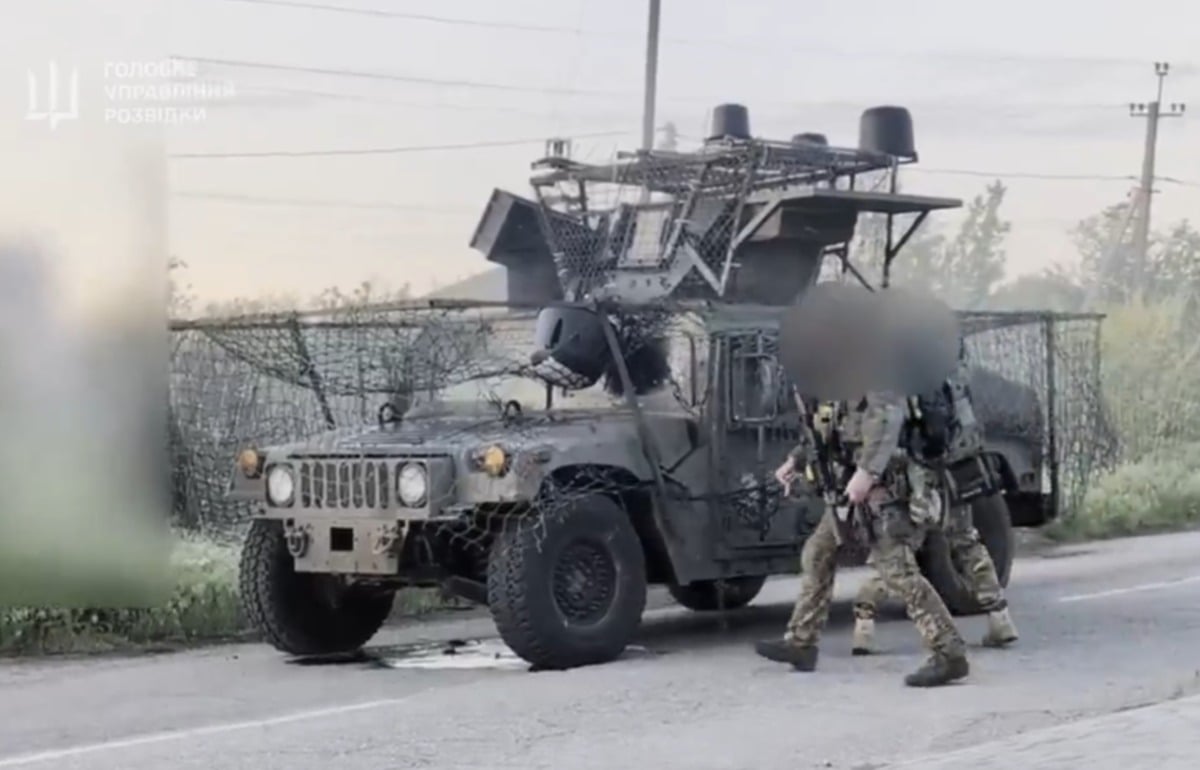
A First-Person View (FPV) drone streaks across the sky, tracking a moving target. It zeroes in on a Ukrainian High Mobility Multipurpose Wheeled Vehicle—the classic American Humvee. The drone, rigged with an explosive charge, slams directly into the vehicle. Smoke billows, metal twists, and the impact shakes the entire chassis.
Yet, the Humvee keeps rolling.
Dramatic combat footage widely circulated on Telegram highlights this exact scenario. Captured from three distinct angles—the attacking drone's feed, an allied vehicle behind it, and a camera inside the cabin—the incident gives us a rare, unfiltered look at modern mechanized warfare. Despite a direct detonation that filled the interior with thick smoke, the soldiers inside survived.
This isn't an isolated stroke of luck. It reveals a massive shift in how light armor handles the relentless threat of cheap, exploding quadcopters on the modern battlefield.
The Survival Blueprint of an Aging Legend
Critics love to call the Humvee a relic of the Cold War. In a way, they're right. AM General designed the vehicle in the late 1970s and early 1980s for a completely different style of conflict. It was meant to be a highly mobile utility truck, not a front-line breakthrough vehicle facing thousands of kamikaze drones.
But the variants keeping Ukrainian crews alive today aren't the soft-skinned models of the Gulf War era.
Vehicles like the M1114 and M1151 up-armored variants are heavily modified platforms. They feature hardened steel plating, reinforced ballistic glass, and blast-resistant floor mats. When an FPV drone hits, the exterior hull absorbs the initial blast wave and fragmentation.
Instead of shredding the cabin, the armor deflects the deadly spall away from the occupants. It turns a potential catastrophe into a deeply unsettling, smoke-filled escape.
Why FPV Drones Don't Always Guarantee a Kill
The internet is flooded with videos of cheap drones blowing up multi-million dollar tanks. That creates an illusion that anything lighter than a main battle tank is a sitting duck. The reality on the ground is far more nuanced.
- Payload limitations: Small commercial or semi-industrial drones carry limited weight. Most are rigged with single RPG-7 warheads or makeshift anti-personnel explosives. If the drone doesn't hit a highly vulnerable weak point—like an open hatch or a fuel line—the blast energy often dissipates across the armored plating.
- The angle of impact: Pilots often strike from the rear or sides to maximize damage. But hitting a fast-moving vehicle at a precise angle while battling electronic warfare jamming is incredibly difficult. A slight miscalculation means the drone detonates against reinforced structural components rather than the thin roof armor.
- Crew compartment isolation: Up-armored Humvees feature a rugged internal roll cage and sealed crew compartments. Even when a blast causes a fire or heavy smoke in the engine bay, the structural integrity of the passenger cabin remains intact long enough for the crew to act.
The Grim Reality Inside the Cabin
While the vehicle might keep rolling, the experience inside during a drone strike is harrowing.
The moment of impact delivers a massive acoustic shock. The pressure wave can easily disorient a crew, causing temporary hearing loss and severe concussions. In the recent multi-angle footage, the immediate challenge wasn't just the physical blast, but the sudden onset of thick, choking smoke filling the cabin.
[Drone Impact] ➔ [Blast Absorption by Outer Armor] ➔ [Acoustic Shock inside Cabin] ➔ [Smoke Accumulation] ➔ [Controlled Evacuation]
Survival relies entirely on crew discipline and rapid egress. Ukrainian soldiers are trained to treat the vehicle as a shield to get out of the immediate kill zone. Once the vehicle slows down or stops, the crew must evacuate immediately before a secondary fire ignites the ammunition or fuel tank, or a second "follow-up" drone targets the immobilized asset.
What This Means for the Future of Light Armor
The ongoing conflict proves that battlefield survivability is no longer just about heavy tanks. Light, mobile, and armored transport units are vital for medical evacuations, rapid troop movements, and supply runs through contested territory.
Western militaries are watching these engagements closely. The fact that a decades-old American design can take a direct hit from a 2026-era kamikaze drone and save its crew validates the heavy emphasis placed on up-armored variants.
However, relying entirely on passive steel armor isn't a long-term solution. To counter the evolving drone threat, light tactical vehicles will need to integrate active electronic warfare systems, localized signal jammers, and lightweight cage armor—often called "cope cages"—directly into their factory designs.
For now, the rugged engineering of the up-armored Humvee remains a vital lifeline on the Ukrainian frontline, proving that basic structural resilience can still triumph over high-tech cheap explosives.
If you want to see exactly how these mechanical survivals play out under pressure, check out this breakdown of Ukrainian Fighters ditching a flaming Humvee after an FPV attack. This combat footage analysis provides a firsthand perspective on how crews react, maintain security, and survive the immediate aftermath of a drone strike.


