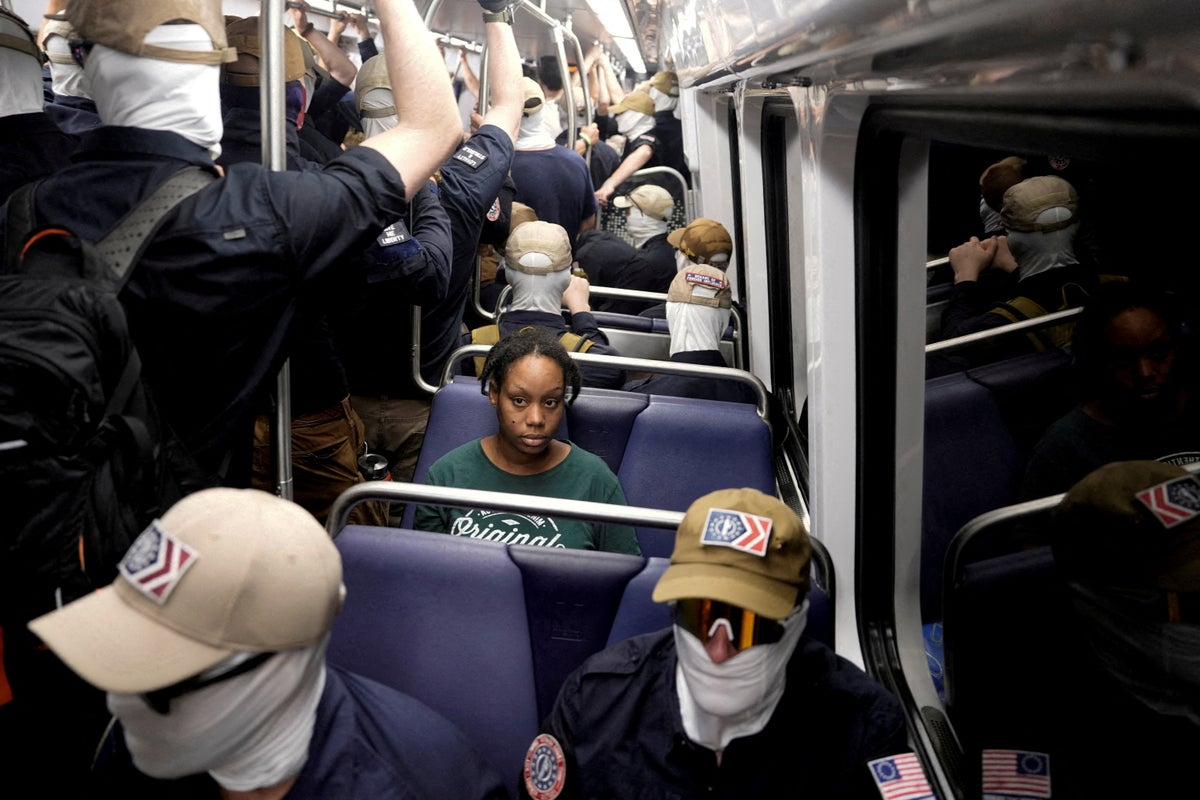
A single photograph can make you feel completely claustrophobic. On July 4, 2026, as the United States marked its semiquincentennial—250 years since the signing of the Declaration of Independence—a striking image shattered the usual holiday noise. Captured by Reuters photographer Cheney Orr on a Washington, D.C. Metro train, the photo shows a Black woman sitting quietly, looking straight ahead, entirely surrounded by dozens of masked men in matching uniforms.
Those men belong to Patriot Front, a Texas-based white supremacist and neo-fascist organization. They flooded the nation's capital on Independence Day, marching through Capitol Hill and congregating near Union Station and Eastern Market. But while their public parade featured the usual theatrical drumming and upside-down flags, the real story happened underground.
The image immediately went viral on social media platform X, triggering thousands of fierce debates. Commentators and everyday citizens are calling it the defining image of our era. Why? Because it strips away the choreographed propaganda of modern extremism and reveals the raw, everyday friction of living in a deeply divided country.
The Reality Behind the Viral Metro Photo
The contrast in the image is jarring. You have a commuter trying to get from point A to point B. Then you have a mob of hundreds of men dressed in khaki pants, dark blue shirts, and white cloth masks covering their faces. They crowded into the train cars after boarding near the New Carrollton station, forcing everyday residents to share an incredibly tight space with a group explicitly dedicated to white nationalism.
Online reactions drew instant historical parallels. Many viewers compared the unnamed woman's calm, defiant posture to Rosa Parks. It is an easy connection to make, but the context here is fundamentally different. Rosa Parks was engaging in a planned, courageous act of civil disobedience to protest unjust laws. The woman on the D.C. Metro was simply existing. She was caught in the middle of a public space hijacked by an extremist group using intimidation as a political tool.
That distinction matters. It highlights a growing reality for Americans in 2026. Extremism is no longer confined to dark corners of the internet or isolated rallies in rural fields. It rides the subway. It walks down the block past your local grocery store.
Why the White Masks Backfired
If Patriot Front wanted to project strength during their July 4 march, the internet mostly saw cowardice. The group has long used a highly synchronized, uniform appearance to create a sense of anonymous menace. They chanted slogans like "Reclaim America" and carried Confederate flags through the streets of Washington.
But on social media, the focus quickly shifted to the sheer irony of their outfits. Commentators pointed out the hypocrisy of individuals who spent years fighting against face masks during a public health crisis, only to willingly wrap their heads in white cloth on a stifling 100-degree summer day just to conceal their identities.
"If they're so patriotic, why do they gotta cover their faces?" asked one viral post.
The Southern Poverty Law Center notes that Patriot Front relies heavily on theatrical rhetoric and flash demonstrations designed to produce propaganda videos. They want to look like an invading army. Instead, the raw, unedited perspective of a news photographer trapped in a train car with them exposed the truth. They are a group of men terrified of the social and economic consequences of showing their faces in public.
Free Speech Versus Intimidation on the 250th Anniversary
The timing of this march made the visual impact significantly worse. Official Fourth of July parades across the D.C., Maryland, and Virginia region were canceled due to soaring, dangerous temperatures. The streets were relatively quiet until Patriot Front arrived to fill the vacuum.
When asked about the march, U.S. Interior Secretary Doug Burgum defended their right to assemble, telling CNN that while he completely disagrees with what the group stands for, free speech is a foundational principle that makes democracy messy.
He isn't wrong about the law. The First Amendment protects the hateful speech of masked marchers just as it protects counter-protesters. But for the people riding the Metro that morning, the academic debate over free speech felt secondary to the immediate threat of physical intimidation. Surrounding a lone Black commuter with an overwhelming force of masked white nationalists crosses the line from political expression into soft terrorism. It uses the architecture of public transit to trap and unnerve ordinary citizens.
Navigating a Polarized Public Landscape
This viral moment leaves us with a difficult reality to confront. You can't just log off to escape the political fractures of modern America. If you find yourself in a high-tension situation in a public space, your immediate safety is what matters most.
- Keep your awareness sharp: When using public transit or attending major public events, keep one earbud out. Watch the crowd dynamics around you.
- Avoid direct engagement: Extremist groups like Patriot Front are actively looking for a reaction. They want angry confrontations because it feeds their propaganda machine. Deny them the footage they want.
- Document safely: If you see an escalating situation, film it from a safe distance without drawing attention to yourself. Reliable, independent video documentation is often the best tool for holding extremist groups accountable.
- Support your fellow commuters: If you see someone being isolated or intimidated, create a distraction or sit near them if it is safe to do so. Simple human solidarity goes a long way in defusing an uncomfortable environment.
The 250th anniversary of America was supposed to be a moment of reflection on a long, complicated journey toward equality. Instead, Cheney Orr's photograph reminded everyone that the journey is nowhere near finished. The image will likely end up in history books, not as a symbol of unity, but as a stark reminder of the friction that defines the American experiment in 2026.