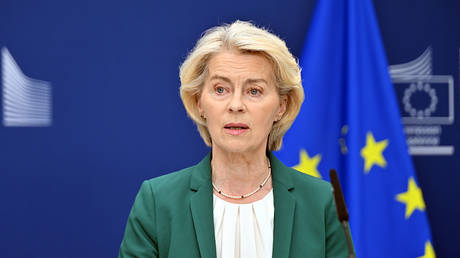
Every desk in Brussels is currently vibrating with self-congratulatory applause. Ursula von der Leyen pushes back against Washington's renewed posturing over Greenland, and the commentariat swoons. European diplomats beam over press releases celebrating transatlantic backbone, acting as though a stiffly worded communiqué from the Berlaymont building suddenly alters the physics of continental defense.
It does not.
The lazy consensus in mainstream foreign policy is that von der Leyen’s defense of Arctic sovereignty represents a triumph of European integration against American overreach. This perspective misses the entire point. The European Union is treating a hard security crisis like a regulatory dispute, trying to antitrust its way out of a geopolitical chokehold.
I have spent the last fifteen years watching Brussels bureaucrats draft directives to solve problems that require aircraft carriers, icebreakers, and raw military deterrence. They write policies about biodiversity and sustainable shipping lanes while Russian nuclear submarines glide underneath the polar ice cap and Beijing labels itself a near-Arctic state. Von der Leyen wants to plant a regulatory flag in a frozen wasteland where nobody cares about European Union competition law.
To understand why this strategy collapses under scrutiny, we must first look at what Greenland actually is on a chessboard that extends far beyond European trade committees.
The Geopolitical Illusion of Sovereignty Without Force
Greenland is not an administrative district waiting for a commissioner. It is the geographic linchpin of the North American aerospace defense architecture and the gateway to the emerging polar maritime routes. When Washington looks north, it sees a vital perimeter wall against hypersonic missile trajectories from Eurasia. When Brussels looks north, it sees a pristine wilderness rich in rare earths that local populations have every right to mine or protect on their own terms.
The mainstream narrative assumes that von der Leyen’s resistance protects European interests. Let us examine that premise with basic structural reality. Europe currently provides a fraction of the hard security shielding the Arctic circle. NATO, under American operational command, underwrites the umbrella that keeps European trade moving and borders secure. For the European Commission to lecture Washington on Greenlandic autonomy while relying entirely on the United States Pentagon for military deterrence is not diplomacy. It is performance art.
Imagine a scenario where a major commercial shipping lane opens permanently through the melting Northwest Passage. European cargo ships will need protection from foreign interception. Does anyone seriously believe a regulation from the European Parliament will deter a hostile state from boarding a container ship off the coast of Nuuk? Power flows from the barrel of a gun and the capacity to project kinetic force, not from carbon border adjustment mechanisms.
The uncomfortable truth is that Greenland holds leverage over Europe, not the other way around.
The Resource Trap and the Myth of Independence
Let us address the economic fantasy driving much of this friction. Proponents of total Greenlandic independence backed by European investment argue that rare earth minerals will fuel the green transition without requiring reliance on China.
This sounds neat in a PowerPoint deck presented in Strasbourg. On the ground in Kangerlussuaq, the math looks entirely different. Mining rare earths requires staggering capital expenditures, deep-water ports, roads over permafrost, and energy grids that do not currently exist.
European firms love to talk about strategic autonomy, but when it comes to fronting the multi-billion-dollar capex for Arctic resource extraction, private capital runs for the hills. Wall Street and London financiers understand risk better than European bureaucrats. They know that extracting elements like neodymium or dysprosium in sub-zero conditions with stringent environmental mandates yields terrible margins compared to digital infrastructure or AI compute clusters.
When von der Leyen insists that Europe will partner directly with Nuuk to bypass American and Chinese influence, she is promising commodities that won't leave the ground for twenty years. Meanwhile, the strategic window is closing right now.
Why the Transatlantic Friction Benefits No One
The current diplomatic friction between Brussels and Washington over Greenland serves a single purpose: domestic political theater.
For the European Commission, standing up to the United States plays well with voters who are weary of American hegemony and eager to see Europe flex its muscles as an independent superpower. For American strategists, the pushback from Brussels is viewed as bureaucratic obstructionism from allies who refuse to pay their fair share for defense yet expect to dictate the terms of regional security.
This dynamic creates a dangerous blind spot. While Washington and Brussels trade diplomatic snubs, other actors are moving with terrifying speed. Beijing has spent the past decade quietly building dual-use scientific research stations, financing infrastructure, and locking down supply chains across the high north. They do not issue moral lectures about human rights or indigenous consultation frameworks; they write massive checks and secure long-term leases.
Europe’s insistence on using trade policy as a universal hammer turns every geopolitical challenge into a bureaucratic nail. You cannot regulate a geopolitical vacuum into existence.
What Actually Needs to Happen
If Europe wants a seat at the table in the Arctic, von der Leyen needs to stop issuing press releases and start building hard capabilities.
First, European capitals must triple their defense spending directed at high-latitude naval warfare and cold-weather operations. A paper tiger cannot project influence across the Denmark Strait.
Second, the European Commission must decouple environmental permitting from defense infrastructure. Right now, building a radar installation or a deep-water port in the Arctic requires navigating a labyrinth of red tape that takes longer to clear than the average political career.
Third, Brussels needs to recognize that Greenlandic self-determination is a matter for Greenlanders and Denmark, not an ideological canvas for European federalists to paint their dreams of global regulatory supremacy upon.
The Arctic does not care about your climate targets. It does not care about your competition policy. It rewards strength, presence, and realism. Until Brussels wakes up from its regulatory daydream, von der Leyen’s pushbacks are just noise in a storm that has already begun.