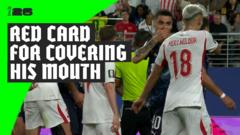
Miguel Almirón made history for the wrong reasons when a referee interpreted his covered mouth as a red-card offense. The flashpoint, which stunned spectators and pundits alike, exposed a widening rift between soccer’s governing bodies and the players who feel increasingly scrutinized by a panopticon of high-definition cameras, lip-readers, and video assistant referees. What looked like a bizarre moment of over-officiating is actually the predictable climax of a multi-year campaign by FIFA to clamp down on dissent. By sending Almirón off, football officials crossed a new threshold, transforming a player's instinctive desire for privacy into an admission of guilt.
The incident marks a permanent shift in how matches are policed. For years, players have shielded their mouths with jerseys or hands to prevent opposing benches, media outlets, and lip-readers from decoding tactical instructions or emotional outbursts. By treating this shielding mechanism as an obstructive act worthy of an immediate dismissal, football authorities have effectively criminalized the act of staying silent.
The Illusion of Absolute Control
Referees have long struggled to manage player dissent, but the modern game has hyper-analyzed every twitch of a player's face. The ruling that caught Almirón rests on a highly contentious interpretation of unsporting behavior. Officials argue that hiding one's mouth while speaking to an official or an opponent prevents the referee from fully assessing the nature of the interaction. They claim it creates an environment where abuse can thrive undetected.
This logic is fundamentally flawed. It assumes that transparency can only exist if a player's face is fully visible to a broadcast camera at all times. By focusing on the physical gesture rather than the actual words spoken—words that the referee is often close enough to hear firsthand—officiating crews are punishing the appearance of defiance rather than the defiance itself.
The pressure on referees to maintain order has reached an all-time high. FIFA's directives ahead of major tournaments have consistently emphasized zero tolerance for player dissent, pushing officials to hand out cautions for any sign of disrespect. Yet, this aggressive stance has created a paradox. Instead of defusing tension on the pitch, it has escalated minor disagreements into match-altering disciplinary actions.
The Rise of the Lip-Reading Industry
To understand why players cover their mouths, one must look at the media landscape surrounding international football. Major tournaments are covered by hundreds of cameras capturing every conceivable angle in ultra-high definition. Broadcasters routinely hire professional lip-readers to dissect post-match footage, turning casual pitch-side remarks into front-page tabloids the next morning.
"A single offhand comment caught on camera can trigger a multi-match ban, corporate sponsorship cancellations, or a public relations disaster."
Players are hyper-aware of this reality. They cover their mouths not necessarily because they are uttering profanities, but because they are protecting their privacy in a workplace that denies them any. When Almirón raised his hand to his face, he was practicing defensive public relations, a habit drilled into modern athletes from their academy days.
The Tactical Shield
Privacy isn't just about avoiding controversy; it is also a matter of competitive advantage. Managers and players frequently use covered mouths to communicate tactical adjustments during a break in play.
- Preventing interception: Opposing benches often employ staff members to monitor the rival team's communications in real time.
- Protecting set-piece audibles: Late-game adjustments on corner kicks or free kicks require absolute secrecy to be effective.
- Managing emotional volatility: Players use the barrier to de-escalate tension between teammates without exposing internal friction to the crowd.
By removing the ability to speak confidentially, FIFA is forcing players into an unnatural state of exposure. The rule change treats the pitch not as a sports arena, but as a courtroom where every utterance must be logged, analyzed, and approved by authorities.
The Gray Area of Unsporting Conduct
The foundational issue with Almirón’s dismissal is the sheer subjectivity of the decision. The Laws of the Game give referees wide latitude to determine what constitutes "bringing the game into disrepute." However, extending this definition to cover a player’s hand placement sets a dangerous precedent.
If covering the mouth is an automatic offense, where does the policing stop? Referees must now determine intent behind a physical reflex. A player might wipe sweat from their face, adjust a mouthguard, or yell in frustration into their jersey. Each of these actions can look identical to deliberate concealment on a slow-motion replay.
Disciplinary Escalation Pathway:
[Verbal Disagreement] -> [Hand Covers Mouth] -> [Referee Suspects Abuse] -> [Red Card Issued]
This escalation pathway skips the crucial step of establishing actual verbal abuse. It replaces concrete evidence with circumstantial suspicion. If a referee does not hear an insult, but issues a red card purely because a player covered their mouth while speaking, the officiating crew is guessing. This reliance on guesswork erodes the credibility of the VAR system, which was implemented to eliminate errors, not validate assumptions.
A Double Standard for Officials
The irony of the situation is not lost on the players. While athletes are demanded to keep their faces entirely exposed to the public eye, referees and VAR officials operate behind a wall of institutional secrecy.
Audio recordings of VAR rooms are heavily guarded, released only selectively by refereeing bodies after intense public pressure. Referees themselves are rarely required to face the media after a match to explain catastrophic mistakes. This asymmetry creates a culture of resentment. Players feel they are subjected to an elite level of surveillance while the individuals enforcing the rules remain shielded from accountability.
The unionization of players and international player associations have already begun voicing concern over this shift. They argue that the field of play is a workplace, and workers have a fundamental right to a degree of privacy, especially when high-stakes emotional outbursts are a natural byproduct of elite competition.
The Real Cost of Cosmetic Discipline
FIFA's obsession with the aesthetics of respect is hurting the sport. By focusing heavily on minor behavioral infractions, governing bodies are missing the bigger picture. Matches are increasingly decided by administrative technicalities rather than athletic merit.
When a star player is removed from a World Cup match for a gesture that caused no physical harm and caused no delay in play, the spectacle suffers. Fans pay to see the best players compete, not to watch referees enforce arbitrary etiquette rules with an iron fist. The Almirón incident will not stop players from trying to hide their words; it will simply force them to find more subtle, creative ways to evade the cameras.
The solution is not more surveillance, but a return to common-sense officiating. Referees need to rely on what they actually hear on the pitch, using cards to punish verifiable abuse rather than policing body language. Until the sport balances the desire for broadcast transparency with the reality of human emotion under pressure, the pitch will remain a highly volatile environment where silence is treated as a crime. Teams must now adapt to a reality where a simple hand gesture carries the same disciplinary weight as a dangerous tackle.