War has always worn a face of stone.
For centuries, the architecture of conflict was built on granite and iron—the unyielding glare of generals, the clank of armor, the thunder of artillery, and the cold geometry of maps marked in red and blue. We grew accustomed to the theater of brutality. We expected leaders at war to look like monuments: weathered, unsmiling, and cast in the permanent shadow of impending doom.
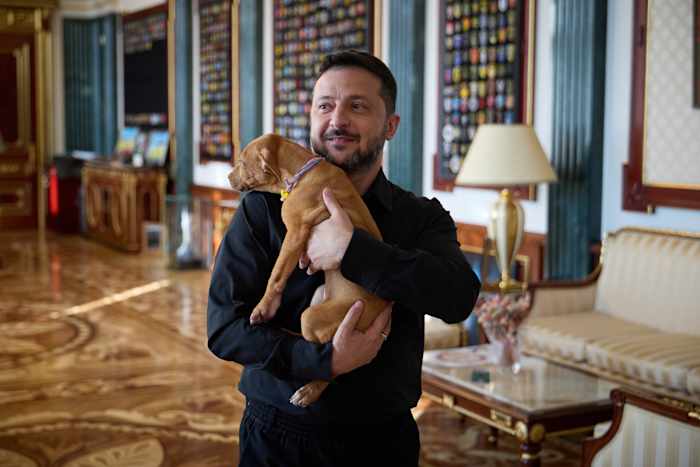
Then a small, wriggling ball of golden fur enters the frame.
Picture a bunker lit by the hum of fluorescent bulbs and the constant, low-frequency anxiety of a city under siege. Outside, the sirens wail a familiar, jagged rhythm. Inside, a man who has aged a decade in a matter of years lowers his gaze, and for a fleeting second, the heavy, armored weight of the presidency vanishes. He cradles a puppy. He coos. He smiles.
It takes four seconds.
Those four seconds travel across fiber-optic cables, bouncing from satellite to smartphone, landing in the palms of millions of people sitting in quiet kitchens thousands of miles away.
To the casual observer, it is just a sweet moment. A brief, human respite from the machinery of slaughter. But in the modern theater of information warfare, nothing is accidental. Every pixel is a calculated stroke on a canvas that spans continents. This is not merely a man loving a dog. This is a masterclass in the war of visuals, and understanding why it matters requires looking past the screen and into the psychology of how we choose sides.
The Calculus of Empathy
When tanks roll across borders, they destroy more than concrete and lives. They obliterate narrative control. In the opening hours of a modern invasion, the aggressor usually relies on shock and awe—the overwhelming presentation of unstoppable force designed to induce paralysis. The goal is to make resistance look not just futile, but absurd.
If you fight a giant, you look small. If the giant is merciless, you look doomed.
Countering that illusion requires a completely different kind of ammunition. You cannot out-tank a superpower. You cannot match the sheer tonnage of steel and ordnance possessed by a nation that measures its military budget in fractions of global GDP. If the war is fought purely on the metrics of destruction, the smaller nation loses before the first trench is dug.
So, the battlefield shifts. It moves from the muddy fields of the east to the glowing rectangles in our pockets.
Consider what happens when a leader chooses tenderness over toughness. When Volodymyr Zelenskyy interacts with a rescue puppy or shares a quiet, unscripted moment of vulnerability, he is engaging in a profound act of psychological fortification. He is answering the question: Who are we fighting for?
An army can defend a border, but an image can defend a national soul. The puppy becomes a symbol not of weakness, but of what is being protected. It represents domestic life, ordinary routines, children playing on sunny sidewalks, and the quiet dignity of a Tuesday afternoon that hasn't been shattered by artillery. By showing himself caring for the vulnerable, the leader mirrors the vulnerability of his entire populace.
He is telling the world: We are human. They are a storm.
The Architecture of Perception
We like to think we consume news objectively. We believe our opinions on geopolitical conflicts are forged through careful analysis of treaties, troop movements, and historical grievances.
We are lying to ourselves.
Human beings are wired for story. We respond to archetypes. Since the dawn of oral history, we have rooted for David against Goliath not because David had superior logistics, but because David represented the underdog charm of human scale against the terrifying bulk of institutional power.
Russia’s information apparatus has historically understood the power of imagery, relying on centuries-old traditions of stoic majesty, vast parades, and unsmiling displays of state dominance. It is an aesthetic designed to evoke awe and compliance. It says: Submit to the inevitable.
Against that backdrop, a video of a Ukrainian official or president holding a tiny animal is an asymmetrical strike. It punctures the solemnity of authoritarian staging with radical authenticity. You cannot meme a grand military parade, but you can feel an immediate, visceral tug in your chest when a man with dark circles under his eyes gently scratches a puppy behind the ears.
It short-circuits our analytical defenses. Long before our brain processes the political implications of foreign aid packages or sanctions, our nervous system registers warmth. We decide whether we like someone in milliseconds. And once that emotional anchor is dropped, our subsequent political opinions tend to drag behind it, anchored to a feeling rather than a fact.
This is why traditional analysts often miss the mark when they dismiss these moments as mere fluff or public relations stunts. Of course it is public relations. Every public act by a politician during wartime is communications strategy. But dismissing it as "just PR" is like looking at a sniper rifle and saying, "It's just a piece of metal." The mechanism matters entirely because of the effect it produces.
The Invisible Stakes
Look closer at the digital battlefield. Every smartphone is a reporting station. Every citizen is a witness.
In past conflicts, the distance between the front lines and the living room was measured in days of newspaper printing and vetted television broadcasts. Today, that distance is zero. A video recorded in a basement in Kyiv reaches a teenager in Chicago or a pensioner in Berlin in real time.
This creates a brutal, relentless demand for emotional resonance. Global support for a war-torn nation is not maintained purely by intellectual alignment with its geopolitical goals. It is maintained by empathy fatigue prevention.
People grow tired. Headlines blur together. Death tolls become abstract numbers scrolling across a ticker tape. When the horror becomes monotonous, public attention drifts. And when public attention drifts, political will evaporates.
This is the invisible stake of the puppy video, the impromptu selfie, the cracked-voice speech delivered into a handheld phone. These acts are psychological defibrillators. They shock a fatigued global audience back into feeling. They remind the world that behind the headlines of strategy meetings and supply chains are breathing, bleeding, living human beings who still pause to love small, helpless things even while the ground shakes beneath them.
It is a reminder that even in the absolute darkest chapters of human history, the battle is never solely about territory. It is about who gets to define what it means to be human.
When the history of this era is written, scholars will analyze the missile trajectories, the economic blockades, and the diplomatic summits. But somewhere in the footnotes, they will have to account for the digital skirmishes fought with smiles, stray animals, and shared moments of quiet grace.
The cameras flash. The shutter clicks. The world watches. And somewhere across a border, a fortress built on fear realizes it has no defense against a tail that won't stop wagging.


.jpg)
