Twenty-three miles.
That is the narrowest stretch of muddy brown water separating Colonia del Sacramento in Uruguay from the sprawling concrete shoreline of Buenos Aires, yet for anyone who has stood on the ferry deck watching the skyline rise out of the haze, it feels like crossing between two entirely different centuries. On one side sits a quiet, secular nation that pridefully stripped religious icons from its public buildings over a hundred years ago. On the other waits a restless, passionate giant where faith, politics, and economic survival collide on every street corner.
Now, Pope Leo is making that exact crossing.
If you only glance at the standard wire reports, the story reads like a routine diplomatic itinerary. Following a well-received visit to Uruguay, the pontiff boards a plane to Argentina. Crowds wave flags. Bishops offer formal greetings. Security motorcades glide down closed avenues.
Those reports miss the pulse of what is actually happening on the ground. They treat a papal journey like a tourist checking boxes on a map rather than what it truly is—a high-wire walk across raw historical nerves. To understand why this short hop across the Río de la Plata carries so much quiet tension, you have to step away from the podiums and look at the people waiting on the sidewalks.
The Quiet Victory in Montevideo
Before looking at the storm ahead in Argentina, consider what just happened in Uruguay.
Imagine—as a hypothetical illustration of the mood in Montevideo—a retired schoolteacher named Mateo sitting at a corner café near Plaza Independencia, nursing a bitter mate while watching the papal motorcade pass on a small television mounted above the bar. Mateo has not stepped inside a parish church since his sister’s wedding in 1998. Like roughly half of his fellow Uruguayans, he identifies with no religion at all. In South America, Uruguay stands alone as an island of deep secularism, a place where Christmas is officially listed on state calendars as Family Day and Holy Week is called Tourism Week.
For decades, visiting church leaders treated Uruguay as a polite obligation—a brief layover before heading to larger Catholic strongholds in Brazil or Argentina. Expectations for Pope Leo’s visit were modest at best. Analysts predicted polite indifference, sparse crowds, and awkward silences between Vatican diplomats and a government famous for progressive social laws that frequently clash with traditional Catholic doctrine.
Instead, something unexpected unfolded.
Pope Leo did not arrive in Montevideo with a megaphone or a list of moral demands. He arrived like a guest who knew how to listen before speaking. During his meetings with civic leaders, he avoided lecturing a country proud of its secular constitution. When he visited a community kitchen in the working-class neighborhood of Cerro, he spent forty minutes sitting on a plastic chair talking to volunteers about the rising cost of bread and cooking oil, leaving the cameras outside.
By the time his plane lifted off from Carrasco International Airport, even hardened skeptics in the Uruguayan press admitted the trip had succeeded. He had earned respect precisely because he did not demand obedience. In a country allergic to institutional authority, humility proved to be the only currency that held value.
Crossing the Water into a Different Reality
Leaving Uruguay behind, however, means leaving behind predictability.
Anyone who has spent time walking the avenues of Buenos Aires during a papal visit—or even during a heated presidential election—knows the electricity that hums beneath the pavement. The air smells of roasted chestnuts, diesel exhaust, and damp jacaranda blossoms. Here, religion is never a private hobby tucked quietly into Sunday mornings. It is woven into the messy fabric of national identity, neighborhood solidarity, and fierce political warfare.
For more than a decade, Argentina lived through an extraordinary emotional paradox. The nation gave the world Pope Francis, the first Latin American pontiff in history, yet his own homeland remained bitterly divided over his legacy. Millions adored him as a champion of the poor who spoke their exact dialect of Porteño Spanish. Millions of others viewed him through the distorted lens of domestic partisan battles, accusing him of favoring one political faction over another, a frustration deepened by the fact that he never returned home after his election in 2013.
That long absence left an unhealed bruise.
When Pope Leo steps onto Argentine soil, he inherits that complicated silence. He is not an Argentine native carrying the baggage of local political rivalries, yet he is stepping into a house where family members are still arguing over the furniture. Every handshake he offers to a government official will be analyzed for hidden political endorsement. Every visit to a peripheral slum, known locally as a villa miseria, will be weighed against the austere economic reforms currently squeezing working-class families.
I remember standing outside the Metropolitan Cathedral in Buenos Aires years ago during a winter vigil, watching an elderly woman wrap a blue-and-white scarf tightly around her neck against the wind blowing off the river. She told me she did not care about Vatican politics or theological debates in Rome. She cared about whether anyone in power still remembered that her pension bought half as much milk as it did six months earlier. That woman’s voice echoes across every block Pope Leo will travel this week.
Why This Journey Matters Beyond Church Walls
You might wonder why a religious trip in the Southern Cone should matter to someone sitting thousands of miles away, checking headlines over morning coffee.
Think of this visit as a stress test for moral authority in a fractured age.
Across the globe, trust in almost every major institution—governments, courts, media networks, corporations, and organized religions—has eroded to historic lows. People have grown exhausted by leaders who speak in polished talking points while remaining insulated from daily hardship. When a global figure steps into a region defined by extreme contrasts—moving directly from the most secular democracy in Latin America into one of its most economically volatile giants—the world gets to watch whether quiet diplomacy still works.
In Uruguay, the challenge was indifference. How do you speak to people who feel they no longer need you?
In Argentina, the challenge is expectation. How do you speak to people who need too much, and who want you to take their side in a fight you did not start?
To navigate that shift requires a delicate balance that few public figures ever master. If Pope Leo speaks too abstractly about peace and unity, Argentines facing runaway inflation and social cuts will dismiss his words as hollow poetry. If he speaks too sharply about economic justice, critics will accuse him of meddling in sovereign domestic policy.
Consider what happens next as his itinerary unfolds:
- The Political Tightrope: Argentine administrations, regardless of ideological stripe, always seek the visual legitimacy of standing beside a pope. Pope Leo’s team has carefully structured his schedule to prioritize hospitals, youth centers, and parishes over extended state banquets, signaling that his primary audience is the public rather than the palace.
- The Generational Divide: Just like in Uruguay, younger Argentines have drifted steadily away from regular church attendance, even while embracing Catholic social movements that run soup kitchens and addiction recovery programs. Pope Leo’s ability to connect with young organizers will determine whether his message outlives the news cycle.
- The Regional Signal: Latin America remains home to nearly forty percent of the world’s Catholics, yet its religious map is shifting rapidly toward evangelical churches and secularism. How Pope Leo bridges the quiet skepticism of Montevideo and the passionate urgency of Buenos Aires will set the tone for his entire papacy across the continent.
The Invisible Weight of the White Cassock
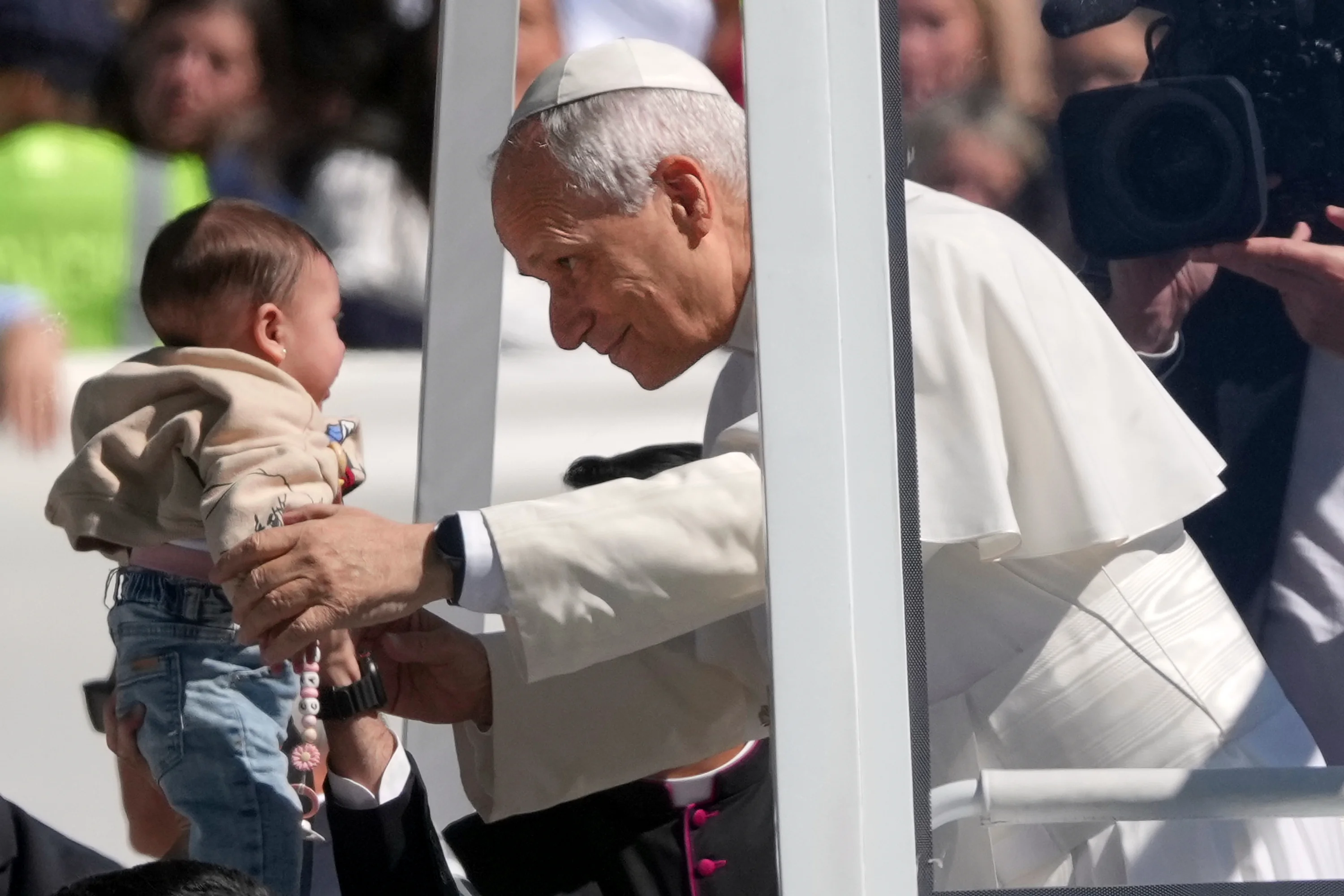
It is easy to look at photographs of a pope smiling from an open vehicle and assume the role carries effortless power. The reality, as historians and longtime Vatican observers often admit, is far lonelier and far more uncertain.
A pope arrives with no army, no legislative vote, and no treasury capable of stabilizing a currency. His only tool is presence—the willingness to stand in a specific place at a specific hour and force the world’s cameras to look where they might otherwise turn away.
In Uruguay, that presence meant honoring a quiet, orderly society without trying to conquer it. It meant showing that faith does not require shouting to be heard.
Now, as his aircraft descends toward Ezeiza International Airport outside Buenos Aires, the noise rises again. Millions will line the barriers along Avenida 9 de Julio, holding up homemade banners, lifting toddlers onto their shoulders, hoping for a glimpse of white fabric moving through the crowd. Among them will be devout grandmothers clutching wooden rosaries, skeptical university students curious about the spectacle, and exhausted workers taking an hour off from second jobs just to feel part of something larger than their daily struggle.
Nobody—not the Vatican planners, not the Argentine bishops, and certainly not the political commentators filling television panels—knows for certain how Argentina will respond once the initial euphoria fades. Public emotion in Buenos Aires can turn on a dime, shifting from roaring affection to sharp critique before the motorcade even reaches the city center.
Yet that uncertainty is precisely what makes this crossing across the Río de la Plata so compelling to watch. Twenty-three miles of water separate two nations with radically different relationships to belief, authority, and hope. One country taught Pope Leo the power of restraint. The other is about to test the depth of his courage.
When the cabin door opens in Buenos Aires and he steps out into the humid southern wind, the speeches printed in his briefcase will matter far less than the expression on his face when he looks out at the crowd waiting below.