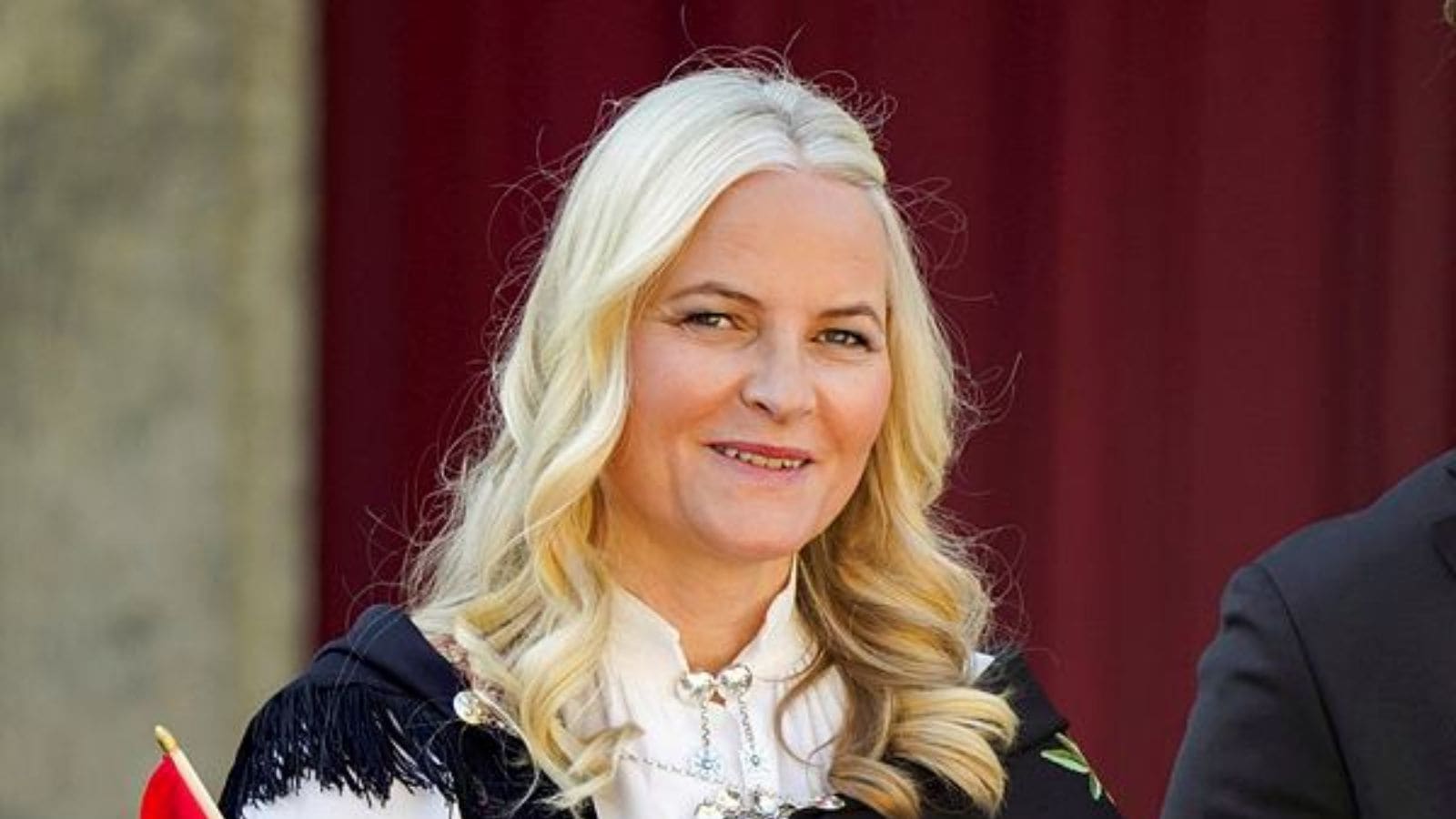
The snow in Oslo has a way of silencing the world, wrapping the stone walls of the Royal Palace in a heavy, white insulation. Inside those walls, life is governed by a rigid architecture of duty, protocol, and the perpetual awareness of one’s own image. But image is a fragile thing. It is not a statue carved from marble; it is more like a reflection in a dark fjord—easily distorted by a single pebble tossed into the water.
Crown Princess Mette-Marit knows this better than most. Her journey into the Norwegian royal family was already a script that defied the traditionalists. She was the single mother with a "rebellious" past, a woman who had walked through the grit of the real world before ascending the steps of the throne. That history gave her a rare currency in the world of royalty: authenticity. People trusted her because she had been one of them.
Then came the shadow of Jeffrey Epstein.
It is a name that acts as a social toxin. To be caught in its orbit is to be stained by association, regardless of intent. When news broke that the Crown Princess had met with the convicted sex offender multiple times between 2011 and 2013, the silence of the Oslo snow felt less like peace and more like a collective intake of breath.
The Anatomy of a Social Trap
Imagine for a moment the social ecosystem of the global elite. It is a world of charities, climate summits, and "brain-tickling" conversations. In these high-altitude circles, the air is thin and the gatekeepers are few. You are introduced to a man who is described as a philanthropist, a connector, a supporter of global health initiatives. He is wealthy, yes, but more importantly, he is present. He is at the tables where the world’s problems are supposedly being solved.
For Mette-Marit, the connection wasn't born in a vacuum. It was facilitated by mutual acquaintances in the international social circuit. She was, at the time, deeply involved in global health work, specifically with UNAIDS.
Epstein was a predator who specialized in the "social camouflage" of legitimacy. He didn't always lead with his darkness; he led with his Rolodex. He offered intellectual stimulation. He offered access. He offered, in the Princess’s own words, to "tickle the brain."
It is a chilling phrase in hindsight.
It suggests a hunger for intellectual engagement that Epstein was masterful at exploiting. He positioned himself not just as a financier, but as a catalyst for ideas. For a royal often confined by the scripted nature of her role, the promise of a raw, unvarnished intellectual exchange can be an intoxicating lure.
The Meetings in the Shadows
The facts are uncomfortable. The Crown Princess met Epstein in social settings, including a meeting at his home in New York and several encounters in London. These weren't accidental run-ins at a gala. They were deliberate.
Yet, there is a crucial distinction that often gets lost in the heat of a scandal. At the time of these meetings, Mette-Marit claims she was unaware of the full extent of Epstein’s crimes. He had already served a short sentence in Florida by 2008, a "sweetheart deal" that was not yet the global lightning rod it would become after the 2019 reporting by the Miami Herald.
To the world in 2011, Epstein was a man who had "had some legal trouble" but remained a fixture at the edge of the world stage. He was the man who flew presidents and scientists on his private jet.
The Princess eventually broke her silence.
"I never would have had anything to do with Epstein if I had been aware of the seriousness of the crimes he had committed," she stated. "I should have looked more closely into his past."
It was a rare moment of royal vulnerability. It wasn't a polished PR deflection; it was an admission of a blind spot. It was a confession of being fooled.
The Cost of the Crown
In the halls of power, information is supposed to be the primary defense. Royals have teams of advisors, security details, and intelligence briefings. This raises the question that many Norwegians—and the international community—began to whisper: How did the palace fail to vet a man with a criminal record?
The answer is often more human than conspiratorial. When a royal travels in a private capacity, or meets "friends of friends," the formal vetting process often softens. Influence works through osmosis. If a trusted diplomat or a high-ranking official introduces you to someone, you assume the work has already been done. You trust the filter of your social circle.
Epstein lived in the gaps between those filters.
He didn't just target the vulnerable; he targeted the influential to create a shield of perceived respectability. If a future Queen of Norway is sitting in your living room, who are the police to question what happens in the basement? Every handshake with a person of integrity was, for him, a brick in a wall of impunity.
The Invisible Stakes
Why does this matter now, years after Epstein’s death in a Manhattan jail cell?
It matters because it highlights the terrifying efficiency of social grooming. If a woman with the resources of a monarchy can be drawn into the periphery of a predator, what does that say about the rest of our institutions?
The stakes aren't just about a tarnished reputation or a few awkward headlines in the tabloids. The stakes are the survivors. Every time a public figure admits to a "brain-tickling" connection with a man like Epstein, it serves as a reminder of how the powerful were utilized as unwitting scenery in a house of horrors.
The Crown Princess expressed deep regret. She spoke of her sympathy for the victims. But the reality of royal life is that your presence is your policy. Where you stand, and with whom you stand, defines the values of the nation you represent.
The Fading Echo
The Norwegian public is famously pragmatic. They value the monarchy, but they value honesty more. By addressing the connection directly, Mette-Marit attempted to cauterize the wound. She didn't hide behind a spokesperson’s "no comment." She stepped into the light, even though that light revealed a mistake.
But the ghost of the association lingers. It sits in the back of the room during every speech she gives on human rights or the protection of the vulnerable. It is the silent "but" at the end of every sentence.
History is a relentless editor. It tends to flatten complex human experiences into single bullet points. For Mette-Marit, the bullet point of her youth—the "party girl" turned Princess—was replaced by a much darker association.
She remains a figure of significant popularity in Norway, a woman who has used her platform to advocate for those on the margins. Perhaps that is why the Epstein connection stung so deeply. It felt like a betrayal of the very empathy she had built her public life upon.
We want our leaders to be infallible, yet we also want them to be human. In the case of the Crown Princess, we got the latter. We saw a person who sought out intellectual stimulation and found herself in the company of a monster. We saw the failure of the "filters" that are supposed to protect the highest offices in the land.
The snow continues to fall over Oslo. It covers the tracks of the day, smoothing over the ruts in the road and the footprints on the palace grounds. But under the ice, the memory of the handshake remains. It is a reminder that in the interconnected web of the global elite, the most dangerous thing you can do is fail to look behind the curtain of a charming introduction.
The "brain-tickle" was a trap. The Princess escaped with her title, but she left a piece of that hard-won authenticity behind in a New York townhouse.
Would you like me to analyze how other global figures have navigated the fallout of their associations with Epstein?