The marble floors of the United States Capitol do not care about time. They have absorbed the footfalls of generals who went on to lose empires, of senators who argued about the price of iron and the shape of a continent, of young pages running with notes that changed the balance of the world. Those floors are cold, dense, and indifferent.
On a quiet afternoon, a wheelchair moved across that marble.
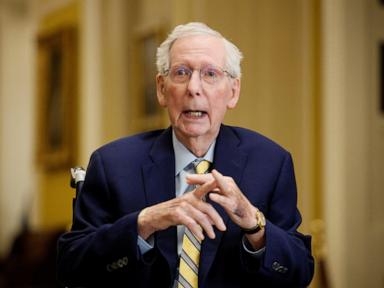
In it sat Mitch McConnell.
To watch the junior senator from Kentucky navigate the halls of power is to watch a study in pure endurance. For decades, his presence in Washington was defined by an eerie, calcified stillness. He was the man who counted votes like a jeweler weighs diamonds—quietly, ruthlessly, without a wasted gesture. He moved through the corridors with a deliberate, measured cadence that signaled he intended to outlast every room he entered.
Then came the fractures. The falls. The frozen moments before bank of television cameras where his gaze drifted into a private distance, searching for a thought that seemed just out of reach.
Now, the wheelchair.
We live in a culture that treats physical decline as a personal failure or a political vulnerability, an inconvenience to be hidden behind closed doors or rushed past with a PR team trailing behind. We prefer our leaders carved from granite, unchanging and immortal, standing behind mahogany podiums until the clock runs out. But mortality is a stubborn tenant. It does not send advance notice. It arrives uninvited, knocking over coffee cups, stealing words from the tongue, and demanding a reckoning with the fragile machinery of the human body.
Consider what happens next in that chamber.
When a man who has held the levers of American legislative power for a generation returns to the floor seated, the calculus of the room shifts. The whispers stop. The aides slow their pace. The senators who spent years plotting against him, or bowing to him, are forced to look at something they spend their entire lives avoiding: the physical cost of a life spent in service to an institution that consumes its inhabitants whole.
It is easy to reduce politics to a spreadsheet. We count the bills passed, the judges confirmed, the millions raised, the committee seats won and lost. We treat Washington like a giant chessboard where pieces are moved by disembodied hands. But beneath the procedural maneuvers and the floor speeches lies a brutal physical reality. Power has a metabolism. It burns through sleep, through ligaments, through balance, and through blood.
McConnell’s return to the Senate floor following his hospitalization was not merely a logistical update for the evening news. It was a visible manifestation of an old truth. The work does not stop because the body falters. Or perhaps, more accurately, the man cannot stop because the work is all that remains.
For months, medical bulletins had trickled out. Concussions from a dinner party fall. Rib fractures. Staring spells that sparked frantic cable news speculation about the future of Senate leadership. Every public appearance was parsed by neurologists on Twitter and political strategists looking for a sign of weakness. Every wobble was turned into content.
Yet there he was, rolling past the bust of Abraham Lincoln.
There is a profound loneliness in aging publicly. Most of us get to grow old in private. Our stumbles happen behind closed doors, witnessed only by family members who love us or care workers who tend to us with professional tenderness. Our cognitive slips are whispered about over Sunday dinners, not broadcast in high-definition across global networks. We are allowed to fade slowly, offstage.
For public figures, the fade is public property. Every ounce of lost strength is tabulated by opponents. Every tremor becomes a talking point in an upcoming primary.
Yet, strip away the partisanship, the anger, the decades of legislative trench warfare that left deep scars across the American political landscape, and you are left with a fundamental human portrait. You see a man who has structured his entire identity around being the person in the room who knows where the bodies are buried and how the votes are counted. To step away from that room is to cease to exist, at least in the currency of Washington.
To stay in that room while your legs no longer carry you is an act of sheer, stubborn will.
Is it ambition? Undoubtedly. Politics at that level is not fueled by altruism; it is driven by an unquenchable thirst for agency. But it is also something simpler, something recognizable to anyone who has ever watched an aging parent refuse to hand over the car keys. It is the terror of irrelevance. It is the belief that as long as you are breathing the stale air of the chamber, as long as your finger can press the voting button, you still matter.
The wheelchair moved down the aisle. The votes were cast. The procedural gears of the federal government ground forward, indifferent to the mechanics of the vessel operating them.
When the session adjourned, the lights in the chamber dimmed. The reporters packed up their laptops. The aides gathered their briefing books. The marble floors grew quiet once more, waiting for tomorrow's performance, indifferent to the footprints and the wheel tracks left behind by those who crossed them.