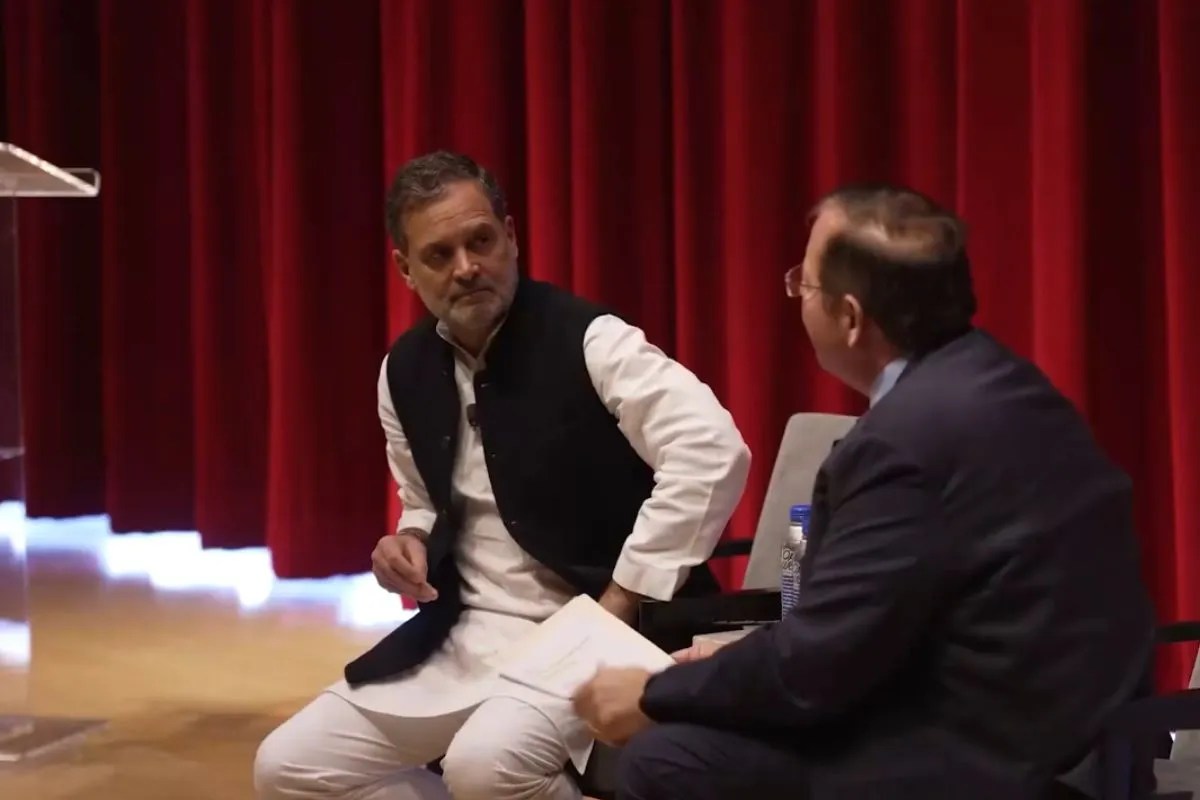
Silence. That is the first thing a foreign policy speech usually creates when it touches a burning border thousands of miles away.
You sit in a room with heavy velvet curtains and water glasses that sweat onto polished wood. Outside, traffic hums like a distant river. Inside, someone reads a line that refuses to sit quietly on the page. India must not bow to anyone’s pressure. Not over Israel. Not over Gaza. Not when capitals far from New Delhi whisper that loyalty is a binary choice between one flag and another.
I have spent enough years watching diplomatic cables move across desks to know how small words can suddenly feel like bricks. A phrase spoken in Parliament or a press briefing does not stay inside a microphone. It travels. It lands on the desk of a trade negotiator in Brussels or Washington. It echoes in a refugee shelter where clean water is rationed by the cup. It reaches a family in Kerala or Lucknow whose relative works in the Gulf and wonders whether regional tension will choke remittances or flight routes.
When Rahul Gandhi argues that India should not yield to outside pressure on the Israel-Gaza conflict, he is stepping into one of the oldest and most unforgiving arguments in statecraft. What does sovereignty actually mean when the world pushes hard on your shoulder? Does it mean standing apart in moral solitude? Does it mean balancing ancient friendships and urgent modern interests without letting stronger powers dictate your conscience? Or does it risk sounding vague when people on the ground are demanding clear, unambiguous moral lines?
Let us be honest from the start. I do not have a crystal ball that shows every backroom phone call between ministries, nor can any observer claim complete certainty about how every diplomatic signal is decoded in Tel Aviv, Ramallah, Cairo, or Washington. Foreign policy is messy. Sometimes the moral instinct and the strategic calculation pull in opposite directions, and pretending the choice is simple only makes the noise louder.
To see why a call against external pressure hits so close to the bone, consider a hypothetical scenario. Picture Meera, a mid-level logistics analyst in Mumbai whose firm ships pharmaceuticals and medical supplies across West Asia. She is not a diplomat. She does not read white papers on Middle Eastern geopolitics over morning chai. Yet every time missile alerts flash on her phone or a port faces delays, her workday stretches into midnight. She tracks freight insurance premiums that jump overnight. She listens to her younger cousin in Dubai talk about how tense the neighborhood feels even when daily life looks calm on the surface. For Meera, foreign policy is not an abstraction debated on television panels. It is whether a shipment of insulin arrives on time and whether her family’s savings stay steady.
Now widen that lens slightly. Imagine another hypothetical character, Tariq, a young history graduate in Delhi who follows news from Gaza on grainy mobile streams late at night. When he sees images of flattened apartment blocks, hospital generators running low on fuel, and children pulled from dust, he feels a sharp, aching anger that makes textbook diplomacy sound cold. When Tariq hears a politician warn against bowing to external pressure, he listens for something specific: will India stand firmly for civilian protection, international law, and Palestinian statehood without flinching when powerful allies urge caution?
Meera and Tariq are invented figures, built to give human weight to forces that usually appear only as headlines. The underlying dilemma, however, is real and recurring. India’s relationship with Israel has grown deep over recent decades—spanning defense technology, agriculture, counterterrorism, and intelligence. At the same time, India’s ties with Arab nations and its longstanding support for the Palestinian cause are woven into decades of history, energy security, and the lives of millions of Indians living and working in the region.
Pressures rarely arrive wearing a badge that says Pressure. They come disguised as urgency, alliance solidarity, supply-chain convenience, or quiet warnings about what happens if you do not pick a side quickly enough.
When Quiet Rooms Turn Loud
Diplomacy used to look like a chess game played behind frosted glass. Moves were measured in months, communiqués were sanded down until every sharp edge vanished, and public statements rarely broke ranks unless a crisis boiled over.
That era feels thinner every year. Today, every vote at the United Nations, every press statement from New Delhi, and every pause in rhetoric is dissected in real time across social media feeds and cable studios. A single sentence from an opposition leader or a ruling minister can trigger accusations of appeasement from one side and accusations of cowardice or moral blindness from the other.
Think of statecraft like steering a heavy cargo vessel through narrow straits when crosswinds hit from both beams. A small boat can spin on a dime. A giant ship carries momentum, and momentum cuts both ways. If you turn too sharply toward one wind, you risk scraping the reef on the other side. If you freeze completely, the current still drags you forward.
When Rahul Gandhi says India should not bow to pressure on Israel and Gaza, he is touching a nerve that runs right through that strait. For decades, India prided itself on strategic autonomy—a phrase that sounds dry in textbooks but means something vital in practice: the right to decide your own path rather than becoming a junior partner in someone else’s quarrel.
Yet critics often ask a pointed counter-question. Autonomy from whom, and toward what end? If a country refuses to bend to Western or Israeli pressure, does it also resist pressure from domestic lobbies, arms suppliers, or regional blocs? And when civilians are dying in Gaza or hostages are held in captivity, is invoking "no external pressure" enough if the concrete actions on the ground feel cautious or incremental?
Those are fair questions. A serious citizen does not have to agree with every political speech to recognize the tension at its core. Watching families grieve on both sides of a brutal conflict strips away polite euphemisms. When bombs fall on densely packed neighborhoods, when humanitarian aid trucks wait at crossings, and when political leaders trade slogans thousands of miles away, ordinary people can smell the gap between high-minded rhetoric and real leverage.
The Invisible Stakes Beneath Headlines
Most coverage of a political statement on West Asia focuses on who said what, who clapped, and who criticized whom on prime time. That surface drama is easy to film. It is also the least revealing part of the story.
Look underneath the shouting match and you find three quiet currents shaping every decision.
First comes the human geography of the Gulf. Roughly nine million Indians live and work across West Asia. Nurses in Riyadh, engineers in Doha, construction workers in Abu Dhabi, shopkeepers in Muscat. Their wages send money back to villages and towns across India, paying for school fees, medical bills, and wedding expenses. When regional instability flares, those lives sit right inside the blast radius—economically, logistically, and emotionally.
Second comes defense and technology. Over the past thirty years, India and Israel built a partnership that moved from quiet backchannels to open cooperation in surveillance systems, drones, missiles, and agricultural drip irrigation. In a neighborhood where border threats are constant, access to reliable defense hardware and intelligence cooperation is not a trivial matter. Leaders who manage national security rarely treat those ties casually.
Third comes moral memory and global standing. India’s freedom movement shaped a tradition of anti-colonial solidarity and vocal support for oppressed peoples. Many Indians still measure their country’s greatness not just by GDP growth or missile tests, but by whether New Delhi speaks plainly when innocent civilians are crushed under overwhelming military force.
A metaphor helps here, provided we keep its limits clear. Imagine a house built with two load-bearing beams—one representing hard security and economic interests, the other representing historical solidarity and moral principle. If you neglect either beam for too long, the roof sags. If you yank one beam out to test your strength, the whole frame groans.
When opposition voices push the government not to yield to outside pressure, they are often arguing that the moral and independent beam is being leaned on too lightly while external powers demand alignment. When government supporters defend a measured approach, they often argue that keeping both beams intact requires quiet diplomacy, aid shipments, and careful calibration rather than dramatic public breaks.
Both sides claim to defend India’s true interest. Both sides can point to real risks if the balance slips.
Why Pressure Feels Different Now
Why does the warning against bowing to pressure resonate so strongly whenever Gaza and Israel enter Indian political debate?
Part of the reason lies in how global power has hardened. In a more fractured world, major powers increasingly expect smaller or middle powers to fall into line. Sometimes pressure is explicit—diplomatic nudges, trade leverage, subtle hints about defense cooperation or visa policies. Other times it is softer and more insidious: the assumption that because India shares strategic concerns with certain capitals on one issue, it should mirror their framing on every other issue.
Consider how that feels from inside a policy meeting. Suppose officials in New Delhi are trying to keep humanitarian channels open, protect Indian citizens in the region, maintain ties with Arab partners, and still talk to Israel. Outside voices may push for sharper alignment or warn against statements that could irritate a key partner. Resisting that push takes nerve. Caving to it looks like weakness.
Yet there is another side to this coin that deserves candid scrutiny. Sometimes politicians use the language of resisting external pressure to score domestic points without spelling out what a different policy would actually achieve. Calling for firmness is easy at a podium. Negotiating safe passage, securing diplomatic access, and keeping multiple channels open when tempers are hot is grueling work that rarely makes a snappy clip.
I have watched enough speeches over the years to notice that difference. The strongest leaders—whichever party holds power—are the ones who pair conviction with realism. They know when to say no to outside pressure, and they also know that moral clarity without practical leverage can leave vulnerable people no safer than before.
Still, dismissing the call against external pressure as mere politics misses why so many citizens respond to it. People sense when their country’s voice sounds muffled. When images of starving children or shattered hospitals fill their screens, hearing a clear refusal to be pushed around by foreign capitals feels like a reminder that India has its own mind, its own history, and its own conscience.
What Courage Looks Like in Unforgiving Times
If we strip away partisan spin, what does a serious, independent foreign policy demand in a crisis as painful as Israel and Gaza?
It begins with refusing false choices. Standing against external pressure does not mean abandoning realism, and pursuing strategic partnerships does not require silence when international humanitarian law is strained or civilians pay the heaviest price. A confident country does not need permission from Washington, Tel Aviv, or anywhere else to state its position plainly—nor does it need theatrical posturing that burns every bridge in sight.
It also requires honesty about limits. India is not the sole arbiter of peace in West Asia. No speech in New Delhi alone will halt a rocket barrage or reopen a bombed-out clinic tomorrow morning. Pretending otherwise only breeds cynicism when reality proves stubborn. What India can do—through diplomatic weight, humanitarian relief, consistent support for a two-state solution with security and dignity for both Israelis and Palestinians, and steady protection of its diaspora—matters in real, measurable ways.
Think back to Meera in Mumbai and Tariq in Delhi. Meera wants stability so life and livelihoods do not unravel under sudden shocks. Tariq wants his country’s voice to ring out clearly for human dignity when suffering is plain to see. Neither of them is asking for recklessness. Both are asking for a spine that does not bend at the first cold gust from abroad.
Borders may be far away, and diplomatic cables may read like dry prose, but the choices made around them reach straight into ordinary homes. A steady voice in a storm does not calm the sea by magic. It reminds everyone on board that the helm is still held by hands that refuse to let go.


