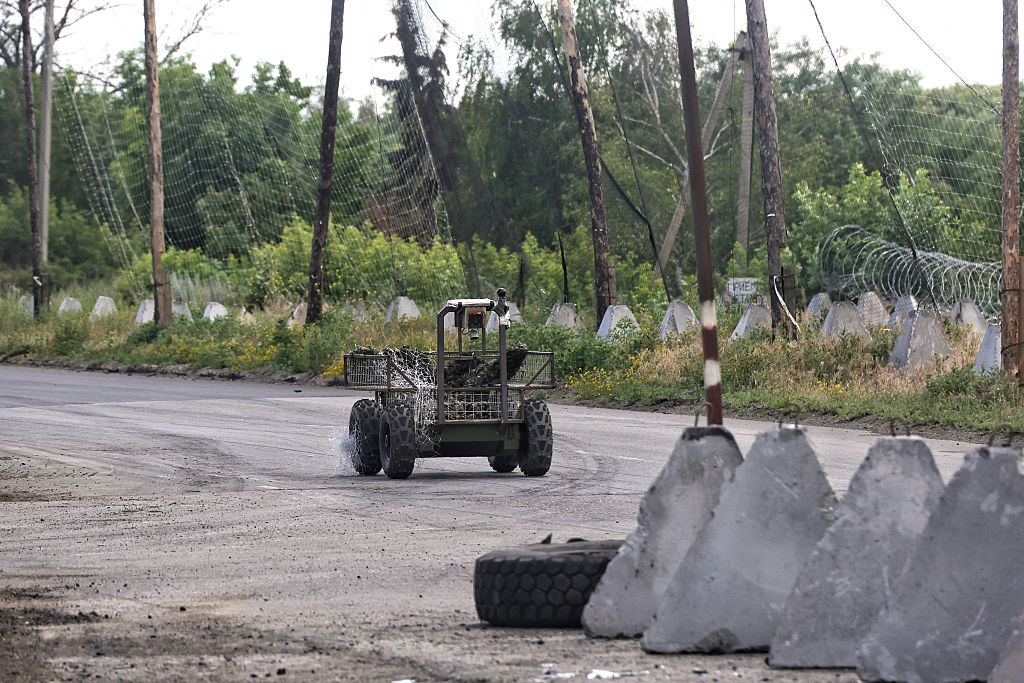
Everyone loves a David versus Goliath story. It is the ultimate narrative comfort food. A plucky underdog takes a punch, stands back up, and defies the odds while the pundits cheer from the safety of cable news desks. For years, the media machine has fed us a steady diet of triumphant headlines, framing the conflict in Eastern Europe as a straightforward battle of good versus evil where raw moral clarity automatically translates to strategic victory.
Chalk one up for Ukraine, they tell us. Every destroyed tank, every captured treeline, every defiant video message from Kyiv is treated as proof that the arc of the moral universe is bending toward total military triumph.
It is a comforting fantasy. It is also entirely detached from the cold, unyielding mathematics of modern statecraft and attrition.
I have spent years watching strategic analysts look at a map, point to a tactical counter-offensive, and scream breakthrough while ignoring the bleeding structural arteries underneath. The conventional wisdom treats this conflict like a football match where points on a scoreboard dictate the eventual winner. War does not work that way. War is an economic, industrial, and demographic grinding machine. When you look past the social media clips and examine the structural reality of what is actually happening on the ground and in global supply chains, a terrifying truth emerges.
By defining victory as total territorial restoration, the West is sleepwalking into a strategic disaster.
The Fallacy of the Endless Line
Let us strip away the sentimentality and look at the physical mechanics of this war. The lazy consensus relies on a linear projection of momentum. If Ukraine takes back fifty square miles this month, the logic goes, they will take back five thousand square miles next year.
That is not how attrition works.
Attrition compounds exponentially against the side with a smaller demographic base. Industrial warfare consumes bodies and steel at a rate that peacetime economies cannot comprehend. I have watched defense planners underestimate artillery barrel wear and shell consumption rates since the opening weeks of the invasion. They built strategies on spreadsheet assumptions rather than physical constraints.
The industrial capacity of the West to manufacture 155mm shells has struggled to keep pace with daily consumption. Meanwhile, adversaries with command economies and suppressed domestic dissent have shifted their entire state apparatus into high-gear war production. North Korea and Iran are filling supply gaps with crude, low-tech reliability that outproduces bespoke Western engineering.
When you trade a high-end, precision-guided missile for a mass-produced drone swarm, you are losing the economic war even if you win the tactical engagement. Every time a million-dollar air defense system intercepts a cheap loitering munition, the attacker wins a war of attrition. The math is brutal. It does not care about your values. It does not care about your righteous indignation.
The Sanctions Mirage
For the first eighteen months of the conflict, the narrative was absolute: economic sanctions would bring the aggressor state to its knees. Western leaders stepped up to podiums and promised that financial isolation would collapse the ruble and starve the war machine of cash.
It was a catastrophic miscalculation born of institutional hubris.
Globalized commodities do not care about national borders. Oil and gas found new transit routes through non-aligned middlemen in the Global South. Ships went dark, ownership structures became deliberately opaque, and hydrocarbons flowed seamlessly from sanctioned ports to eager refineries in Asia. The global economy fractured into parallel trading blocks, and Western influence over international trade channels shrank rather than expanded.
We mistook financial integration for absolute leverage. We assumed that because Wall Street and London dominate global finance, every nation would bow to regulatory pressure. Instead, we incentivized half the world to build alternative payment rails that bypass the dollar entirely.
The sanctions did not break the target economy. They accelerated the decoupling of the global financial system. That is not a victory. That is an unforced strategic error of historic proportions.
The Demographic Bleed
We must talk about the human cost, and not just in the sanitized language of casualty statistics. Nations are defined by their living populations.
Millions of citizens have fled westward, integrating into European labor markets where aging populations quietly welcome young, educated workers. But those refugees are not coming back. When a mother relocates her children to Berlin or Warsaw, finds an apartment, and enrolls her kids in local schools, the psychological anchor to the homeland frays.
A nation can rebuild concrete, steel, and asphalt with foreign aid and international loans. It cannot easily replace a lost generation of working-age adults and children. The demographic deficit was already severe before the first shot was fired. Today, it is an existential freefall. Winning a war over ruined fields while your demographic core empties out into Western Europe is a hollow, pyrrhic outcome.
The Myth of Unconditional Support
Politicians love to declare that they will support an ally "for as long as it takes." It sounds noble. It plays well in speeches. It is also a geopolitical impossibility.
Political will has a half-life. Domestic economic pressures, inflation, housing crises, and voter fatigue inevitably erode the appetite for open-ended foreign expenditures. When grocery bills climb and infrastructure at home crumbles, the public's tolerance for writing blank checks begins to curdle.
By pretending that infinite support is a sustainable policy rather than a temporary window of political convenience, Western leaders failed to establish a realistic end-state. They refused to define what victory actually looked like, substituting moral slogans for a concrete military strategy. When you have no defined destination, every road looks like the right one until you drive off a cliff.
The Strategic Diversion
While Washington and Brussels fixate entirely on a single theater, the geopolitical tectonic plates are shifting elsewhere.
Global adversaries are watching, learning, and adapting. They are stress-testing their supply chains, observing how modern drone warfare scales, and preparing for future conflicts in other regions. Every artillery shell shipped to one front is a shell missing from another strategic stockpile.
The United States military cannot fight a two-front war against peer competitors today. Decades of counter-insurgency operations in the Middle East hollowed out our industrial base, and current stockpiles are being drained faster than they can be replenished. By treating this European conflict as the sole litmus test of global order, we have blinded ourselves to broader systemic threats in the Indo-Pacific and beyond.
The Hard Truth About Peace
We have created a cultural taboo around the concept of negotiated settlements. To suggest that a conflict should end at a negotiated line rather than total military victory is treated as moral cowardice.
This is dangerous delusion.
Every major war in human history has ultimately ended at a negotiating table. Wars of absolute annihilation are rare, and when they do occur, they leave behind smoking ruins that destabilize entire continents for generations. The longer this war drags on past the point of diminishing strategic returns, the more dependent Ukraine becomes on foreign patrons, turning a sovereign state into a permanent protectorate sustained by international life support.
Real leadership requires the courage to puncture comforting illusions. It means looking at casualty reports, industrial output metrics, and global economic shifts, and having the spine to say that our current trajectory leads to ruin.
Chalk one up for wishful thinking. The real world does not grade on a curve.
Stop pretending that throwing more steel at a demographic meat grinder changes the laws of economic gravity. Face the reality of the math, abandon the dangerous addiction to perpetual stalemate, and start planning for the world as it actually is, not as cable news wishes it to be.


