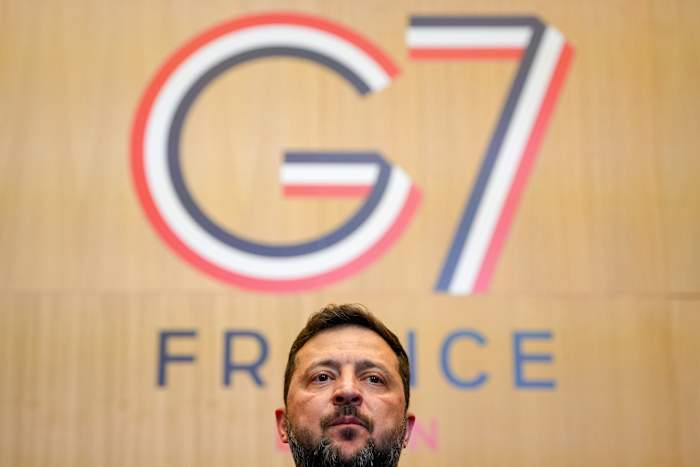
World leaders just wrapped up their latest high-stakes huddle in France, and the message coming out of Evian-les-Bains sounds incredibly familiar. Ukrainian President Volodymyr Zelenskyy walked away from the 52nd G7 Summit with a fresh stack of pledges for air defense systems, economic pressure on Moscow, and energy infrastructure protection.
If you feel like you have read this exact headline before, you aren't alone. This brutal conflict is now grinding through its fifth year. Cynicism is easy right now. With Washington heavily distracted by the outbreak of the Iran war and shifting political tides across Europe, many onlookers assumed Ukraine would take a back seat at this year's summit.
That didn't happen. The joint declaration published overnight shows that global backing for Kyiv remains surprisingly sticky, even as domestic pressures mount for leaders like U.S. President Donald Trump and German Chancellor Friedrich Merz. But beneath the diplomatic glad-handing, the actual dynamics of this war have changed dramatically. The promises made this week aren't just a repeat of 2023 or 2024. They reflect a completely new phase of the conflict.
The Patriot Missile Crunch and the Manufacturing Shift
For years, the West followed a simple playbook. Ukraine asked for weapons, and Western nations dug into their existing stockpiles to ship them over. That model is officially broken. The conflict in the Middle East has heavily depleted American stockpiles of Patriot air defense missiles, leaving Kyiv dangerous exposed to Russia's strategic bombing campaign.
Zelenskyy made it clear on X that additional air defenses were his top priority in France. While the G7 promised more capabilities, they notably avoided specifying exactly what weapons they would send or when they would arrive.
Instead, the real breakthrough lies in a shift toward domestic production. The G7 leaders announced they are looking into granting Ukraine licenses to manufacture Western-designed weapons on its own soil. Kyiv has been aggressively pushing for the permits required to build Patriot missiles locally.
This tells us that the West is finally acknowledging that this war cannot be sustained by dwindling foreign stockpiles alone. Building high-tech defense systems inside a country under active bombardment is an incredible logistical nightmare, but it is fast becoming the only viable path forward.
How Ukrainian Drones Changed the Equation inside Russia
The rhetoric from Western officials at the summit was noticeably more upbeat regarding Ukraine's recent battlefield performance. Canadian Prime Minister Mark Carney openly remarked that the tide is turning in Kyiv's favor. This isn't just diplomatic cheerleading.
Over the last few months, Ukraine's military strategy has relied heavily on long-range, high-tech drone strikes. These aren't just defensive tools anymore. Ukrainian drones are actively pinning down Russian troops on the front lines, choking off supply routes in occupied territories, and systematically striking oil refineries deep inside Russia.
By hitting the infrastructure that funds Moscow's war economy, Ukraine has accomplished two things. First, it crippled a vital source of revenue for the Kremlin. Second, it brought the reality of the war directly to the Russian public. For years, Vladimir Putin successfully framed this conflict as a distant special military operation that didn't affect the average citizen in Moscow or St. Petersburg. The smoke rising from domestic oil facilities has shattered that illusion.
This newfound battlefield momentum gave Zelenskyy significant leverage in France. He wasn't arriving as a desperate petitioner begging for survival. He arrived with proof that his military can inflict serious, systemic damage on Russia if given the right tools.
The Distraction Factor and Putin's Strategy
We have to look honestly at the competing priorities facing the G7. The war involving Iran has consumed an enormous amount of political energy in Washington. Putin understands this perfectly. The Kremlin's strategy relies entirely on outlasting Western patience and waiting for the United States to completely turn its attention elsewhere.
Kremlin spokesperson Dmitry Peskov recently hinted that Zelenskyy could travel to Moscow for direct talks, provided he was ready for responsible and serious discussions. It sounds like an opening for peace, but it is a classic diplomatic trap. Putin wants to bypass European leaders entirely and negotiate Ukraine's future directly with Washington, aiming to secure a deal that freezes the conflict on his terms while the U.S. is busy in the Middle East.
The G7 joint statement was an explicit rejection of that strategy. By doubling down on sanctions against Russia's oil and gas sectors, and promising to strengthen investigations to freeze and seize Russian virtual assets, the G7 is trying to show Moscow that its economic pain will only intensify.
What Happens Next
Words and declarations don't intercept ballistic missiles. The real test of the 2026 G7 summit will play out over the coming weeks through concrete actions.
Watch the European Union summit in Brussels next. Ukraine officially started EU membership negotiations this week, and Zelenskyy is heading straight to Belgium to lock in those diplomatic gains.
Keep a close eye on the actual transfer of weapon blueprints and manufacturing licenses. If Western defense firms drag their feet on allowing Ukraine to build its own air defense components, the pledges made in France won't mean much when winter arrives and Russia resumes its attacks on the Ukrainian energy grid.
The Western alliance showed it can still put on a unified front when the cameras are rolling. Now they have to prove they can deliver the industrial capacity to back it up.