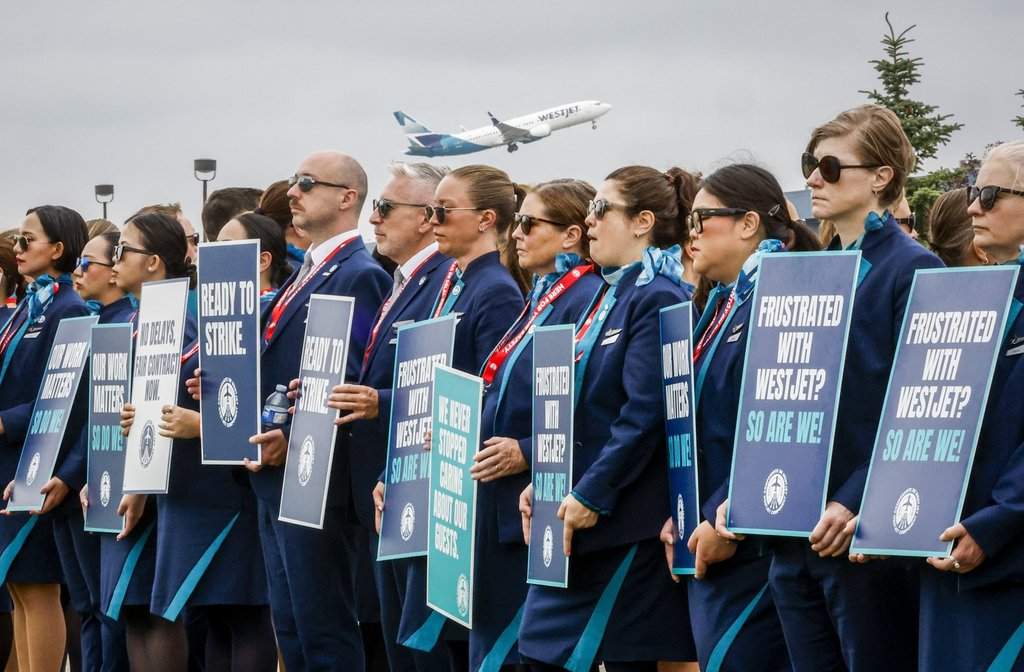
The headlines are bleeding panic. The regular commentators are running their usual script. WestJet flight attendants have voted overwhelmingly in favor of a strike mandate, with the clock ticking down toward an August 2 deadline. Mainstream financial analysis says this is a disaster for a carrier trying to stabilize its operations. The travel vlogs are telling passengers to cancel their summer vacations.
They are all missing the real story.
A strike mandate is not the beginning of the end. In the brutal, low-margin reality of post-pandemic aviation, a labor showdown is the exact pressure test WestJet needs to force a reality check on both its balance sheet and its workforce. The lazy consensus screams that labor disruption destroys shareholder value. The inverse is true: prolonged labor peace built on unsustainable compromises is what actually kills an airline.
The Cost Certainty Illusion
Aviation executives love predictability. They spend millions on fuel hedging and fleet planning just to remove variables from the equation. When a union delivers a 90-plus percent strike vote, management teams usually panic and look for the quickest way to buy peace.
That is a catastrophic mistake.
When you buy peace in the airline industry, you usually buy it by indexing your future labor costs to the highest peak of the current economic cycle. The competitor analysis focuses entirely on the immediate price of canceled flights and rebooking fees. What they ignore is the long-term structural drag of a bloated collective agreement signed under duress.
I have watched airlines bleed cash for a decade because they folded during a summer peak negotiation. They avoided a two-week shutdown but inherited a permanent 15% inflation spike in their operating expense line. In aviation, capacity discipline and cost control are the only things keeping you out of bankruptcy protection.
A strike vote creates something far more valuable than temporary calm: it forces absolute transparency. It strips away the posturing. If WestJet management blinks now to save the August long weekend traffic, they cement an uncompetitive cost structure that will haunt them the next time fuel spikes or demand softens.
Dismantling the Consumer Panic Narrative
Let us address the standard consumer advocacy angle that dominates the news cycle whenever a strike looms. The narrative says that the airline is holding the traveling public hostage.
This premise is fundamentally flawed.
Air travel is not a public utility, even if domestic networks in vast countries sometimes make it feel like one. It is a highly volatile commercial enterprise. Passengers want ultra-low-cost fares, perfect on-time performance, and premium service all at once. It is an impossible mathematical equation.
When a union threatens to walk out, it forces a correction in consumer expectations. The risk of disruption prices itself into the market. Travelers who demand rock-bottom prices have to confront the reality of what produces those prices: tight operational margins and highly optimized labor utilization.
If you want absolute certainty, you pay for a legacy global carrier with deep interline agreements and a massive fleet reserve. If you buy a ticket on a carrier restructuring its model, you are trading premium assurance for a lower fare. A labor dispute simply makes that risk profile explicit.
The Operational Reset Nobody Wants to Talk About
Every major airline carries operational debt. This is the accumulation of inefficient scheduling practices, outdated crew looping, and legacy work rules that creep into operations during periods of rapid growth.
Fixing these inefficiencies during normal operations is like trying to overhaul an engine while the car is doing a hundred miles an hour down the highway. The friction is too high. The daily pressure to launch flights overrides the need for structural repair.
A simulated or actual operational stoppage acts as an involuntary hard reset.
- It flushes out the scheduling backlog.
- It forces the optimization of standby crew ratios.
- It strips away the inefficient routes that were only being maintained to satisfy legacy slot requirements.
During a normal month, management lacks the political capital within the organization to cut the dead wood. A strike threat provides the ultimate justification. It allows leadership to audit every single position, every flight pair, and every overnight station cost against a zero-base budget.
Why the Union Underestimates Its Own Leverage Point
The union leadership always plays the same card: the threat of total reputational ruin. They calculate that the fear of bad press will force the board of directors to overrule the executive team and open the checkbook.
This strategy ignores the shifting landscape of corporate finance in aviation. Modern airline valuation is not driven by emotional brand loyalty; it is driven by unit cost metrics like Cost per Available Seat Mile (CASM).
If WestJet signs a contract that pushes its CASM out of alignment with its regional and global peers, the long-term damage to its ability to secure capital is far worse than a temporary hit to its Net Promoter Score. Customers forget delays within six months if the price is right. Investors do not forget structural margin erosion.
By pushing for a strike right at the peak of summer, the union is actually accelerating the timeline toward a definitive resolution. A strike in October can drag on because the financial pain is muted. A strike in August forces an intense, high-stakes negotiation where both sides have to drop the ideological rhetoric and look at the hard data within days, not months.
Moving Past the Binary View of Labor Conflict
The public discussion surrounding the WestJet vote treats labor relations like a sporting match where one side wins and the other loses. This binary view is why most airline reporting is completely useless to anyone trying to understand the business.
A strike vote is a tool of price discovery. Labor is a market commodity, just like jet fuel or aircraft leases. The union is trying to discover the absolute maximum price the employer can pay without collapsing the business. Management is trying to discover the absolute minimum compensation package required to retain qualified personnel and maintain safety standards.
Sometimes, the only way to find that equilibrium point is to step right up to the edge of the cliff.
The competitors are writing post-mortems for WestJet's summer season before a single flight has been canceled. They are missing the strategic opportunity. If handled with absolute discipline, this confrontation will force an aggressive modernization of work rules, establish a realistic cost baseline, and clear out the operational inefficiencies that have plagued the carrier's recent expansion.
Stop looking at the potential walkout as a sign of failure. It is the ultimate diagnostic tool for an airline trying to define what it wants to be for the next decade.