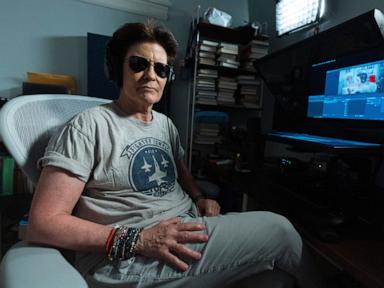
The room was always too hot, intentional or not. A young billionaire would sit under the harsh studio lights, adjusting a collar that suddenly felt suffocating, trying to explain why his platform wasn’t actually breaking democracy. Across from him sat a woman in signature dark aviator sunglasses. She did not take them off indoors. She did not nod politely to make him feel comfortable. She simply waited for him to finish speaking, let the silence hang for a terrifying beat, and then asked the one question he had spent weeks rehearsing how to avoid.
For three decades, Kara Swisher was the self-appointed sheriff of Silicon Valley.
If you built a tech empire, you had to pass through her gauntlet. She knew who was lying, who was crying in the bathroom after a board meeting, and who was genuinely trying to build the future. Tech giants traded in code and capital, but Swisher traded in the one currency they could never fully control: absolute, unvarnished accountability.
But a shift has occurred. The power center of the world moved from the garages of Palo Alto to the servers of Virginia, and now, it is calcifying somewhere else entirely. The tech billionaires grew up, bought media companies, funded super PACs, and realized that controlling the algorithm is only half the battle. To truly dictate reality, you have to control the state.
Swisher noticed. She always notices first. Now, she is turning her sights toward the 2028 presidential campaign, signaling a fundamental transformation in how political power will be brokered, questioned, and won.
The Architect of Accountability
To understand why a tech journalist entering the political gravity well matters, you have to understand what she built. In the nineties, technology journalism was mostly cheerleading. It was a trade-press echo chamber filled with product specs, breathless praise for basic software, and worshipful profiles of eccentric coders. Swisher saw something different. She saw raw, unchecked power disguised as boyish optimism.
She treated tech executives not like inventors, but like politicians.
Imagine a local mayor deciding to tear down a public park to build a private highway without asking anyone. That is what tech companies were doing to the public square every single day. Swisher treated them with the exact level of skepticism that reality demanded. Her reporting at The Wall Street Journal, her creation of the AllThingsD conference, and later her work at Recode and The New York Times became the definitive record of the digital age.
Her weapon was never malice. It was deep, institutional memory. When an executive tried to pivot or rewrite their own history, she would quote their own private emails from five years prior back to them. She understood that tech founders suffered from a systemic lack of historical perspective. They believed every problem they encountered was entirely new, a unique puzzle only their brilliant minds could solve. She constantly reminded them that human greed, arrogance, and vanity are as old as time.
When Silicon Valley Bought the Ballot
The lines between the tech industry and Washington used to be clear. Silicon Valley viewed government as a slow, incompetent dinosaur to be bypassed or ignored. Washington viewed Silicon Valley as a cash cow to be milked during campaign season but otherwise left alone.
That truce is dead.
The turning point was subtle at first. It started with tech executives realizing that regulation was the only real threat to their monopolies. Then came the realization that they could use their immense wealth to actively shape the regulatory environment from the inside out. Consider a hypothetical scenario where a single tech executive controls the satellite network a nation relies on for defense, the social media platform where its citizens get their news, and the artificial intelligence models shaping its education system. That is not a business leader. That is a shadow sovereign.
We are living in an era where tech money does not just fund political campaigns; tech ideology defines them. The libertarian tech elite have moved from funding fringe think tanks to actively backing candidates who promise to dismantle the institutions that regulate them. The 2028 campaign will not be fought over traditional economic theories or standard foreign policy debates. It will be fought over who controls data, who owns intelligence, and who decides what is true.
Swisher’s pivot to this arena is not a career change. It is a pursuit of the story. The story moved.
The New Campaign Trail Lies in the Earbuds
Traditional political media is broken. The Sunday morning talk shows, once the arbiters of political destiny, are watched by an aging, shrinking audience. The standard newspaper profile has lost its teeth, watered down by public relations teams and cautious editors.
The new arena is audio. It is long-form, intimate, and inescapable.
Think about how you consume political information today. It is rarely through a curated evening broadcast. It is a voice in your ear while you run, while you wash dishes, while you commute. Podcasts like Pivot, which Swisher co-hosts with Scott Galloway, and her interview show On with Kara Swisher, have created a blueprint for a new kind of political discourse. It is loose, it is incredibly fast, and it is brutally honest.
Politicians are terrified of this format because they cannot rely on talking points. A talking point sounds reasonable in a thirty-second television spot. It sounds utterly ridiculous when you are forced to defend it across forty-five minutes of intense, conversational scrutiny. Swisher’s gift is her refusal to accept the pivot. When a guest tries to slide away from a difficult truth into a pre-packaged campaign slogan, she calls it out in real time, often with a laugh, but never letting go of the point.
The Stakes of 2028
The next presidential cycle will be the first to fully grapple with synthetic reality. Artificial intelligence will generate deepfakes so convincing that truth will become a matter of faith rather than evidence. Micro-targeted influence campaigns will operate at a scale and precision that makes previous election interference look like a child playing with blocks.
The people running for office are, by and large, completely unequipped to handle this. Most lawmakers still struggle to understand how basic social media algorithms function. They are bringing knives to a laser fight.
This is the vacuum Swisher is stepping into. She bridges the gap between the people who understand the technology and the people who wield the political power. Her influence in 2028 will not be found in endorsement statements or campaign contributions. It will be found in her ability to act as the translator and the interrogator for a confused electorate.
She can look at a candidate’s policy proposal on AI or digital antitrust and tell the public exactly which billionaire tech donor wrote it for them. That is a terrifying prospect for campaigns that rely on voters remaining technologically illiterate.
The View from the Inside
There is a distinct vulnerability in admitting that our democratic systems are fragile enough to be swayed by a handful of programmers and venture capitalists. It is uncomfortable to realize that the guardrails we assumed would protect our institutions are easily bypassed by deep pockets and sophisticated code.
For years, critics argued that Swisher was too close to the people she covered. She dined with them, joked with them, and held court at exclusive conferences. But proximity is often the price of true insight. You cannot understand the psychology of an empire builder from afar. You have to see how they behave when they think no one is watching.
What she saw was not a group of evil geniuses plotting world domination, but rather a collection of deeply insecure, brilliant individuals who lacked a basic understanding of human nature and civic responsibility. They genuinely believed that optimizing an efficiency metric was the same thing as improving society.
Now, those same individuals are trying to optimize the American presidency.
The Next Battleground
The sun is setting over San Francisco, casting long shadows across the empty office buildings that once housed the absolute height of the tech boom. The money is still there, but the energy has drifted. It has drifted eastward, toward Washington, toward Miami, toward the campaign trail.
The traditional political reporters are preparing their standard notebooks, their familiar questions about polling data and swing state demographics. They are looking at the map through an old lens, tracking historical trends that no longer apply in a world dictated by algorithmic feedback loops.
But Swisher is already there, waiting. She has her glasses on. She knows that the real campaign is happening in the private group chats of billionaires, in the code deployment schedules of defense tech startups, and in the hearts of voters who are increasingly unable to distinguish between what is real and what is manufactured.
The tech giants spent decades trying to disrupt everything. They succeeded. Now, the disruption has reached the highest levels of governance, and the woman who watched them build their empires is ready to hold them accountable for what they break next.