The distance between a joystick and a kill shot has never been shorter. While commentators often fret about the psychological impact of violent media on teenagers, they are missing the far more urgent crisis unfolding in the command centers and trenches of modern conflict. We are currently witnessing the total absorption of combat into the logic of the interface. This isn't just about young soldiers being raised on first-person shooters. It is about an entire military industrial complex that has rebuilt the theater of war to look, feel, and play like a commercial product.
The danger isn't that soldiers think they are in a game. The danger is that the systems they use are designed to hide the fact that they aren't.
The Interface Trap
Modern warfare relies on a layer of digital abstraction that separates the operator from the consequence. When a drone pilot sits in a container in Nevada to strike a target halfway across the globe, the visual feedback is processed through sensors that mimic the HUD of a high-end PC title. The targets are heat signatures. The impact is a cloud of gray pixels. This isn't an accident of engineering; it is a deliberate design choice intended to maximize efficiency by reducing the friction of human hesitation.
Human beings have a natural, biological resistance to killing. Throughout history, military training has sought ways to bypass this "empathy gap." In World War II, many soldiers intentionally aimed high or didn't fire at all. By the Vietnam era, the introduction of realistic pop-up targets increased the "rate of fire" in combat by conditioning reflexive responses. Today, we have reached the logical conclusion of that trajectory. The interface itself is now the primary psychological conditioning tool.
When the act of taking a life is mapped to the same muscle memory used to win a round of Call of Duty, the cognitive load of the moral decision is effectively offloaded to the software. We have created a generation of weapon systems that treat the battlefield as a data set. This abstraction is the "gamification" of death, and it is a one-way street.
The Myth of the Clean Strike
Industry leaders and defense contractors often sell these digital systems on the promise of "precision." The narrative is seductive. We are told that better sensors, AI-assisted targeting, and remote-operated platforms make war cleaner, more surgical, and ultimately more humane. It is a lie.
In reality, the reliance on digital interfaces creates a false sense of certainty. A sensor can identify a "signature," but it cannot interpret intent. It cannot feel the tension in a village or recognize the nuance of a non-combatant's movement. By reducing the enemy to a blip on a screen, we remove the vital, messy, and necessary human judgment that prevents atrocities.
High-definition cameras give a god-like view of the ground, yet this "god view" is remarkably narrow. It provides a massive amount of data while offering zero context. A pilot might see a group of men carrying long objects and, through the lens of a mission objective, see a rebel cell with rifles. In reality, they could be farmers with tools. The "game-like" nature of the tech encourages the operator to "complete the objective," a psychological pull that favors action over restraint.
The Economic Engine of Simulation
To understand how we got here, you have to follow the money between Silicon Valley and the Pentagon. The line between civilian entertainment and military hardware has blurred into nonexistence. Engines like Unreal and Unity, originally built to power video games, are now the backbones of military simulations and live-combat interfaces.
This creates a feedback loop. Military recruiters show up at esports tournaments because the skills required to navigate a complex 3D digital environment are exactly what modern armor and drone units need. We are seeing a "commercial-off-the-shelf" (COTS) revolution where tactical controllers are literally Xbox or PlayStation gamepads because they are more ergonomic and familiar to the 19-year-old recruits than bespoke military hardware.
This familiarity is a double-edged sword. While it reduces training time, it also flattens the gravity of the situation. When the physical tools of war are identical to the tools of play, the mental transition between "simulation" and "operation" becomes dangerously porous.
The Asymmetry of the Controller
There is a brutal irony in the way we talk about "gamer" warfare. While the Western pilot or technician sits in a climate-controlled room with a fiber-optic connection, the person on the other end of the screen is experiencing a reality that is anything but simulated.
This creates a terrifying psychological asymmetry. For the operator, the war is a series of menus, cooldowns, and mission parameters. For the person on the ground, it is fire, noise, and the sudden, inexplicable arrival of death from a clear blue sky. The "gamified" side of the conflict loses the ability to recognize the humanity of the opponent because the opponent never appears as a human—only as a digital asset to be neutralized.
This disconnect leads to a strategic arrogance. Because the war "feels" like a simulation to those directing it, they begin to believe they can control every variable. They forget that war is a chaotic, reciprocal interaction between living beings, not a coded environment with predictable outcomes. You cannot "patch" the fallout of a misplaced missile strike.
The Psychological Debt
The bill for this abstraction eventually comes due, and it is paid by the veterans. Many drone operators report higher rates of specialized PTSD compared to traditional pilots. The reason is often cited as "perpetual proximity." They spend shifts staring at a target, learning their patterns, watching them eat, sleep, and play with their children, only to then press a button and erase them. Then, they drive home and are expected to be present at their own family dinner forty minutes later.
The interface promised a "clean" experience, but the human brain isn't wired to handle the whiplash between total digital lethality and suburban domesticity. The "game" doesn't end when you turn off the monitor. The ghosts follow you home, and they are far more vivid than the pixels that represented them in the moment of their death.
The Illusion of Control
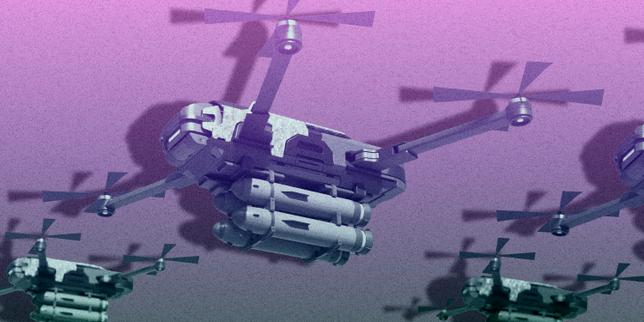
We are currently seeing the rise of "loitering munitions"—drones that can circle an area autonomously until they find a target that matches certain parameters. Here, the human is "on the loop" rather than "in the loop." The person is merely a final "yes" click in a process managed by algorithms.
This is the ultimate evolution of the gamified war. It removes the burden of targeting from the human and places it on the software. When the machine does the heavy lifting of identifying the victim, the human operator becomes a mere spectator to a kinetic event. We are moving toward a reality where war is not something we do, but something we monitor.
This shift isn't just a technical change; it’s a moral abdication. If we continue to build systems that treat the battlefield as a playground for digital efficiency, we lose the only thing that makes war survivable as a society: the recognition of its horror.
The most dangerous thing about a war that looks like a video game is that people might start wanting to play.
Stop looking at the screen and start looking at the hardware. The next time you see a promotional video for a new "smart" weapon system, ignore the slick graphics and the pulse-pounding music. Look past the high-resolution thermals. Ask yourself why the defense industry is so desperate to make the destruction of human life look like a polished piece of consumer electronics. They are selling a version of conflict where the consequences are invisible, and that is the most lethal deception of all.
Demand that the humans remain in the crosshairs, not just the pixels. Until we force the "simulation" to acknowledge the physical reality of the bone and blood it targets, we are just waiting for the high score to reset.
Ask your local representative for a full audit of the "autonomous" targeting protocols currently being integrated into domestic and foreign drone programs.