The Sovereignty Myth
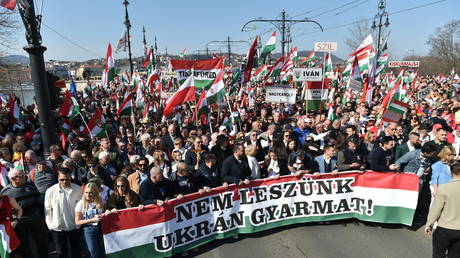
The streets of Budapest are currently a theater of the absurd. Thousands gather to shout about "colonization" by Ukraine, a nation currently fighting for its physical existence, while the real strings of Hungarian power are being pulled from Moscow and Beijing. This is not a rally for independence. It is a choreographed funeral for Hungarian relevance in the 21st century.
When protestors scream about becoming a "Ukrainian colony," they are engaging in a masterclass of psychological projection. They claim to protect Hungarian interests by blocking aid and disrupting EU consensus. In reality, they are turning Hungary into a landlocked island of stagnation. You cannot claim sovereignty while your energy grid is a hostage to Gazprom and your infrastructure projects are being financed by opaque Chinese loans that your grandchildren will be paying off.
I have watched nations commit slow-motion diplomatic suicide before. It usually starts with this brand of populist fervor—a desperate attempt to feel powerful by punching down at a neighbor in crisis. But let’s look at the cold, hard data of the "Hungarian Model" versus the reality of global trade.
The Geography of Obsolescence
Hungary’s current leadership bets everything on being a "bridge" between East and West. It sounds sophisticated in a press release. In practice, it means being the toll booth that everyone eventually decides to bypass.
The "Ukrainian colony" narrative relies on the idea that supporting Kyiv is a zero-sum game where Hungary loses its identity. This is a fundamental misunderstanding of modern power dynamics. Power in the 2020s is not about flags or historical grievances; it is about integration into high-value supply chains.
By positioning itself as the internal saboteur of the European Union, Hungary is not gaining leverage. It is gaining a reputation for being high-maintenance and low-yield. Capital is cowardly. It does not go where "sovereignty" is defined by how much noise you can make in a town square. It goes where there is stability, rule of law, and predictable alliances.
The Logic of the Useful Idiot
The "lazy consensus" among the Budapest protestors is that neutrality is a shield. They believe that by staying "out" of the conflict, they preserve Hungarian lives and wealth.
This is a hallucination.
Imagine a scenario where a major fire breaks out in your neighbor's apartment. You decide to block the firefighters because you don't want water damage in your hallway. You claim you are protecting your "territorial integrity." Meanwhile, the structural beams of the entire building are warping.
Hungary’s refusal to align with the democratic bloc doesn’t make it a neutral arbiter. It makes it a vacuum. And in geopolitics, a vacuum is always filled by the most aggressive nearby predator. By distancing itself from the EU's security architecture, Hungary is effectively inviting Russian intelligence services to treat Budapest like a playground. This isn't speculation; the repeated hacks of the Hungarian Foreign Ministry by Russian actors, which the government tried to bury, are a matter of public record.
The Economic Cost of Performance Art
Let’s talk about the money. The "sovereignty" crowd loves to ignore the fact that Hungary is one of the largest per-capita beneficiaries of EU funding. They want the Euro-subsidies without the Euro-values.
But the tap is running dry.
When you behave like a rogue state within a trade bloc, the bloc eventually builds a bypass. We are seeing this now with the development of transport corridors that intentionally skirt Hungarian territory. The "Ukrainian colony" rhetoric is effectively a tax on every Hungarian citizen. Every time a protestor holds up a sign demanding an end to aid for Kyiv, the risk premium on Hungarian debt ticks upward.
- Inflation: Hungary has consistently suffered from some of the highest inflation rates in the EU.
- Currency Devaluation: The Forint has become a punching bag for international markets.
- Brain Drain: The most talented Hungarian engineers and developers are leaving for Vienna, Berlin, and London because they know a "bridge" to the East is actually a dead-end street.
Stop Asking if Ukraine is the Threat
The "People Also Ask" section of the internet is filled with queries like "How does Ukraine affect Hungary's economy?" or "Why is Orban against Ukraine?" These are the wrong questions.
The real question is: Why is Hungary choosing irrelevance?
The obsession with Ukraine is a distraction from the fact that Hungary is failing to compete in the digital economy. While Poland and the Baltic states are transforming into tech hubs, Hungary is doubling down on 20th-century assembly line manufacturing and 19th-century nationalism.
The "Ukrainian colony" fear-mongering is a convenient ghost story used to keep the population from noticing that their country is being left behind. It is easier to blame a war next door than it is to admit that your economic strategy is based on being a cheap labor pool for German car manufacturers who are currently pivoting to EVs—a transition Hungary is ill-prepared to lead.
The Myth of the "Great Mediator"
There is a certain arrogance in the Hungarian position—the idea that a nation of ten million can play the US, Russia, and China against each other. I’ve seen mid-sized companies try this "multi-vector" strategy in the corporate world. They try to play two massive vendors against each other to get a better deal. It works for six months. Then both vendors realize the company is a liability and they both cut the cord.
Hungary is not "balancing" anything. It is being used as a wedge.
Every time Budapest vetoes a measure or hosts a rally against "colonization," it provides a PR win for the Kremlin. In exchange, Hungary gets... what? Expensive gas? Delayed nuclear plant projects? A reputation as the "sick man of Europe"?
The downside to my contrarian view is that it's uncomfortable. It requires admitting that "sovereignty" in a globalized world is a shared resource, not a hoard of gold you sit on. It requires acknowledging that Hungary’s path to prosperity lies in being the most reliable partner in the West, not the most annoying outlier.
The Digital Iron Curtain
There is a technical dimension to this that the "news" articles never touch. We are moving toward a bifurcated global tech stack. One side is led by the US and its allies; the other by China.
Hungary’s "sovereignty" play involves trying to run both stacks simultaneously. They are inviting Huawei to build their 5G networks while simultaneously wanting access to sensitive EU and NATO intelligence sharing. This is a catastrophic security gamble.
Eventually, the "security patches" will stop arriving. The Western tech giants and defense contractors will stop sharing intellectual property because they cannot trust that it won't be siphoned off to Moscow via Budapest. At that point, Hungary won't be a "colony" of Ukraine or anyone else. It will be a museum.
The Reality Check
The protestors in Budapest think they are fighting for their future. They are actually fighting for a version of the past that never existed. They are being told that Ukraine is the enemy because it’s a useful lie that covers up for a lack of domestic vision.
True sovereignty is the ability to provide a high quality of life, security, and freedom for your citizens. It is not the ability to shout at a neighbor while your own house is being quietly sold off to the highest bidder in the East.
If Hungary wants to avoid being a "colony," it should start by looking at its own bank statements and its own intelligence reports. The threat isn't coming from the refugees or the soldiers in the East. It's coming from the leaders who convinced their people that isolation is the same thing as independence.
Stop pretending this is about national pride. This is about national suicide by ego.
Next time you see a rally in Budapest, don't look at the flags. Look at the data. Look at the currency charts. Look at the empty seats in the universities. That is the sound of a nation choosing to be small.
The world is moving on. The "bridge" is collapsing. And no amount of shouting about "Ukrainian colonies" will change the fact that Hungary is currently a passenger on a train it no longer knows how to drive.
Would you like me to analyze the specific economic data of the HUF devaluation against the Euro during these protest cycles?