The news that a six-year-old Ebola patient taken from a DR Congo hospital was found safe and doing well brings a massive sigh of relief. It also exposes a raw, terrifying reality about how global health crises play out on the ground. When a young child disappears from an isolation ward, Western observers usually panic. They assume the worst. They blame ignorance or malice.
The truth is way more complex.
Living through an Ebola outbreak in the Democratic Republic of the Congo means navigating a web of deep-seated fear, historical trauma, and broken promises. To understand why a desperate family would break their own child out of a specialized medical facility, you have to look past the sterile statistics. You have to see the crisis through the eyes of the community.
When we look at the mechanics of containment, tracking down an escaped patient isn't just about security. It's a delicate dance of community diplomacy. Here is what really happens when an Ebola patient goes missing, why families take that risk, and how field teams manage to bring them back alive without triggering a localized riot.
The Terror Behind the Plastic Walls
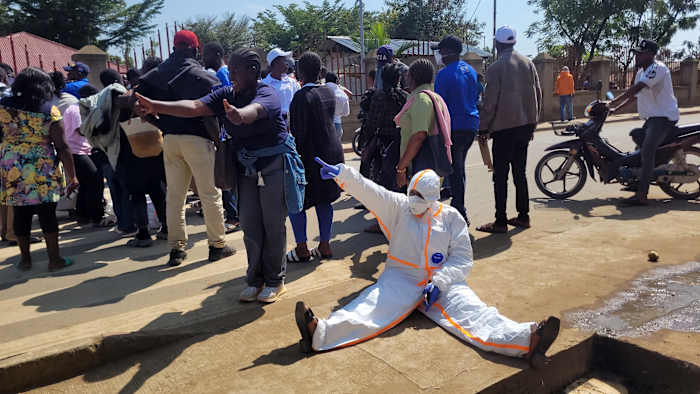
Ebola treatment centers are intimidating places. Imagine your six-year-old child wakes up with a burning fever, vomiting, and bleeding. You take them to a clinic. Suddenly, white van-like vehicles roll in. People climb out wearing head-to-toe white hazmat suits, goggles, and thick rubber gloves. They look less like doctors and more like space aliens.
They take your child away. They put them behind heavy plastic sheeting.
You aren't allowed to touch them. You can barely see their face through a foggy window. For a parent in a remote village in North Kivu or Equateur province, this doesn't feel like medical care. It feels like an abduction.
Historically, early Ebola treatment units had shockingly high mortality rates. Communities watched loved ones walk into these tents and leave in body bags. Rumors spread fast. Some believed the Western doctors were stealing organs. Others thought the bleach sprays used for decontamination were actually spreading the virus. If you think your child is going to die alone in a plastic tent, your parental instinct tells you to run. You want them home. You want to comfort them. You want to use traditional remedies you actually trust.
This isn't anti-science behavior. It's a desperate act of love.
Health organizations like the World Health Organization and Doctors Without Borders learned this the hard way during major outbreaks. When medical teams rely purely on force or top-down mandates, communities revolt. They hide the sick. They bury their dead in secret, bypassing safe burial protocols and accelerating the spread of the virus.
Tracking a Missing Patient Without Causing a Panic
When a patient disappears from a ward, the clock starts ticking. Ebola spreads through direct contact with bodily fluids. A bleeding, vomiting six-year-old child is highly infectious. Anyone who helps transport that child, cleans up after them, or holds their hand risks contracting a virus that can kill up to 90% of those it infects.
The response teams can't just send in armed police. Doing that destroys whatever fragile trust exists between the medical community and the public.
Instead, the response relies on local contact tracers and community liaisons. These are often people from the exact same neighborhoods or villages. They know the families. They speak the local languages, like Swahili or Lingala. They don't show up in hazmat suits. They show up in regular clothes, sitting down with the parents to listen to their fears.
The priority is negotiation. Field teams offer reassurances. They promise the parents that they can stay close to the treatment center. They explain the benefits of new monoclonal antibody treatments, which have radically improved survival rates if given early.
In the case of the six-year-old child recently recovered, the strategy worked. The child was found, evaluated, and determined to be doing well under medical supervision. But the fact that the escape happened at all shows that the communication gap remains wide.
The Hidden Danger of Secondary Transmission
Every single hour an Ebola patient spends outside of isolation multiplies the risk of a super-spreader event. Think about the path an escaped patient takes. They might ride on the back of a motorcycle taxi. They walk through crowded markets. They return to a home shared with siblings, grandparents, and neighbors.
Contact tracers have to map out every single human interaction that occurred during that window of absence.
- The driver who transported the family must be found and monitored.
- The family members who handled the child need immediate vaccination.
- The home itself requires thorough decontamination with chlorine solutions.
This operation requires immense logistical precision. If a single contact is missed, a new cluster of infections erupts weeks later, completely resetting the containment timeline.
Why Survival Rates Are Shifting
There is good news hiding behind these tense standoffs. Ebola is no longer the automatic death sentence it used to be. During the historic 2018-2020 outbreak in the eastern DRC, clinical trials proved that therapeutics like Inmazeb and Ebanga can save lives. If an infected person receives these treatments early, their chances of survival skyrocket past 60% to 80%.
We also have highly effective vaccines now, like Ervebo.
When a missing patient is found safe and doing well, it's usually because these medical advancements are backing up the field teams. The treatments work fast. They reduce the viral load, making the patient less infectious and speeding up recovery.
But medicine only works if people accept it. The real struggle in the DRC isn't a lack of science. It's a lack of trust. Decade-long conflicts, political instability, and exploitation by outside forces have taught local populations to be skeptical of institutional authority. When an international agency pours millions of dollars into an Ebola response while local people continue to die of preventable malaria, hunger, and violence, suspicion grows naturally.
Steps for Safer Community Health Management
Fixing this issue means changing how medical isolation works on a fundamental level. Future outbreak responses must adapt to human needs rather than forcing humans to adapt to rigid bureaucratic protocols.
Medical teams need to prioritize transparent isolation units. Using clear glass or high-visibility materials lets families see their children constantly. Seeing that a child is eating, resting, and smiling removes the mystery and the terror.
Local elders, religious leaders, and trusted community figures must be integrated into the hospital management teams. If a pastor or a village chief says the treatment center is safe, the community listens.
Response networks must treat the whole person, not just the single virus. Providing general healthcare, clean water, and nutritional support to the wider community proves that the medical intervention is about saving lives, not just containing a geopolitical biosecurity threat.
When these elements align, patients stay in hospitals, families cooperate with contact tracers, and children get the care they need to survive.