Michel Kuka Mboladinga, the legendary living statue superfan of the Democratic Republic of Congo, was barred from entering the United States for his country's historic World Cup match in Atlanta. Officially, the U.S. Department of State holds a wall of silence regarding individual visa denials. Unofficially, Mboladinga became collateral damage in a bureaucratic machine where strict American immigration laws, public health protocols over a domestic Ebola outbreak, and geopolitical inertia collided with FIFA's promise of an open, global tournament. While his team fought for survival on the pitch, their most visible symbol of national pride was left stranded across the Mexican border.
The tournament was sold to the public as a festival without borders. This expanded forty-eight-team format was supposed to celebrate the global footprint of modern football across three nations. The reality on the ground has proven much colder. For fans traveling from the Global South, an international tournament remains hostage to the visa interview window, consular whim, and the rigid national security architectures of the host country. Mboladinga's forced absence from the Mercedes-Benz Stadium in Atlanta is not an isolated administrative glitch. It is the predictable outcome of a sporting governing body that demands borderless luxury for its sponsors and executives while leaving ordinary supporters to navigate a punishing immigration apparatus.
The Border Wall FIFA Forgot to Negotiate
International football tournaments like to pretend they exist in a vacuum separate from international relations. They do not. When the United States, Canada, and Mexico won the rights to host this tournament, they signed binding agreements with FIFA regarding entry procedures for players, officials, and accredited media. Those agreements ensure accelerated processing, dedicated consular lines, and a high probability of approval. Fans enjoy no such protections. They enter the standard pool of applicants, where the assumption of immigrant intent governs every decision made by a consular officer behind armored glass.
The friction between the open-door rhetoric of soccer executives and the fortress mentality of domestic immigration policy became obvious when Mboladinga attempted to follow his team from Mexico into Georgia. He had already spent time in Guadalajara, watching Congo drop a tense match to Colombia. When the squad packed their bags for Atlanta, Mboladinga discovered that his ticket did not guarantee safe passage. The U.S. immigration system requires visa applicants to demonstrate strong economic ties to their home country to prove they will return. For a cultural performer whose primary income is derived from public appearances and national support, satisfying the strict requirements of a non-immigrant visitor visa is an uphill battle.
The Congolese government tried to intervene. Ambassador Kapinga Yvette Ngandu launched a high-profile diplomatic push from Washington to secure a waiver or an expedited review for the man who has become the public face of the Leopards. The effort failed. Consular decisions are notoriously insulated from diplomatic pressure unless they involve heads of state or high-ranking trade officials. By the time the kickoff whistle blew in Atlanta, the diplomatic cables had produced nothing but polite statements of hope for future rounds.
The Performance of Remembrance and the Weight of History
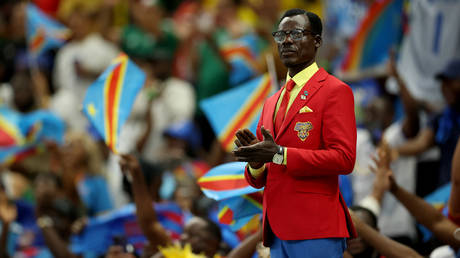
To understand why this denial cuts so deep, one must understand what Mboladinga represents. He is not merely a fan who paints his face and screams into a megaphone. Known across the continent as Lumumba Vea, Mboladinga performs a grueling, silent act of living theater during every match. He stands completely motionless for ninety minutes, his arm raised in a specific, rigid salute. This is a direct recreation of the statue of Patrice Lumumba, the first democratically elected prime minister of the Democratic Republic of Congo, who was executed by a firing squad in 1961 after a Western-backed coup.
The contrast between Mboladinga and the chaotic, dancing crowd around him is striking. While thousands of fans beat drums and sing, he remains as still as granite. His clothing is a meticulously tailored suit exploding with the red, blue, and yellow of the Congolese flag. The act requires immense physical stamina, a meditative focus that transforms a sporting event into an act of political and cultural memory. In Kinshasa, this performance made him a national hero. Following his viral rise during the Africa Cup of Nations in Morocco, the Congolese government gifted him a vehicle and official recognition. He was eventually integrated into the formal delegation as an ambassador of the nation's footballing culture.
There is a dark historical irony in Washington denying entry to a man embodying Patrice Lumumba. The legacy of American involvement in the destabilization of the post-independence Congo remains a highly sensitive topic within African intellectual circles. To see the living embodiment of that historical trauma turned away at an American port of entry because of a failure to meet arbitrary immigration metrics reads like a bitter historical rhyme. The state department sees a visa applicant without traditional corporate employment. The Congolese public sees a Western superpower rejecting their national identity.
Public Health Security Meets Sporting Globalism
The administrative justification for Mboladinga's delayed travel and ultimate denial contains a more contemporary layer of complexity. The Democratic Republic of Congo is currently battling an Ebola outbreak that has claimed over three hundred lives out of more than twelve hundred confirmed cases. This health emergency has triggered strict surveillance protocols across international transit hubs. Public health security and immigration control routinely cross paths during times of outbreak, often creating insurmountable walls for travelers from affected regions.
Mboladinga's initial journey to North America was severely delayed by these health-related travel restrictions. He faced extensive quarantine reviews and compliance checks designed to monitor travelers leaving central Africa. By the time he cleared those hurdles and arrived in Mexico to catch up with the team, the clock was already ticking down toward the crucial group-stage matches. The extra scrutiny jammed his application in the U.S. visa system, turning a standard processing window into an administrative quagmire.
+--------------------------------------------------------------+
|             THE TRANSIT TIMELINE OF LUMUMBA VEA              |
+----------------------+---------------------------------------+
| Location             | Status / Outcome                      |
+----------------------+---------------------------------------+
| Kinshasa, DRC        | Departure delayed by Ebola protocols  |
| Guadalajara, Mexico  | Attended Colombia match (Lost 1-0)    |
| Atlanta, USA         | Entry denied; watched from afar       |
+----------------------+---------------------------------------+
When public health fears combine with immigration bureaucracy, the result is almost always a total shutdown of discretion. Consular officers who are evaluated on their ability to mitigate risk rarely err on the side of cultural significance. A superfan, regardless of how many millions of views he accumulates on social media, looks exactly like a high-risk traveler under the emergency guidelines issued during an active outbreak. The tournament organizers at FIFA have consistently declined to comment on individual health screenings, passing the responsibility entirely to domestic health agencies.
The Two Tier Travel System of International Football
The reality is that international sport operates on a caste system. When Newcastle United forward Yoane Wissa or forward Fiston Mayele require clearance to enter a country for a match, an army of corporate fixers, federations, and lawyers handle the paperwork weeks in advance. The players travel on sports visas that are treated with the utmost urgency by host governments because millions of dollars in broadcast revenue depend on their presence. They are shielded from the indignities of the standard immigration terminal.
The supporters face an entirely different world. A fan from Kinshasa must pay a visa fee that often represents several months of local wages, with absolutely no guarantee of a successful outcome. They must schedule appointments months in advance, produce mountains of bank statements, and submit to biometric tracking. If a consular official decides on a whim that the applicant might not return home, the money is lost, the ticket is wasted, and the dream of supporting their country on the global stage disappears.
This disparity exposes the profound hypocrisy at the center of modern football. Governing bodies talk endlessly about the beautiful game belonging to everyone, yet they choose host nations that maintain aggressive, exclusionary border policies without demanding systemic exceptions for the fans who give the sport its soul. If a country cannot, or will not, provide a clear and fair mechanism for international supporters to enter and watch their teams, that country should not be awarded the privilege of hosting the world.
A Bitter Victory in Atlanta
The ultimate tragedy of Mboladinga's exclusion is that he missed the greatest night in modern Congolese football history. On Saturday, inside the very stadium he was barred from entering, the Leopards pulled off an astonishing comeback victory against Uzbekistan. The stakes could not have been higher. Congo needed a win to secure a maiden berth in the World Cup knockout rounds.
The match began in disaster. Uzbekistan captain Eldor Shomurodov capitalised on a defensive lapse to score in the tenth minute, silencing the Congolese contingent in the stands. The team looked rattled. Without the steady, stoic presence of their living statue in the front rows, a substitute fan attempted to mimic Mboladinga's routine, standing still in the terraces as a tribute. It was a noble effort, but it underscored the void left by the real Lumumba Vea.
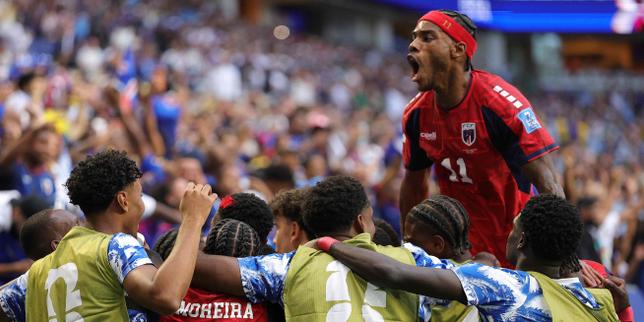
The players found their footing in the second half. Congo dominated possession, pinning Uzbekistan back until Yoane Wissa won and converted a penalty kick to level the score. The momentum shifted completely. In the seventy-eighth minute, Fiston Mayele produced a moment of pure magic, beating the Uzbek goalkeeper with a deft flick that sent the traveling fans into a frenzy. Wissa added a third in stoppage time, securing a historic 3-1 victory and a round of 32 clash against England next Wednesday back in Atlanta.
The players celebrated wildly on the pitch, but the joy was incomplete. In the post-match press conferences, the conversation repeatedly drifted away from the tactics and toward the empty space in the delegation. The team had conquered the pitch, but their most visible cultural ambassador had been conquered by a visa spreadsheet.
The World Cup moves on, indifferent to the individuals it discards along the way. The Leopards will return to Atlanta to face England in a match that will draw tens of millions of viewers worldwide. The corporate sponsors will fill the luxury suites. The television cameras will capture the bright lights of the stadium. Somewhere in a hotel room across the border, the man who spent years standing perfectly still to honor his nation's history will watch the broadcast on a screen, locked out by a system that loves African football talent but fears African football fans.
The challenges encountered by global football supporters are thoroughly documented in this insightful look at World Cup Visa Hurdles, which analyzes the administrative burdens and immigration complexities that fans face when attempting to travel to major international tournaments.