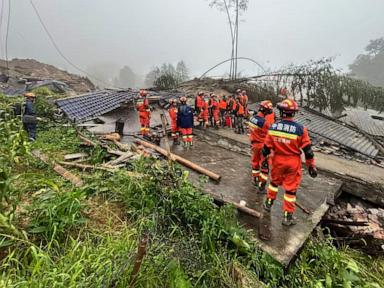
The official death toll from the devastating mudslide in eastern China’s Jiangxi province climbed to three following days of relentless downpours delivered by Typhoon Saudel. Emergency response teams battling treacherous terrain and unstable earth in Suichuan County continue to search for nine individuals still listed as missing. When the hillside gave way early Saturday morning, it swallowed roughly a dozen homes, transforming a quiet rural settlement into a theater of urgent rescue operations.
Yet, focusing solely on the immediate body count misses the structural realities of how modern meteorological anomalies intersect with vulnerable rural geography. Typhoon Saudel did not arrive as a sudden, sharp punch. Its path was meandering and erratic. After executing dual landfalls in Zhejiang province and grinding inland as a tropical storm in Fujian, the system stalled over south-central and eastern China. This atmospheric parking maneuver dumped historic quantities of water onto soil already saturated by seasonal rains.
The mechanics of a debris flow are deceptively simple and terrifyingly fast. When precipitation rates exceed the infiltration capacity of mountain slopes, water pressure builds within the soil matrix. Cohesion vanishes. Earth, rock, and uprooted timber liquefy into a slurry that moves faster than a sprinting human. In Suichuan County's Gaoping town, residents reported hearing a deep, subterranean roar seconds before the mountainside dropped. There was no time for formal evacuation warnings. The mud wave moved through the valley floor with absolute kinetic authority, crushing foundations before homeowners could reach their thresholds.
The Regional Scale of the Disaster
Jiangxi is far from the only province bearing the brunt of Saudel's lingering moisture. Across south-central China, particularly in Hunan province, parallel disasters have unfolded. State media briefings confirmed additional fatalities tied directly to secondary landslides and structural collapses. Meanwhile, coastal hubs like Fujian enacted massive precautionary measures ahead of the storm's arrival, evacuating approximately 600,000 residents from high-risk zones.
Dikes breached under the strain. Urban streets devolved into navigable rivers requiring rubber inflatable boats for basic transit. More than a hundred homes collapsed in Putian’s Huating Town alone. The sheer geographical spread of the damage highlights a persistent vulnerability in China's interior infrastructure. While major metropolitan centers boast advanced flood defenses and sophisticated drainage networks, rural townships nestled in mountainous transition zones often rely on antiquated terracing and natural drainage paths that are utterly overwhelmed by multi-day precipitation events of this magnitude.
The Geography of Risk
Why do rural mountain communities remain chronically exposed to catastrophic slope failures? The answer lies in historical settlement patterns conflicting with shifting climate baselines. Villages in provinces like Jiangxi and Fujian were historically established along valley floors and lower slopes to maximize proximity to arable flatland and water sources. For generations, these locations were relatively safe, buffered by dense canopy cover and predictable seasonal monsoon rhythms.
Those historical baselines are obsolete. Higher atmospheric temperatures increase the moisture-holding capacity of tropical cyclones, yielding denser, more intense rainfall events per square kilometer. When these concentrated volumes strike deforested or agriculturally modified slopes, the threshold for mass-wasting events drops precipitously.
Engineering solutions exist, but they are exceptionally difficult to implement uniformly. Constructing check dams, retaining walls, and sub-surface drainage arrays across every vulnerable rural hamlet requires staggering capital allocation. Local governments often operate under severe budgetary constraints, prioritizing urban flood protection where economic density is highest. Consequently, mountain villages remain the primary shock absorbers of meteorological disasters. Heavy machinery from specialized units like the China Anneng Group can only deploy after the earth moves, shifting the operational paradigm from proactive prevention to reactive excavation.
As rescue units comb through the rubble in Suichuan County, the limits of human intervention in the face of raw geological force become starkly apparent. Mud and debris harden quickly under sun exposure, turning the search zone into a concrete-like maze that slows canine units and manual digging alike. The missing individuals remain trapped under feet of dense particulate matter, and time is the one variable emergency planners cannot negotiate.