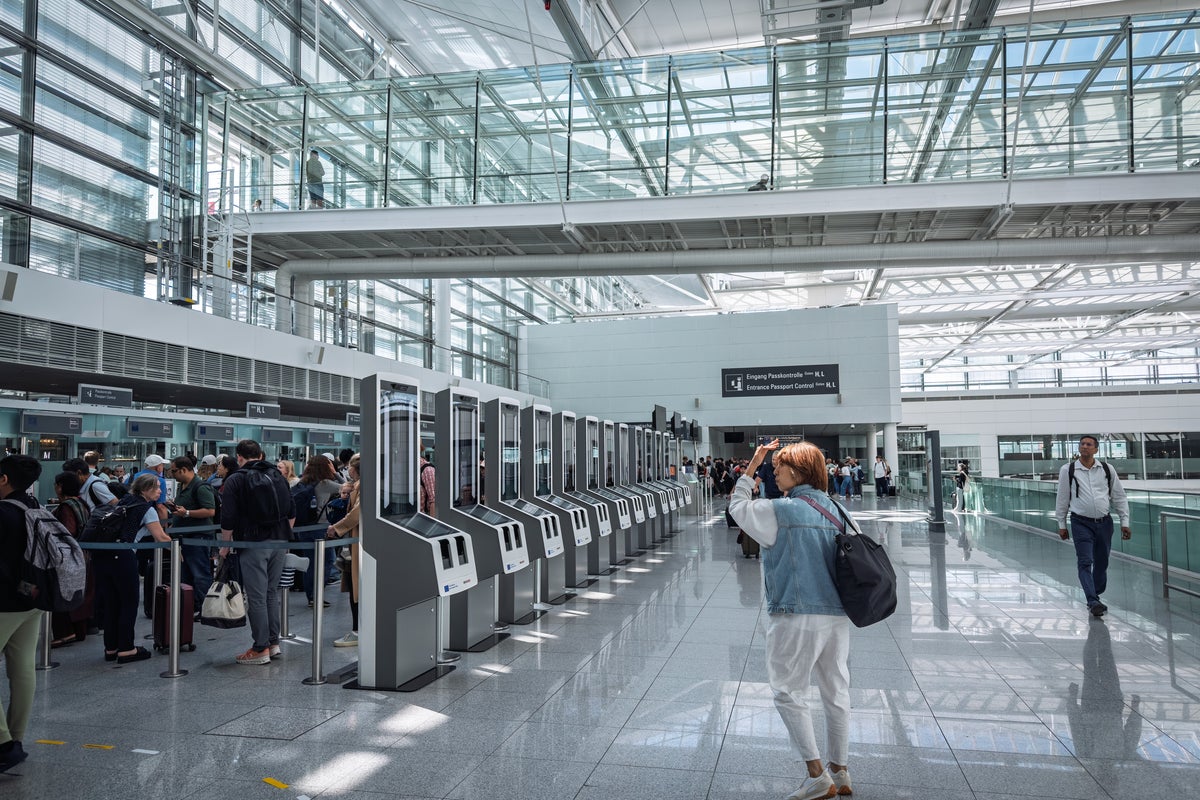
The European Union’s flagship digital border security initiative, the Entry/Exit System, is facing widespread operational collapse as major international hubs quietly override automated biometric checkpoints to prevent catastrophic passenger gridlock.
For months, Brussels insisted that the transition away from physical passport stamps toward automated facial recognition and fingerprint scanning would proceed without sweeping concessions. Yet behind closed doors and on congested terminal floors across Amsterdam Schiphol, Paris Charles de Gaulle, and Rome Fiumicino, a very different reality has taken shape. When arrival queues stretch toward the multi-hour mark, local border authorities routinely turn off the technology entirely, reverting to legacy manual checks just to keep terminals moving.
This systemic friction exposes a deep structural disconnect between political ambition and physical infrastructure. Brussels designed a digital architecture to secure the external perimeter of the Schengen Area, but left national governments to shoulder the financial and spatial burden of implementation. The result is a patchwork of bottlenecks where the theory of automated efficiency crashes hard against the reality of constrained physical space.
The Mathematics of Failure
The fundamental flaw of the new border framework lies in a simple, stubborn metric. Processing a non-EU traveller through traditional manual passport inspection historically takes roughly twenty to twenty-five seconds. Introducing biometric data collection—capturing facial images and fingerprint data upon initial entry, followed by subsequent verification checks—triples that transaction window.
When processing time jumps to ninety seconds per person, terminal mathematics change overnight.
Consider a regional holiday airport designed to handle three thousand arriving passengers per hour across a dozen traditional booths. Under the new operational parameters, throughput capacity plummets by more than sixty percent. Unless a terminal quadruples its physical footprint to install additional self-service kiosks and biometric gates, massive queues become a mathematical certainty rather than a temporary anomaly.
Airlines and airport operator associations warned of this exact tipping point in joint petitions to the European Commission. They pointed to chronic infrastructure deficits at primary southern European holiday entry points, demanding systematic flexibility to suspend digital controls when congestion crosses critical thresholds.
Brussels initially pushed back against broad suspensions, arguing that selective enforcement creates dangerous legal loopholes. If a traveller enters the Schengen zone through a port where biometric tracking is active, but departs through a facility where the system is offline, tracking continuity breaks down. This administrative gap threatens to misclassify legal visitors as overstayers, exposing innocent travellers to wrongful fines or entry bans down the line.
The Quiet Workaround
Faced with intransigence from the European Commission and mounting public frustration, major transport hubs have adopted an informal survival strategy. They turn the system off.
This unacknowledged reliance on manual overrides reveals an unspoken truth about large-scale technological mandates in public administration. When software demands more physical time than a concrete terminal can physically accommodate, the software loses. Ground handlers and border guards are making real-time tactical decisions to protect airport safety and keep flight rotations on schedule, bypassing the digital mandate in favour of a stamp in a blue passport.
This ad-hoc mitigation cannot last indefinitely. Emergency regulatory waivers permitting temporary system shutdowns carry strict expiration timelines. As autumn approaches, European authorities expect terminals to return to permanent, uninterrupted compliance. Without a massive injection of capital for terminal redesigns and a dramatic expansion of automated kiosks, the underlying math will reassert itself.
The friction at the border is not merely a teething problem of a new IT rollout. It is a collision between modern security paranoia and the physical limits of European travel infrastructure, leaving passengers caught in the crossfire of an unyielding bureaucratic machine.