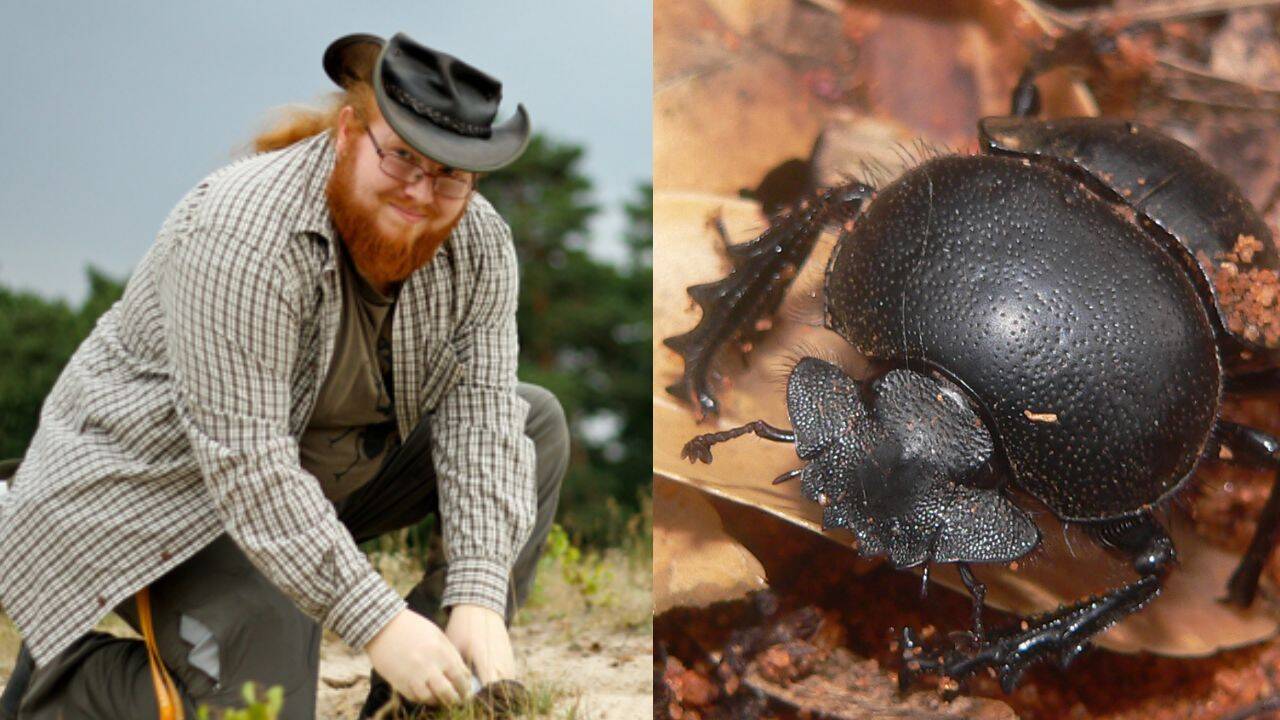
German biologist Patrick Urban did not discover a new insect by hacking through the dense undergrowth of a remote Asian rainforest. Instead, the breakthrough happened under the fluorescent lights of a museum drawer, proving that modern biological discovery often relies as much on archival persistence as it does on fieldwork. Working at the LWL-Museum of Natural History in Münster, Urban identified a brand-new species of dung beetle—Onthophagus (Gibbonthophagus) draconisaurei—hidden amongst physical specimens collected years prior from the mountainous terrain of north-west Yunnan, China.
This revelation throws open a much broader, uncomfortable conversation about modern institutional science. While flashy field expeditions command public attention and large venture grants, museum basements around the globe are quietly overflowing with uncatalogued biodiversity. Millions of specimens sit in glass-topped boxes, waiting for eyes sharp enough to notice what previous generations missed.
The Anatomy of a Museum Discovery
Taxonomy is slow, unglamorous work. It requires navigating centuries of historical nomenclature, dissecting minute morphological structures, and comparing physical traits against fragile type specimens that serve as the ultimate reference points for scientific names. When Urban began processing dung washings originating from the Yunnan province, several small scarabaeoid beetles defied simple identification keys. They belonged to the tribe Onthophagini, a massive group of coprophagous insects whose members often look remarkably similar to the untrained observer.
A casual glance might register an ordinary bug. A trained taxonomist sees a puzzle of micro-sculptures, clypeal shapes, and genital characteristics that tell an evolutionary story spanning millennia. Urban compared the anomaly against historical type material for related species such as Onthophagus balthasari and Onthophagus taurinus. Only meticulous character matrix mapping and detailed photographic documentation proved that the Yunnan specimens represented an independent lineage previously unknown to science.
The formal description, published in the journal Zootaxa, represents a quiet victory for natural history collections. It serves as a reminder that the archives we already possess are just as rich and mysterious as any unexplored wilderness on Earth.
Why Natural History Collections Are Dying for Attention
Despite producing foundational data for modern ecology, natural history museums face persistent funding crises. Governments and private donors frequently favor digital tech initiatives or high-profile conservation projects with immediate visual payoffs. Consequently, curation budgets shrink, and the number of active, specialized taxonomists dwindle.
When a museum loses its dedicated specialists, its collections effectively turn into institutional ghosts. Cabinets remain physically intact, but the knowledge required to interpret their contents vanishes. Urban’s work underscores what is at stake when society starves basic taxonomic research. Without experts capable of parsing subtle differences between closely related insects, thousands of cryptic species could quietly go extinct inside glass drawers before science even knows they exist.
Furthermore, coprophagous insects like dung beetles act as vital ecological indicators. They recycle nutrients, aerate soils, and suppress parasite loads in animal waste. Yet, their populations face severe threats from modern intensive agricultural practices and the widespread distribution of veterinary antiparasitic drugs. Finding a new species in an archive highlights the sheer scale of what remains unmapped in these delicate ecosystems.
The Quiet Crisis of Global Biodiversity Tracking
The romanticized image of a lone explorer discovering a vibrant creature in an untouched paradise persists in popular media. Reality is far more mundane and bureaucratic. It involves dusty rooms, binocular microscopes, outdated printing presses, and decades-old jars of ethanol.
Taxonomy operates as the foundation of all biological conservation. If researchers cannot accurately name and categorize an organism, they cannot legally protect it, assess its ecological vulnerability, or understand its role in a shifting climate. Every misidentified specimen or backlog delay represents a blind spot in global conservation strategy.
As natural history institutions pivot toward digitization projects—scanning specimens into high-resolution databases for global access—the demand for physical examination remains absolute. A photograph on a screen cannot replace a tactile, microscopic structural comparison.
Patrick Urban’s discovery in a drawer of Yunnan materials is not merely a neat trivia fact about an obscure beetle. It is a sharp critique of how contemporary science allocates its attention. Real answers often sit right in front of us, gathering dust, waiting for someone willing to look closer.