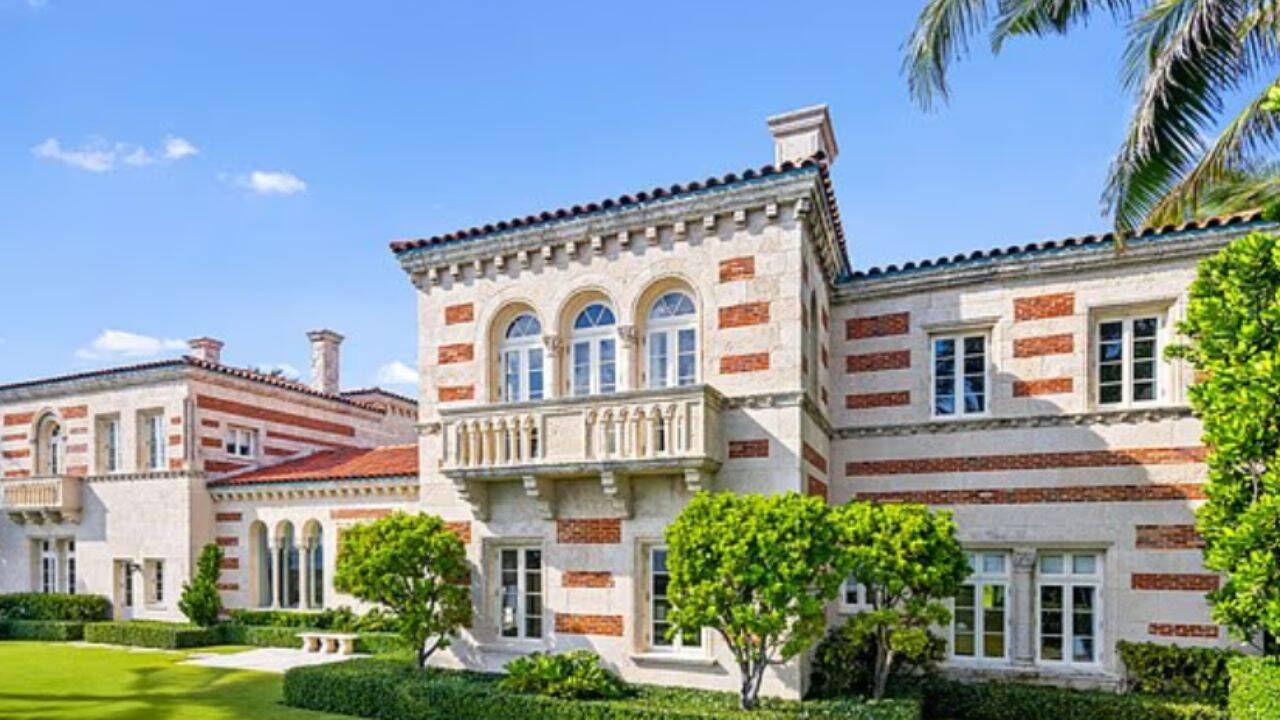
When businessman Marion Antonini and his wife Penny acquired Palm Beach's architectural oddity known locally as the Ham and Cheese House for $15.975 million in 2013, the luxury real estate market operated under an entirely different set of economic physics. Officially designated as Casa Eleda and designed in 1928 by Swiss-born society architect Maurice Fatio, the oceanfront estate has returned to the market carrying an eye-watering asking price of $105 million.
A more than sixfold jump over thirteen years represents more than standard coastal asset appreciation. It serves as a flashing neon indicator of how ultra-prime real estate has decoupled from traditional metrics of valuation, turning historic preservation into an extreme sport played by the global ultra-wealthy.
The Architecture of an Anomaly
Most people walking past the Estate Section of Palm Beach expect uniform Mediterranean Revival pallor, clean stucco, and standard barrel-tile roofs. Casa Eleda disrupts that coastal monotony entirely. Commissioned originally by investment banker Mortimer Schiff and his wife Adele—whose first name spelled backward provides the property’s formal moniker—the mansion features an unmistakable alternating horizontal banding of red brick and gray coquina coral stone.
That striking color separation earned the structure its culinary nickname from local tradesmen and residents decades ago. Beneath the whimsy of its facade lies serious structural engineering by Fatio, who catered to the Roaring Twenties elite with features that still command reverence today. The seven-bedroom Italian Romanesque mansion encompasses over 13,000 square feet of interior space sitting on roughly an acre of prime oceanfront land, complete with roughly 150 feet of direct Atlantic frontage.
Yet the most defining characteristic of the parcel is not visible from South Ocean Boulevard. A subterranean private tunnel runs directly beneath the busy coastal thoroughfare, linking the main residence to an oceanfront cabana, wet bar, and full bathroom on the sand. In a barrier island where traffic congestion and pedestrian safety have escalated into major friction points for billionaires trying to reach the water, a private underpass remains an irreplaceable asset.
Decoding the Nine-Figure Jump
Hitting the triple-digit million mark places Casa Eleda into an ultra-exclusive echelon. Only a handful of properties on the entire island currently test the market at or above $100 million. Defending a $105 million price tag on an asset bought for under $16 million requires an analytical look at what changed between 2013 and the present day.
The immediate post-recession recovery period of the early 2010s was characterized by distressed luxury assets and hesitant capital deployment. Buyers held leverage, and historic properties requiring heavy capital expenditures often sat on the books for years. Fast forward to the post-2020 migration patterns, where Wall Street titans, tech founders, and global family offices flooded South Florida, effectively rewriting supply and demand dynamics for waterfront land.
Furthermore, the Antoninis did not merely hold the deed and wait for the tide to rise. They executed a painstaking, multi-year restoration that earned a preservation award in 2017. They stripped away decades of dark, heavy modifications, revitalized hand-painted cypress ceilings, restored intricate coffered woodwork, and re-engineered the tight interior courtyard into distinct open-air garden rooms.
The Hidden Liabilities of Landmark Status
Owning a historic landmark in Palm Beach sounds glamorous until the town's architectural review commissions become a silent partner in every renovation decision. Historic protection, granted to Casa Eleda in 1979, acts as a double-edged sword for any prospective buyer eyeing a modern footprint update.
While the designation protects the architectural integrity that commands a premium, it simultaneously handcuffs the owner against major structural expansions. You cannot simply bulldoze Fatio’s coquina columns or alter the historic roofline to suit contemporary glass-box minimalist tastes. A buyer at the $105 million level often looks for total customization. Historic preservation forces an incoming owner to accept someone else's century-old architectural vision, albeit meticulously polished.
The math of luxury restorations also reveals razor-thin margins when capital costs are factored into the final exit strategy. Artisans capable of restoring 1920s coquina stonework, Venetian tile patterns, and hand-beamed ceilings do not charge standard contractor rates. When multiplied over years of specialized labor, the capital injected into the property eats significantly into the raw spread between the 2013 purchase price and the current ask.
The Micro-Market Reality Check
Evaluating whether CasaEleda will fetch its nine-figure target requires examining recent liquidity events on the island. Palm Beach inventory at the very top tier moves slowly. The pool of buyers capable of writing a cash check north of $100 million is inherently finite, and those individuals are evaluating competing inventory across Miami, coastal California, and international safe havens.
Properties crossing this threshold must offer absolute perfection or total privacy. Casa Eleda delivers heavily on pedigree and the rare beach tunnel amenity, but its tight one-acre footprint limits the sprawling estate grounds found in other mega-compounds. Buyers seeking massive acreage for multi-structure family compounds may find the single-acre limitation a tough pill to swallow at this valuation tier.
The listing stands as a litmus test for the absolute ceiling of Palm Beach historic preservation value. Whether the market absorbs the property at its current valuation or forces a recalibration, the trajectory of the Ham and Cheese House illustrates an irreversible truth about modern wealth preservation. Authentic architectural pedigree, paired with irreplaceable waterfront access, has transformed into a rare form of fine art where traditional valuation models no longer apply.