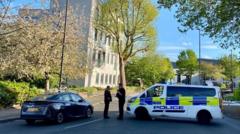
Journalists shouldn't have to worry about being burned out of their offices in a Western capital. Yet, that's exactly what happened in North London. Three men now face serious arson charges after a fire was intentionally set at a building housing Persian-language media outlets. This isn't just a local crime story. It’s a direct assault on the press.
Metropolitan Police confirmed that Saeid Asghari, 28, Alireza Mousavi, 38, and a 17-year-old male who remains unnamed for legal reasons, were charged following the attack. The target? A site on Cricklewood Broadway that serves as a hub for media voices critical of the Iranian establishment. When you look at the timeline, the intent is chillingly clear.
What Happened on Cricklewood Broadway
The fire broke out in the early hours of a Tuesday. While the physical damage to the brick and mortar was contained, the psychological ripple effect hit the local Iranian diaspora immediately. Investigators didn't take long to determine this wasn't some electrical fault or a stray cigarette. It was deliberate.
Scotland Yard’s Counter Terrorism Command took the lead on the case. That should tell you everything you need to know about the gravity of the situation. They aren't treating this as a standard case of property damage. They’re looking at it through the lens of state-backed intimidation and foreign interference. You don't call in counter-terror units for a simple dispute between neighbors.
The Specific Charges
The three individuals face charges of "conspiracy to commit arson with intent to endanger life." That’s a heavy legal hammer. It suggests the prosecution believes the goal wasn't just to smoke out a building, but to potentially kill or seriously injure the people inside.
Saeid Asghari and Alireza Mousavi, both of whom reside in North London, were remanded in custody. The 17-year-old was also held. These charges follow a string of warnings from UK intelligence agencies about threats emanating from Tehran against journalists working on British soil. It's a pattern that has been escalating for years.
Why Persian Media is a Target in London
London is a global center for independent Persian media. Outlets like Iran International and the BBC Persian service have long provided a lifeline of information to people inside Iran who are fed up with state-controlled propaganda. Because these outlets reach millions of viewers back home, they've become a massive thorn in the side of the Iranian government.
If you can't shut them down through legal means or censorship, what's the next step? Historically, it's been harassment. Journalists have reported their families back in Iran being interrogated or threatened. But lately, that harassment has turned physical and moved onto London's streets.
Last year, Iran International had to temporarily move its entire operation to Washington D.C. after the police warned them they couldn't guarantee the safety of their staff at their Chiswick studios. They eventually returned to a new, highly fortified location. This arson attack in Cricklewood shows that the threat hasn't vanished. It's just shifted targets.
A Growing List of Incidents
This arson attempt isn't an isolated event. Think back to the stabbing of Pouria Zeraati, a presenter for Iran International, outside his home in Wimbledon. That happened in broad daylight. The attackers fled the country shortly after.
Then there’s the case of Magomed-Husejn Dovtaev, a Chechen-born man who was sentenced last year for "collecting information useful to a person preparing or committing an act of terrorism" after he was caught filming the Iran International offices. The common thread here is clear. There's a concerted effort to map out, intimidate, and eventually strike at the heart of free Persian media.
The Role of the Counter Terrorism Command
The Metropolitan Police’s Counter Terrorism Command, also known as SO15, is tasked with handling threats to national security. By taking over this arson investigation, they’re signaling that this attack fits into a broader geopolitical puzzle.
Dominic Murphy, the head of SO15, has been vocal about the persistent threats from hostile states. He’s noted that the volume of state-linked threats has increased significantly since the 2022 "Woman, Life, Freedom" protests in Iran. The UK government is basically saying, "We see what’s happening, and we’re not ignoring it."
Is the UK Doing Enough
Critics argue that charging individuals is a reactive move. They want more proactive sanctions against the Iranian Revolutionary Guard Corps (IRGC). Some politicians have been pushing to proscribe the IRGC as a terrorist organization for months.
So far, the British government has resisted that specific move, citing the need to keep diplomatic channels open. But every time a fire is lit or a journalist is followed, that stance becomes harder to defend. You can't claim to protect press freedom while allowing agents of a foreign power to scout out newsrooms in your own capital.
How This Impacts the Diaspora Community
If you're an Iranian living in London, this isn't just a headline. It’s a message. The message is: "We can reach you anywhere." It’s designed to create a climate of fear.
The community in North London is tight-knit. Cricklewood and the surrounding areas have a visible Persian presence. Seeing police tape around a media office sends a chill through local business owners and families. It makes people think twice before speaking out at a protest or posting a critical comment online.
Protecting the Freedom of the Press
The UK prides itself on being a safe haven for journalists. If that reputation crumbles, the democratic foundation of the country takes a hit. These media outlets provide a service that is literally unavailable in Iran. They report on human rights abuses, economic mismanagement, and the inner workings of a secretive regime.
The arson attack in Cricklewood was an attempt to silence that reporting. By charging these three individuals, the UK legal system is attempting to push back. But legal proceedings take time, and the underlying threat remains as active as ever.
What Comes Next for the Accused
The legal process is just starting. Asghari, Mousavi, and the teenager will have to face the evidence gathered by SO15. This likely includes CCTV footage, forensic evidence from the scene, and potentially digital footprints that link them to the planning of the attack.
In cases like this, the prosecution will be looking for links to higher-up coordinators. Most arsonists-for-hire don't just wake up one day and decide to burn down a specific foreign-language media office. There’s usually a chain of command. Whether the police can prove that link in court is the million-dollar question.
The Security Reality for Journalists
For the people working inside those offices, the daily routine has changed. It now involves bag checks, blast-proof glass, and a constant awareness of who is standing behind them at the bus stop. It's a high price to pay for doing a job that involves nothing more than reporting the news.
We need to pay attention to these "small" fires. They are often the precursors to something much larger. If a state feels it can get away with arson in a London suburb, it won't stop there.
Stay informed about the court dates for these individuals. The outcome of this trial will set a precedent for how the UK handles foreign-directed violence on its soil. Don't let these stories slip into the background. Follow the reporters who are risking their lives to keep the world informed about what’s happening in Iran. Support independent media. It's the only way to ensure that these attempts at intimidation ultimately fail.