Paleontologists are stubborn creatures of habit. For the last half-century, the narrative of where we came from has been locked in a very specific geographic box. If you wanted to find the origins of modern apes and, by extension, humans, you packed your bags and headed straight for the East African Rift Valley. It made sense. The fossils were there, the geology was cooperative, and the textbook chapters practically wrote themselves.
But a spectacular discovery in northern Egypt has blown that comfortable consensus wide open.
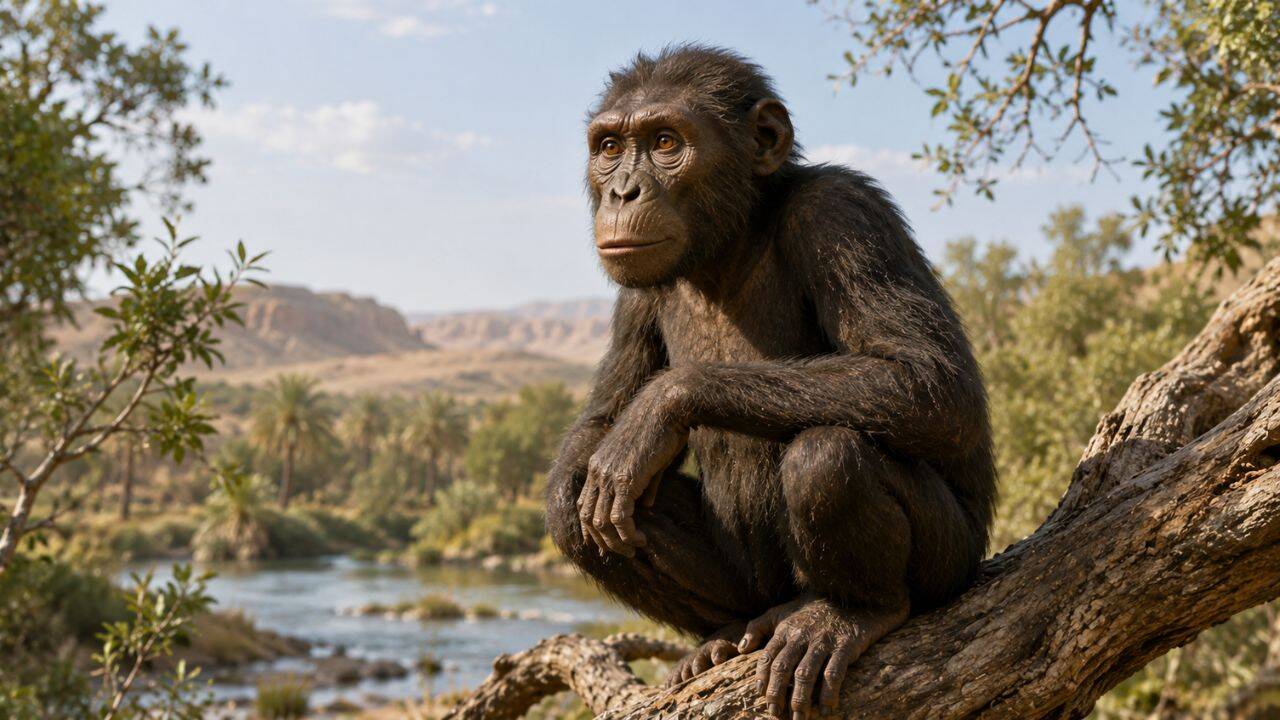
A team of international researchers recently unearthed the jawbone fragments of a 17-to-18-million-year-old primate in the windswept sands of Wadi Moghra. Named Masripithecus moghraensis (literally meaning "Egyptian ape"), this creature isn't just another addition to a crowded family tree. It is the first definitive fossil ape ever found in North Africa from this era. More importantly, it strongly suggests that the actual cradle of modern apes wasn't the dense forests of the east, but the historical crossroads connecting Africa, the Levant, and the Mediterranean.
We have been looking in the wrong place for decades.
The Misfit of Wadi Moghra
You cannot appreciate why Masripithecus has caused such a stir without looking at its teeth. When the team from the Mansoura University Vertebrate Paleontology Center first cleared the desert sediment from the mandible, they didn't find the standard dental patterns typical of East African Miocene apes.
Instead, this creature possessed exceptionally large canine and premolar teeth, coupled with rounded molars featuring highly textured chewing surfaces.
[East African Miocene Apes] ---- Uniform, specialized dental structures
[Masripithecus moghraensis] --- Robust jaws, heavy molar texturing, massive canines
This bizarre combination points to a highly versatile lifestyle. During the Early Miocene, the Afro-Arabian landmass was shifting, bringing unpredictable seasons and changing climates. While its cousins further south relied on steady tropical vegetation, Masripithecus was built for flexibility. It likely gorged on soft fruits when they were abundant but could easily crack open tough nuts, seeds, and abrasive vegetation when times got tough.
Honestly, it was an evolutionary survivor. And that survival strategy might be exactly why it outlasted others to anchor the lineage that eventually produced us.
The Evolutionary Map is Wrong
When you plot early hominoid fossils on a map, the bias becomes glaringly obvious. Nearly everything we thought we knew about the transition from primitive primates to the ancestors of chimps, gorillas, and humans came from a tiny geographic sliver of East Africa. Scientists built elaborate evolutionary models based on that single data pool.
The team led by paleontologist Shorouq Al-Ashqar threw a wrench into those models using a sophisticated analytical approach called Bayesian tip-dating. By plugging the precise anatomical dimensions of the Masripithecus jaw into a system that weighs both physical traits and fossil ages, they mapped out a drastically revised family tree.
The results were startling. Masripithecus sits closer to the base of the living ape branch than any Miocene ape ever discovered in East Africa.
It turns out that northern Africa and the Middle East were functioning as the true geographic crucible for early ape evolution. The region served as a bustling biological transit zone just as the African continent was physically slamming into Eurasia.
Confronting the Scientific Blind Spot
This discovery forces us to confront an uncomfortable reality about paleontology. We don't always find fossils where history happened; we find them where it is easy to dig.
East Africa is a fossil hunter's paradise because the shifting tectonic plates of the Rift Valley naturally push ancient sediment layers up to the surface. Northern Africa, conversely, features vast expanses of harsh, shifting sand dunes that bury history deep underground. It took five grueling years of targeted fieldwork in the Qattara Depression for Hesham Sallam’s lab to find these few jaw fragments.
A few critics naturally urge caution, pointing out that drawing a brand-new evolutionary highway based on a single broken jawbone is a massive leap. They are right to be cautious. We need skulls, limbs, and more sites to confirm the exact migratory routes. But ignoring this find because it is lonely is a worse mistake. The geographic gap has been breached.
If you want to track the next major breakthroughs in understanding human origins, stop watching the excavations in Kenya and Tanzania. Keep your eyes on the northern edge of the continent, because the sands of Egypt are finally starting to talk.
To fully grasp the scale of the expedition that pulled this evolutionary puzzle piece out of the desert, you can watch the SWNS report on the Masripithecus discovery which highlights how this rare specimen is actively shaking up our understanding of primate history.