Imagine a game so addictive that emperors ignored state affairs to play it, noblemen demanded to be buried with their sets, and ordinary folks carved gameboards directly onto building bricks just to catch a quick match. That was Liubo. During China’s Han Dynasty two thousand years ago, it was everywhere. Yet today, nobody actually knows how to play it.
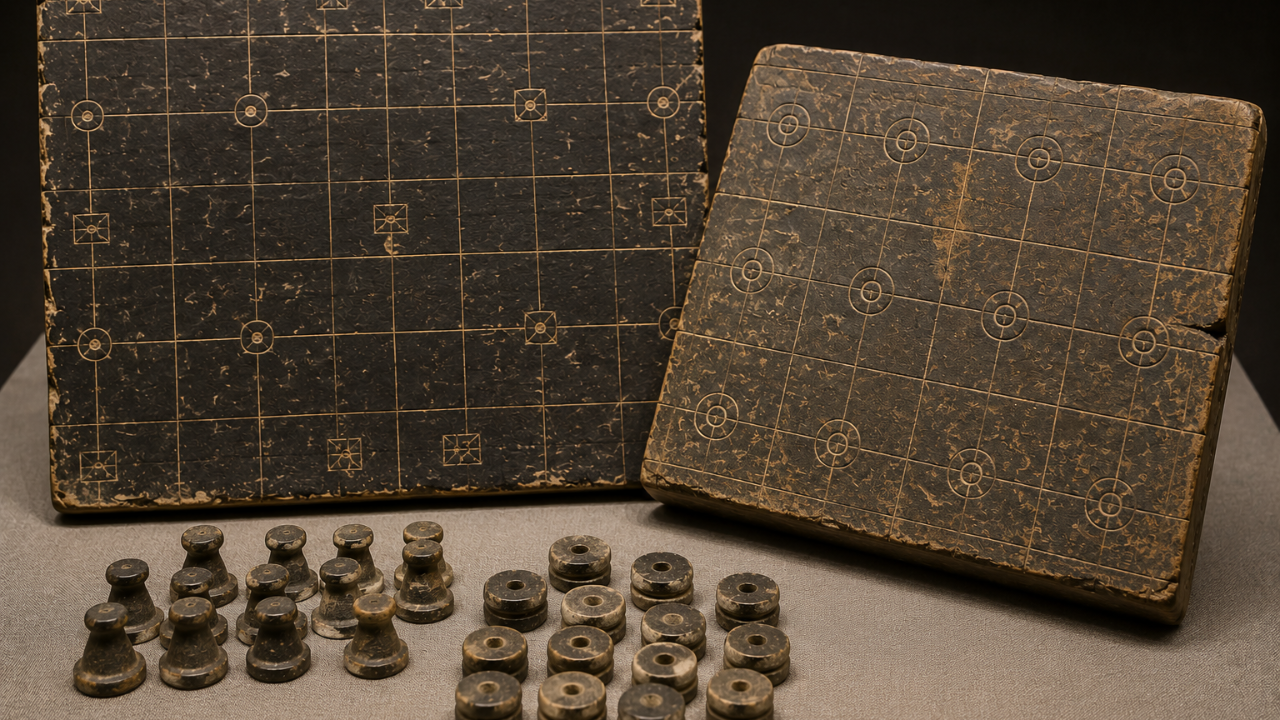
The mystery hit the headlines again when archaeologists from the Shaanxi Provincial Institute of Archaeology revealed new findings from excavations at Shaanxi Normal University’s Chang’an campus in Xi’an. Inside two Han Dynasty tombs labeled M4 and M17, researchers unearthed two square building bricks with the unmistakable pattern of a Liubo board carved straight into their surfaces. One was etched into a plain brick; the other was scratched onto a brick decorated with a geometric fret design.
These brick boards aren't luxurious lacquer sets made for royalty. They are raw, everyday items. That distinction makes them fascinating. They prove that Liubo wasn't just an elite ritual for the dead. It was a obsession that cut across every level of society.
Yet, despite having physical boards, carved ivory pieces, bamboo casting sticks, and even ancient artwork showing people screaming across tables over a match, we still can't say with certainty how a single round played out.
What Ancient Brick Finds Teach Us About Han Dynasty Culture
Finding gaming equipment in ancient Chinese tombs isn't unheard of, but these brick boards stand out. Most famous discoveries, like the stunning 2nd-century BCE set from Mawangdui Tomb No. 3 in Changsha, featured lacquered wooden boards inlaid with mother-of-pearl, complete with ivory game pieces, scoring counters, and bone dice. Those belonged to high-ranking aristocrats.
The Xi'an brick finds tell a different story. These tombs belonged to ordinary people or minor officials buried during a expansion project between the late Western Han and late Eastern Han periods. Carving a gaming grid onto leftover construction materials suggests something personal. Either the deceased loved the game so much that family members scraped together a homemade board for the journey into the afterlife, or brick masons played a quick match during their lunch breaks before laying down the tomb floor.
Either way, the board went into the grave. Han Dynasty burial culture rested on the belief that the afterlife mirrored daily living. If you enjoyed drinking, gambling, and board games while breathing, you needed those same comforts after death.
Along with miniature ceramic stoves, granaries, and bronze mirrors, these two simple bricks guaranteed the deceased wouldn't be bored in eternity.
What We Actually Know About the Game Equipment
While the exact sequence of play is lost, archaeologists and historians have pieced together a solid picture of the physical components. You don't need to guess about the equipment because physical examples survive in surprisingly good shape.
- The Board Grid: Every Liubo board features a distinct, highly geometric layout. Modern archaeologists call this the TLV pattern because the carved lines resemble the uppercase letters T, L, and V. T-shapes sit along the center of each edge, L-shapes mark the areas near the corners, and V-shapes sit directly in the corners. A square track connects these shapes around a central square region.
- The Playing Pieces: A standard set required twelve pieces, giving six to each player. In elite sets, pieces were carved from ivory, bone, or jade. One side usually played with black pieces while the other played with red or white.
- The Randomizer: Instead of standard six-sided dice, traditional Liubo relied on six split bamboo casting sticks called bo. Players threw these sticks onto the table to determine how far their pieces could move. In later regional variations, players swapped the sticks for an eighteen-sided die.
- The Scoring System: Games involved small bamboo counters or "bargaining sticks" used to track points and wagers.
Literary accounts from the period describe the primary objective using a vivid metaphor: catching fish with birds. Each player moved pieces across the grid attempting to maneuver into advantageous positions. If a piece reached the center or fulfilled specific strategic conditions, it was uprighted or transformed into a powerful piece called the xiao, which translates to "owl."
Once a player secured an owl piece, that piece could venture into the central water area to catch "fish," scoring heavy points and rapidly shifting the odds of victory.
Why the Rules Disappeared Entirely
How does a game played by millions across six or seven centuries vanish without a trace?
The downfall started toward the end of the Han Dynasty. As new board games like Go (known anciently as Weiqi) gained traction among intellectuals and elite courts, Liubo began losing its grip on popular culture. Go offered pure strategy without the chaotic luck of rolling sticks, appealing to scholars who viewed it as a superior mental discipline. By the time the Tang Dynasty established power in the 7th century, Liubo had largely faded from daily life.
The main reason the rules didn't survive is simple: ancient readers didn't need rulebooks.
Think about modern games like Tic-Tac-Toe or Checkers. Nobody writes down a manual for Checkers on archival paper because everyone assumes the next generation will just learn it by watching others play. Ancient Chinese writers mentioned Liubo constantly in poetry, historical chronicles, and philosophical debates, but they only discussed controversial plays, high-stakes bets, or court scandals caused by the game. They felt no need to explain basic movement rules that every six-year-old on the street already understood.
By the time scholars in later dynasties tried to figure out what those ancient texts meant, the oral transmission had broken down completely. The living tradition died, leaving behind vague descriptions and cryptic game terminology that made no sense without context.
The Clues Hidden in Disgraced Royalty Tombs
For centuries, modern scholars engaged in fierce debate over how the board functioned. Some argued that Liubo was purely a gambling game. Others insisted it was a complex astronomical tool used by shamans for fortune-telling, pointing out that the TLV pattern on the boards matches design marks found on Han Dynasty bronze cosmos mirrors.
In his study on ancient gaming, Dr. Armin Selbitschka of Ludwig Maximilian University of Munich pushed back hard against the mystical theory. After re-evaluating physical finds alongside written references, Selbitschka argued that Liubo was fundamentally an entertainment and gambling game. While regional religious symbols eventually bled into its artwork during the late Eastern Han period, people sat down at the board primarily to win money and outsmart opponents.
A massive breakthrough occurred when archaeologists excavated the tomb of the Marquis of Haihun in Jiangxi Province. The marquis, a deposed emperor named Liu He who was stripped of his throne after just 27 days, was buried with thousands of bamboo slips.
When researchers at Peking University examined the writing, they found over 1,000 bamboo slips detailing actual records of Liubo games. Instead of abstract poetry, these slips listed explicit moves and gameplay sequences from recorded matches.
For the first time, historians had actual game logs. Instead of guessing how pieces moved across the T, L, and V marks, researchers can now test proposed reconstructions against actual move lists to see if the math and logic hold up.
Reconstructing the Play Experience Today
If you want to experience Liubo right now, you have to accept that any ruleset you find online is a educated guess. Game designers and historians have produced several working reconstructions, but they differ significantly in execution.
The most widely accepted modern model treats Liubo as a race-and-capture game with a heavy gambling element. Players roll their six bamboo sticks to earn movement points. You move your regular pieces along the outer perimeter tracks, attempting to block your opponent's progress while positioning yourself to move toward the center.
When a piece successfully reaches the middle grid, you turn it on its side to signal that it has become an "owl." An owl piece gains expanded movement abilities and can capture enemy pieces or score fish counters. The game ends when one player captures all opposing pieces or reaches a set point threshold through wagering counters.
It feels like a wild hybrid of Backgammon, Ludo, and Chess, where aggressive positioning meets total unpredictability from the stick throws.
If you want to explore the world of ancient board games or attempt your own reconstruction of Liubo, here is how to get started:
- Study the TLV Pattern: Look at high-resolution images of Han dynasty bronze mirrors and Mawangdui game sets. Understanding how the lines divide the board gives you direct insight into space control and movement boundaries.
- Examine the Primary Sources: Read translations of the Chuci (Songs of Chu), an ancient poetry collection containing some of the oldest surviving descriptions of Liubo matches, including mentions of the split bamboo sticks and scoring rules.
- Test Reconstructed Systems: Check out open-source historical game projects like the Liubo Lab research initiative at Carnegie Mellon University, where developers test reconstructed rule sets against the move logs found in the Marquis of Haihun tomb.
- Build a Physical Set: Draw the square grid on a piece of wood or heavy cardstock, grab six craft sticks marked on one side, gather twelve tokens, and try running a session using a race-and-capture rulebook. Testing the physical mechanics yourself quickly reveals which movement rules create smooth play and which ones break the game.