Synchronized bipedal movement under sensory asymmetry presents a complex optimization problem in biomechanics and cognitive load management. When a sighted guide and a visually impaired athlete run in tandem, they establish a real-time, closed-loop feedback system. This relationship is frequently oversimplified in popular media as an act of mere companionship or general assistance. In reality, guide running requires the precise calibration of stride frequency, joint kinematics, and verbal telemetry to mitigate the catastrophic risk of mechanical interference.
To scale the performance of a visually impaired athlete, the guide runner cannot operate simply as an escort; they must function as an externalized sensory cortex. This analysis deconstructs the operational framework of guide running, isolating the variables that govern successful tethered locomotion and detailing the physiological costs borne by both participants.
The Biomechanical Tether: Managing the Kinetics of Coupling
The primary physical link between a guide and an athlete is the tether—a short, non-elastic cord held by both runners. The tether acts as a low-latency data cable, transmitting changes in direction, acceleration, and terrain elevation through tactile tension.
The physics of this coupled system can be modeled through specific constraints:
- Asymmetric Arm Swing Restriction: Human running relies on an alternating arm swing to counter the angular momentum generated by the legs. In a guide-athlete binary, each participant loses 50% of their lateral counterbalance because one arm is fixed to the tether. This forces a compensatory increase in core trunk rotation and places higher torque demands on the obliques and transverse abdominis to maintain directional stability.
- Stride Phase Synchronization: If the guide and athlete run out of phase (e.g., the guide's left foot strikes while the athlete's right foot strikes), the lateral hip displacement creates a destructive shearing force along the tether. The pair must achieve near-perfect phase locking, matching their strike frequencies ($\text{Hz}$) and stride lengths precisely to prevent kinetic energy dissipation.
- The Center-of-Mass Pendulum: The two runners effectively become a single system with a shifting center of mass. Any sudden, unannounced lateral movement by the guide introduces a rotational vector that can destabilize the athlete's footing, increasing the probability of a high-velocity fall.
The mechanical efficiency of the pair degrades rapidly if there is a height or stride-length mismatch. The optimal guide-athlete pairing matches anthropometric measurements—specifically inseam length and hip height—to align their natural swing frequencies.
The Cognitive Load Bottleneck and Verbal Telemetry
Operating as a guide runner shifts the primary exhaustion factor from metabolic fatigue to cognitive overload. While the athlete focuses purely on physiological output and immediate tactile cues, the guide executes a continuous loop of environmental scanning, predictive trajectory mapping, and verbal translation.
[Environmental Obstacle] ➔ [Guide Visual Processing] ➔ [Verbal Telemetry Conversion] ➔ [Athlete Auditory Processing] ➔ [Motor Adjustment]
This transmission delay introduces latency. At a sprint pace of 5 meters per second, a 500-millisecond delay in communication and execution results in the pair traveling 2.5 meters before a hazard is addressed. To overcome this latency, the guide must employ a highly structured communication protocol based on three distinct pillars:
1. Spatial Orientation Mapping
Guides utilize a standardized clock-face system to dictate direction rather than subjective directional terms. "Obstacle at 2 o'clock" provides an absolute spatial vector, whereas "turn right a bit" requires cognitive translation that consumes critical processing milliseconds.
2. Predictive Elevation Telemetry
Changes in terrain require proactive cadence modulation. The guide must signal steps, curbs, or surface transitions exactly three strides in advance. This structural pacing allows the athlete to adjust their leg stiffness and preparatory muscle activation before impact, preventing joint hyperextension.
3. Pacing and Volumetric Dictation
The guide monitors the athlete's breathing patterns to assess metabolic thresholds while simultaneously projecting directional cues above ambient race noise. This requires the guide to possess a VO2 max significantly higher than the athlete's, ensuring they can speak clearly and authoritatively while operating under high physical exertion.
The Asymmetrical Energy Cost of Tandem Running
The physiological profile of a guide runner differs fundamentally from that of a solo athlete. Quantitative assessments of energy expenditure during tethered running reveal an increased metabolic cost that is disproportionately distributed.
The guide experiences an elevated heart rate and higher blood lactate accumulation at lower relative velocities compared to their solo baselines. This metabolic penalty stems from two factors: the continuous micro-adjustments required to maintain tether alignment and the muscular tension held in the tethered arm. Holding a rigid hand position to maintain clean tether tension requires isometric contractions of the forearm, biceps, and anterior deltoid, leading to localized premature fatigue.
The athlete faces a distinct psychological barrier: the processing of trust under high velocity. For a visually impaired runner to achieve peak velocity, they must completely suppress the protective braking mechanisms naturally triggered by the central nervous system when vision is compromised. If the guide’s tether feedback is inconsistent or erratic, the athlete's brain automatically triggers a defensive stride shortening and increases ground contact time, reducing running efficiency.
Operational Implementation: Protocols for Synthetic Synchronization
Transitioning an individual into an effective guide runner demands a rigorous training progression that prioritizes sensory deprivation training and systematic calibration over sheer cardiovascular volume.
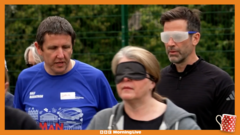
- Blindfold Inverse Training: The sighted guide must log initial mileage under blindfold conditions while paired with an experienced guide. Experiencing the vulnerability of absolute visual reliance establishes the sensory baseline required to understand the precision needed for verbal cues.
- Cadence Matching Drills: Utilizing electronic metronomes, the pair must practice matching footfalls on treadmills placed side-by-side. This isolates the auditory component of synchronization before introducing the physical constraint of the tether.
- Tether Tension Calibration: The pair conducts short interval runs where the explicit goal is to maintain a constant, measured tension on the cord. The tether must never sag (loss of data transmission) and must never pull taut (mechanical disruption). The optimal zone is a neutral, sensitive tautness that registers micro-oscillations without pulling either runner offline.
Systemic Limitations of the Binary Model
Despite rigorous optimization, the guide-athlete binary possesses inherent system vulnerabilities that cannot be entirely engineered out.
The first limitation is environmental saturation. In high-density race environments, ambient noise frequently overrides verbal telemetry, isolating the pair to purely tactile communication. This reduces the predictive window and forces a conservative reduction in velocity to maintain safety margins.
The second limitation is the single-point-of-failure vulnerability of the guide. If the guide suffers an acute injury or cramping during an event, the athlete’s race is terminated instantly, regardless of the athlete's personal physical condition. This structural dependency necessitates the development of backup guide rotations for ultra-endurance events, introducing further complications regarding synchronization handoffs under fatigue.
To maximize competitive output, athletic organizations must move away from treating guide selection as an informal matchmaking process. It must be approached as a strict engineering challenge, pairing runners based on exact biometric compatibility, mechanical output alignment, and the cognitive capacity to manage continuous environmental data translation under hypoxia. The bottleneck to performance is rarely the athlete's physical engine; it is the throughput capacity of the interface between the guide and the track.