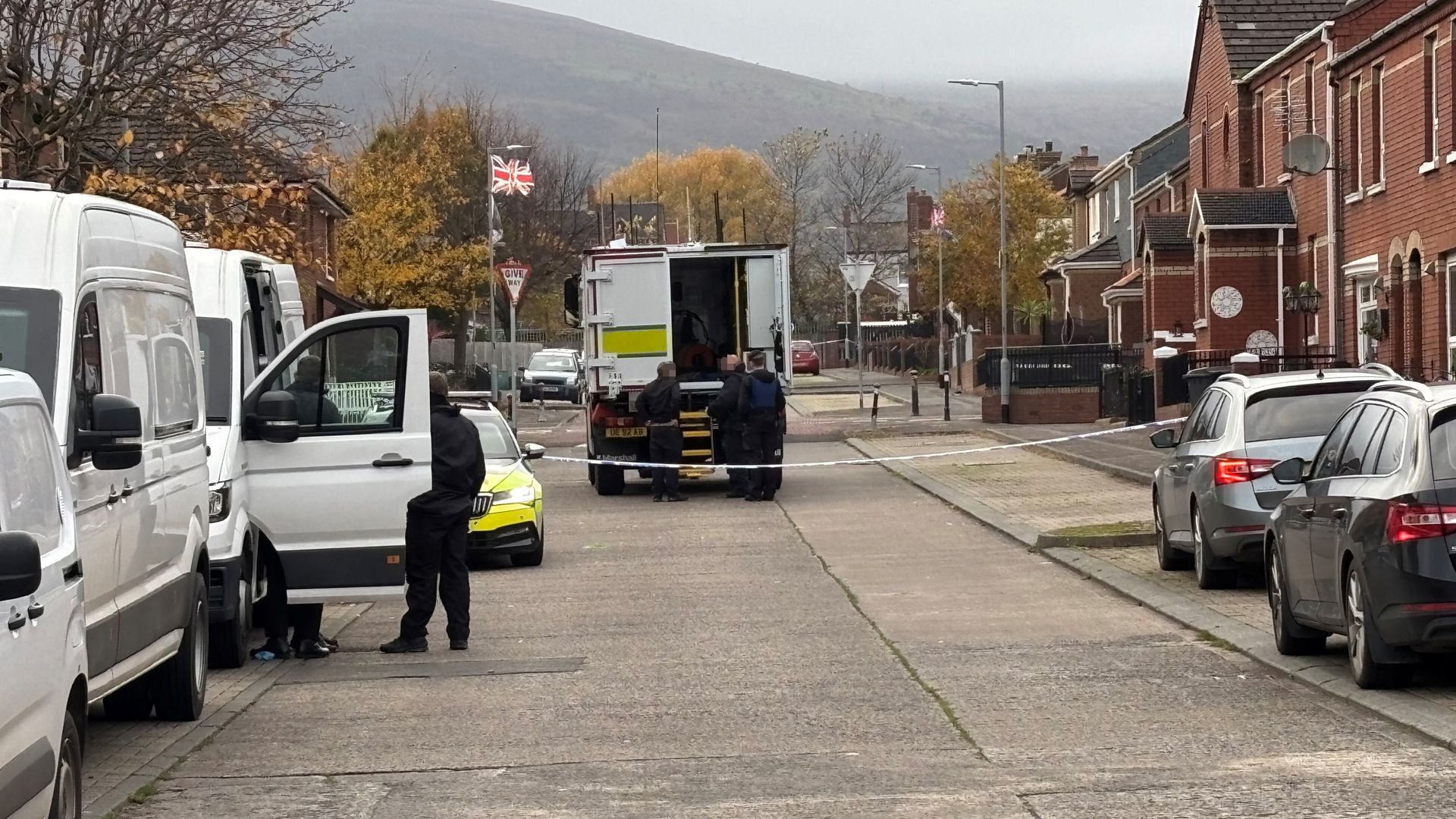
Every time a wire report drops with the headline "Man charged with explosives offences in Belfast," the media machine runs the exact same tired script. Out come the stock photos of armored Land Rovers. Out come the vague references to "legacy issues" and "splinter groups." Readers scan three paragraphs of police press-release boilerplate, nod grimly at the ghost of the Troubles, and move on.
That reflex is dangerously outdated.
Treating a Belfast explosives arrest as a routine footnote in a decades-old political conflict is the laziest consensus in modern security reporting. It confuses historical geography with current operational reality. When a suspect is hauled before Belfast Magistrates' Court under the Explosive Substances Act 1883, the story isn't that Northern Ireland is slipping backward. The story is how modern illicit logistics, decentralized manufacturing, and organized crime have completely rewritten the threat profile—while the public is still looking in the rearview mirror.
The Myth of the Monolithic "Dissident"
Mainstream coverage loves a clean narrative. If explosives turn up in West or North Belfast, the default assumption is paramilitary nostalgia. Journalists reach for terms like "dissident republicans" as a catch-all bucket, implying a rigid, ideological command structure operating like a miniature army from the 1980s.
In the real world of threat intelligence, that picture falls apart fast.
Having spent years tracking how illicit supply chains actually move across the Irish Sea and through European ports, I can tell you the lines between ideological actors, narco-gangs, and freelance fixers blurred into irrelevance a long time ago. Today, high-risk contraband rarely moves through dedicated political networks. It rides the exact same logistical rails as synthetic drugs, counterfeit goods, and laundered cash.
Consider the mechanics of an arrest under the Explosive Substances Act 1883. Section 4 of that statute—making or knowingly having possession of an explosive substance under suspicious circumstances—does not require a fully assembled military-grade device sitting in a duffel bag. Under UK case law, "explosive substance" sweeps in precursors, makeshift timers, pyrotechnic mixtures, and components intended to cause an explosion.
When police announce a charge under this statute, the public pictures Semtex smuggled from abroad. The operational reality is far messier. Modern threat actors rely on dual-use commercial chemicals, improvised recipes traded over encrypted messaging apps, and localized, small-batch assembly. You don't need a quartermaster general or an international arms syndicate to trigger an Explosives Act prosecution. You need a garden shed, a basic understanding of chemistry, and an encrypted chat group.
Why Legacy Law Meets Modern Reality
To understand why these arrests happen—and why standard reporting misreads them—you have to look at the legal machinery driving the prosecutions.
The Police Service of Northern Ireland (PSNI) and the Public Prosecution Service (PPS) operate under a statutory framework built in the Victorian era, reinforced by modern counter-terrorism powers under the Terrorism Act 2000 and the Justice and Security (Northern Ireland) Act 2007. That legal architecture gives investigators wide latitude to intervene early.
And they do. Constantly.
What looks to the casual reader like a dramatic, isolated bust is usually the final frame of a months-long intelligence operation involving telecommunications data, financial tracking, and physical surveillance. By the time a suspect stands in the dock at Laganside Courts, the actual disruption happened weeks earlier.
Here is the nuance the press misses: an arrest for explosives offences is often a symptom of criminal diversification, not political resurgence.
In post-conflict economies across Europe—from the Balkans to Northern Ireland—paramilitary structures that fail to demobilize completely almost always mutate into organized crime syndicates. Extortion, fuel laundering, drug distribution, and illegal lending become the core business. Violence, or the threat of explosive violence, shifts from a political lever to a commercial enforcement tool. A pipe bomb left under a car in Belfast today is just as likely to be a debt-collection notice from a local drug franchise as it is a political statement.
Yet when the charge sheet hits the press wire, the political framing takes over. The criminal enterprise gets a free ideological makeover, and the public gets a distorted view of what is actually happening on their streets.
Dismantling the Wrong Questions
When news of an explosives charge breaks in Northern Ireland, search engines light up with the same predictable questions. Almost every single one is built on a flawed premise.
"Are the Troubles coming back?"
No. Asking whether a single explosives arrest signals a return to the Troubles is like asking if a bank robbery in Chicago means Al Capone is back. During the peak of the conflict in the early 1970s, Northern Ireland experienced thousands of shootings and hundreds of bombings every single year. Today, security incidents are measured in the low dozens annually, the overwhelming majority of which are intercepted before any device is deployed.
The political, economic, and demographic conditions that sustained a thirty-year insurgency no longer exist. Treating isolated criminal or fringe-extremist arrests as evidence of an impending civil war is sensationalism masquerading as historical awareness.
"Why hasn't the PSNI eliminated these groups completely?"
This question assumes that underground networks can be eradicated through policing alone, like clearing weeds from a driveway. Any counter-insurgency or organized-crime researcher—from the Independent Reporting Commission (IRC) to the Royal United Services Institute (RUSI)—will tell you that complete eradication is a fantasy.
Policing suppresses capability; it does not erase socioeconomic pockets where paramilitary branding still carries street currency. As long as localized deprivation, unresolved community trauma, and profitable illicit markets exist, a small pool of recruits will always be willing to store a package, move a component, or take a risk for cash or status.
"Does an arrest mean the threat has been neutralized?"
Wrong again. In decentralized networks, arresting the courier or the custodian of a stash house rarely collapses the operation.
Imagine a scenario where a low-level operator is paid a few hundred pounds to store a sealed crate in a lockup in East or West Belfast. Police raid the lockup, recover the materials, and charge the custodian with possession of explosives under suspicious circumstances. The headlines celebrate a major blow. Meanwhile, the person who sourced the precursors online and the broker who arranged the drop are three encrypted accounts away, completely untouched. The arrest disrupts a single node, not the network's underlying capability.
The Invisible Shift to Digital Quartermasters
The biggest blind spot in legacy security reporting is its obsession with physical borders and historical grievances while ignoring the digital supply chain.
Twenty years ago, moving explosive materials into Belfast required physical smuggling networks—hidden compartments in haulage trucks, sympathetic safe houses, and strict operational security. Every physical handoff created a vulnerability that intelligence agencies like MI5 and the PSNI could exploit.
Today, the quartermaster doesn't need a warehouse. They need a browser.
- Sourcing: Commercial fertilizers, industrial solvents, and pyrotechnic compounds are legally sold across the UK and European Union for legitimate agricultural, construction, and manufacturing use. While regulations like the UK Poisons Act 1972 (as amended by the Control of Explosives Precursors and Poisons Regulations) restrict high-concentration sales and require suspicious-transaction reporting, determined actors bypass single-point scrutiny by micro-purchasing across multiple jurisdictions and online marketplaces.
- Knowledge Transfer: Technical manuals that once required physical distribution are now indexed, mirrored, and shared across encrypted channels and decentralized file-sharing networks. A novice with zero formal training can access step-by-step synthesis guides in seconds.
- Attribution Shielding: By recruiting expendable intermediaries—often young men with no prior ideological footprint—organizers insulate themselves from direct forensic exposure. When the raid happens, the person holding the bag is rarely the person who designed the operation.
Mainstream news articles almost never mention precursor regulation, suspicious-transaction reporting, or digital radicalization pathways. They stick to the courthouse steps, quote a ten-word police statement, and leave readers thinking the entire affair is just another chapter in an old local feud.
The Downside of My Own Argument
Let's be honest about the flaw in treating these cases purely as modern organized crime or decentralized tech-enabled threats: ideology still matters as a force multiplier.
If you strip away the political history entirely and treat Belfast explosives offences as identical to gang crime in Manchester or Glasgow, you miss a critical vulnerability. In Northern Ireland, historical symbols and unresolved constitutional tensions provide a ready-made recruitment narrative that ordinary street gangs lack. A drug dealer in Liverpool cannot wrap a protection racket in a century-old struggle for national self-determination or loyalist identity. In Belfast, criminal syndicates routinely hijack political grievances to legitimize extortion, silence witnesses, and intimidate communities into non-cooperation with police.
Ignoring the ideological wrapper is just as dangerous as being blinded by it. The real threat lives in the hybrid space where profit-driven criminality borrows the legitimacy and fear factor of historical paramilitarism.
How to Actually Read Security News Without Getting Played
If you want to understand what is really happening the next time a wire service publishes a three-paragraph blurb about an explosives charge in Northern Ireland, stop reading the headline and start auditing the details that actually matter.
- Check the exact statutory charge. Charges under Section 2 or Section 3 of the Explosive Substances Act 1883 (causing an explosion or acting with intent to cause one) signal an active operational plot. Charges under Section 4 (possession under suspicious circumstances) point toward storage, logistics, or precursor accumulation—a vastly different stage of the threat cycle.
- Look at the court venue and remand status. Cases routed swiftly through specialized remand hearings with objections to bail based on "risk of reoffending" and "interference with witnesses" usually indicate active intelligence surveillance rather than an accidental discovery during an unrelated search.
- Watch for co-defendants and cross-border links. Single-defendant arrests often point to isolated custodians or amateur actors. Multi-defendant charges spanning different towns—or coordinated raids conducted alongside An Garda Síochána south of the border—signal an active logistical network.
- Separate the crime from the press release. Police statements are legally constrained by sub judice rules once a person is charged; they cannot tell you the motive, the intelligence backstory, or the wider network context without risking a mistrial. Journalists who treat a sparse police press release as the whole story are mistaking legal caution for a lack of depth.
Stop reading every Belfast court report as a rerun of 1974. The uniforms, the laws, and the street names might look familiar, but the threat has evolved into a decentralized, hybrid criminal-extremist ecosystem—and until you stop looking at it through a rearview mirror, you will miss what is actually coming down the road.